Stock Analysis · Legence Corp (LGN)
Overview
Legence Corp operates in engineering and construction, with a focus on designing, building, and maintaining complex building systems. Its work is tied closely to commercial, institutional, and industrial facilities where energy efficiency, mechanical systems, electrical infrastructure, and specialized technical services matter. In practical terms, the company helps customers plan and deliver buildings and upgrades that are safer, more efficient, and more compliant with modern performance standards.
The business model is largely project- and service-based. Revenue mainly comes from contracting and technical services delivered to customers over the life of construction, retrofit, and facility improvement projects. Based on public filings and company materials, the company’s revenue mix is primarily concentrated in building-related engineering, construction, and energy solutions rather than in a broad portfolio of unrelated businesses.
The main revenue sources appear to be:
- Construction and installation services: likely the largest contributor, centered on mechanical, electrical, plumbing, and related building system work performed on new projects and major upgrades.
- Engineering, design, and consulting: planning, system design, technical studies, and project development tied to building performance and infrastructure modernization.
- Energy efficiency and sustainability solutions: retrofit work, performance upgrades, and projects linked to decarbonization, electrification, and lower operating costs for buildings.
- Service, maintenance, and support: recurring activity from inspection, repair, optimization, and ongoing facility support after project completion.
Public disclosures indicate strong top-line expansion in recent years, with total revenue rising from about $1.25 billion in 2022 to roughly $2.55 billion in 2025. That points to a company that has been scaling quickly, even though profitability has remained uneven.
One notable pattern is that gross profit has expanded alongside revenue, but interest expense and operating costs have also taken a meaningful share of that growth. That helps explain why sales momentum has been impressive while bottom-line performance has been more volatile.
The broad financial flow shows a business that has become much larger in a short period. Gross profit improved significantly from 2022 through 2025, and operating income turned positive after earlier losses, but heavier overhead and financing costs continued to pressure net income.
Key Figures
| Metric | Value | Sector ⓘ |
|---|---|---|
| Date | Oct 03, 2026 | |
| Context | ||
| Sector | Industrials | |
| Industry | Engineering & Construction | |
| Market Cap ⓘ | $8.82B | |
| Beta ⓘ | N/A | |
Value (Cheapness) | ||
| P/E Ratio ⓘ | N/A | 22.45 |
| P/B Ratio ⓘ | 14.31 | 1.98 |
| FCF Yield ⓘ | 3.66% | 6.31% |
| Dividend Yield ⓘ | N/A | 1.96% |
| EBIT / EV ⓘ | 1.12% | 4.81% |
| PEG ⓘ | N/A | |
Growth (Business expansion) | ||
| Revenue Growth ⓘ | 110.70% | 9.10% |
| RPS Growth (5Y CAGR) ⓘ | 26.32% | 7.75% |
| EPS Growth (5Y CAGR) ⓘ | N/A | -13.59% |
| BVPS Growth (5Y CAGR) ⓘ | -14.03% | 6.22% |
| Margin Growth (5Y Trend) ⓘ | 3.74% | 0.72% |
| FCF Growth (5Y CAGR) ⓘ | 583.75% | 10.98% |
| DPS Growth (5Y CAGR) ⓘ | N/A | 9.48% |
Quality (Business durability) | ||
| ROIC (Latest) ⓘ | 6.23% | 10.92% |
| ROA (Latest) ⓘ | -1.42% | 5.41% |
| ROIC (5Y Median) ⓘ | N/A | 9.21% |
| ROA (5Y Median) ⓘ | N/A | 4.94% |
| Net Debt / EBIT (Latest) ⓘ | 16.23 | 2.07 |
| Net Debt / EBIT (5Y Median) ⓘ | 35.46 | 2.28 |
| Net Debt / EBITDA (Latest) ⓘ | 4.69 | 1.43 |
| Net Debt / Assets ⓘ | 24.17% | 19.27% |
| EBITDA / Interest ⓘ | 2.54 | 9.53 |
| Operating Margin (Latest) ⓘ | 1.49% | 10.50% |
| Operating Margin (5Y Median) ⓘ | 1.36% | 10.27% |
| Debt to Equity (Latest) ⓘ | 199.13% | 65.48% |
| Profit Margin (Latest) ⓘ | -1.20% | 6.62% |
| Free Cash Flow (Latest) ⓘ | $323.18M | |
Momentum (Price trend) | ||
| 3Y Return ⓘ | N/A | +58.56% |
| 12M Return (excl. last month) ⓘ | N/A | +15.63% |
| 6M Return ⓘ | -4.92% | +4.19% |
| Price vs. 200-Day MA ⓘ | -15.15% | +0.93% |
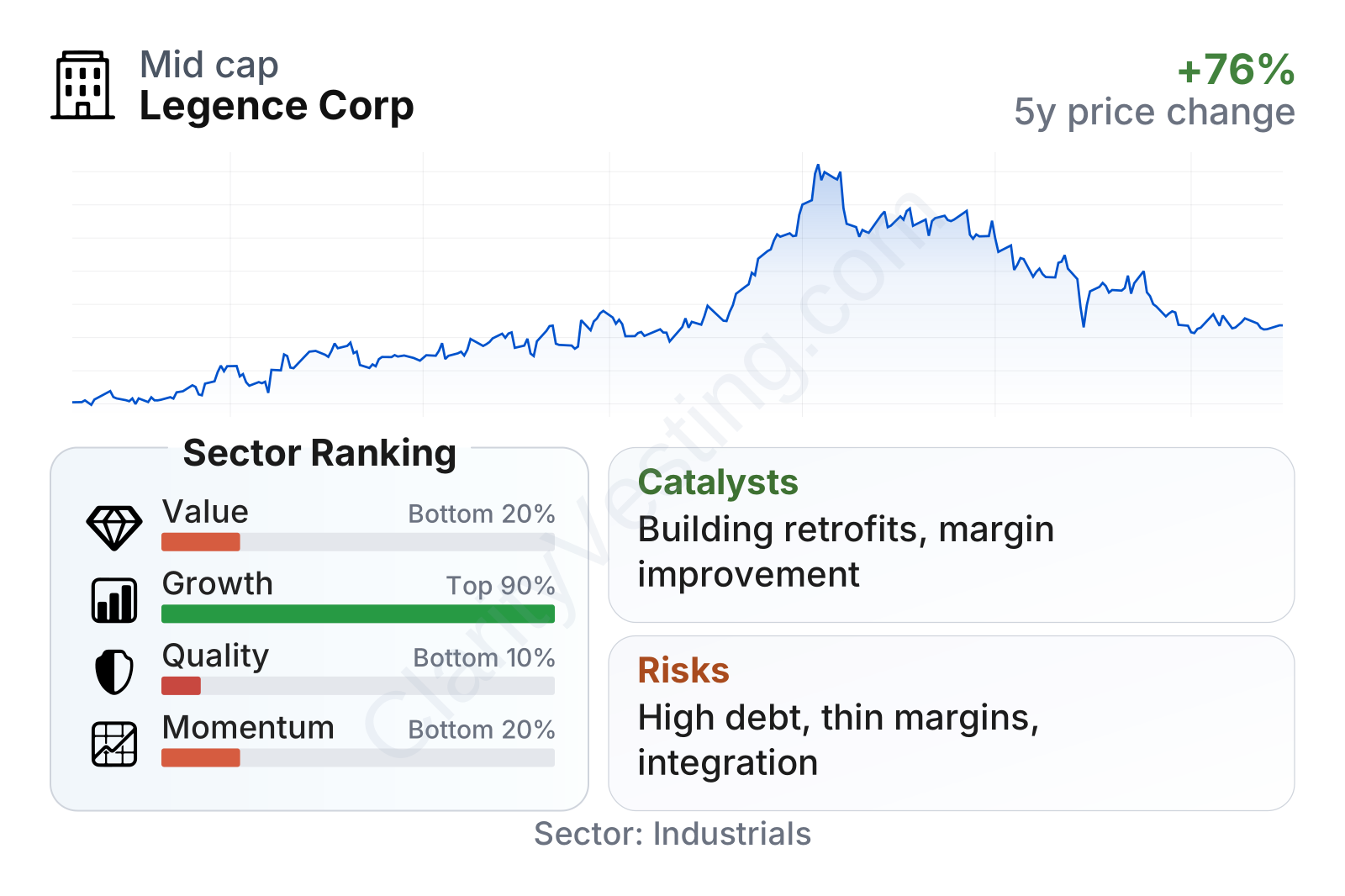
Legence is now a mid-sized public company by market value within the industrials universe. The table points to a mixed profile: growth stands out clearly, while valuation and balance-sheet quality look far less favorable. Revenue expansion is running well above the sector median, and longer-term growth in revenue per share and free cash flow has also been strong. By contrast, returns on assets and invested capital are weak, leverage is elevated, and margins remain thin compared with typical engineering and construction peers.
The stock has also been volatile. It climbed sharply into mid-2026 and then pulled back materially, leaving recent momentum weaker than much of the sector. That kind of price behavior often reflects a market that is trying to balance strong expansion prospects against concerns around debt, profitability, and execution.
Growth
Legence operates in an area with long-term structural support. Buildings account for a large share of energy use, and owners are under pressure to improve efficiency, modernize aging systems, reduce emissions, and manage power needs more effectively. Those trends support demand for the types of services Legence provides, especially in retrofits and technically demanding building upgrades.
The strategy also makes sense on paper. A company positioned at the intersection of engineering, installation, and efficiency services can benefit from multiple spending themes at once: infrastructure renewal, electrification, decarbonization, and the need for more resilient facilities. Customers increasingly prefer integrated providers that can handle design, execution, and long-term support rather than coordinating many separate contractors.
Growth metrics are unusually strong relative to the sector. Year-over-year revenue growth is far above the industry median, and the five-year growth rate in revenue per share is also materially stronger than peers. Free cash flow has increased sharply over the longer term as well. Those numbers suggest that Legence has not merely participated in a healthy market; it has been expanding faster than many competitors.
A potential catalyst is the continued push for energy-efficient buildings and performance upgrades across commercial and institutional real estate. Another is the company’s ability to convert a larger installed customer base into repeat service and maintenance revenue, which is usually steadier than large one-time projects. If the company can improve margins while sustaining growth, the operating model could become more attractive than it looks today.
Recent public information also indicates continued corporate activity and scaling efforts, which can create additional opportunities if integrations go well. In this industry, acquisitions can deepen local market presence, add specialized capabilities, and increase access to recurring service work.
Risks
This article is for informational purposes only and does not constitute financial advice. Some content is AI-generated. See Disclaimer