Stock Analysis · Lifestance Health Group Inc (LFST)
Overview
LifeStance Health Group is a large outpatient mental health provider in the United States. The company operates a network of psychiatrists, psychologists, therapists, and nurse practitioners who treat patients for conditions such as anxiety, depression, ADHD, and other behavioral health needs. Care is delivered through in-person visits and telehealth, with the business built around a multi-clinician platform rather than a single hospital or clinic model.
Its revenue is generated almost entirely from patient services that are reimbursed by commercial insurance plans, government programs, and patient self-pay amounts. Based on company filings, the business is economically driven by visit volume, the number of active clinicians, clinician productivity, reimbursement rates, and payer mix rather than by product sales or subscriptions.
The revenue mix is best understood as follows:
- Patient service revenue: approximately 100% of total revenue. This includes psychiatric evaluations, medication management, therapy sessions, and related outpatient behavioral health services delivered either in person or virtually.
Within that single reported revenue line, the business is supported by several operating levers:
- Therapy visits, which tend to be high-volume recurring appointments.
- Medication management and psychiatry services, which can support higher reimbursement per visit.
- Telehealth encounters, which expand geographic reach and convenience.
- New clinician additions and de novo centers, which increase capacity over time.
Over the last several years, the company has moved from a period of heavy losses to positive net income, while revenue increased from about $668 million in 2021 to about $1.42 billion in 2025. Gross profit also expanded materially, and operating losses narrowed before turning into operating profit in 2025. That progression suggests a business that is gaining scale and extracting more efficiency from its platform.
The financial flow shows a clear pattern: revenue has risen steadily, gross profit has widened, and selling, general, and administrative costs have become much more manageable as a share of sales. Interest expense also declined sharply by 2025, helping the company move from large losses to modest profitability.
Key Figures
| Metric | Value | Sector ⓘ |
|---|---|---|
| Date | Oct 24, 2026 | |
| Context | ||
| Sector | Healthcare | |
| Industry | Medical Care Facilities | |
| Market Cap ⓘ | $4.69B | |
| Beta ⓘ | 1.24 | |
Value (Cheapness) | ||
| P/E Ratio ⓘ | 94.85 | 25.42 |
| P/B Ratio ⓘ | 3.29 | 3.08 |
| FCF Yield ⓘ | 4.48% | 3.12% |
| Dividend Yield ⓘ | N/A | 1.85% |
| EBIT / EV ⓘ | 1.60% | 0.56% |
| PEG ⓘ | N/A | |
Growth (Business expansion) | ||
| Revenue Growth ⓘ | 26.10% | 7.50% |
| RPS Growth (5Y CAGR) ⓘ | 15.61% | 8.60% |
| EPS Growth (5Y CAGR) ⓘ | N/A | -17.73% |
| BVPS Growth (5Y CAGR) ⓘ | -4.71% | 3.72% |
| Margin Growth (5Y Trend) ⓘ | N/A | -0.57% |
| FCF Growth (5Y CAGR) ⓘ | N/A | 0.96% |
| DPS Growth (5Y CAGR) ⓘ | N/A | 6.69% |
Quality (Business durability) | ||
| ROIC (Latest) ⓘ | 3.24% | 3.17% |
| ROA (Latest) ⓘ | 2.34% | 2.98% |
| ROIC (5Y Median) ⓘ | -8.37% | 4.56% |
| ROA (5Y Median) ⓘ | -8.70% | 1.87% |
| Net Debt / EBIT (Latest) ⓘ | -0.33 | 1.34 |
| Net Debt / EBIT (5Y Median) ⓘ | N/A | 1.86 |
| Net Debt / EBITDA (Latest) ⓘ | -0.19 | 1.00 |
| Net Debt / Assets ⓘ | -1.16% | 5.06% |
| EBITDA / Interest ⓘ | 13.02 | 9.55 |
| Operating Margin (Latest) ⓘ | 4.87% | 9.25% |
| Operating Margin (5Y Median) ⓘ | -17.56% | 7.33% |
| Debt to Equity (Latest) ⓘ | 13.58% | 26.68% |
| Profit Margin (Latest) ⓘ | 3.19% | 3.34% |
| Free Cash Flow (Latest) ⓘ | $210.03M | |
Momentum (Price trend) | ||
| 3Y Return ⓘ | +141.07% | +51.61% |
| 12M Return (excl. last month) ⓘ | +133.27% | +19.90% |
| 6M Return ⓘ | +81.77% | +10.10% |
| Price vs. 200-Day MA ⓘ | +37.11% | +6.44% |
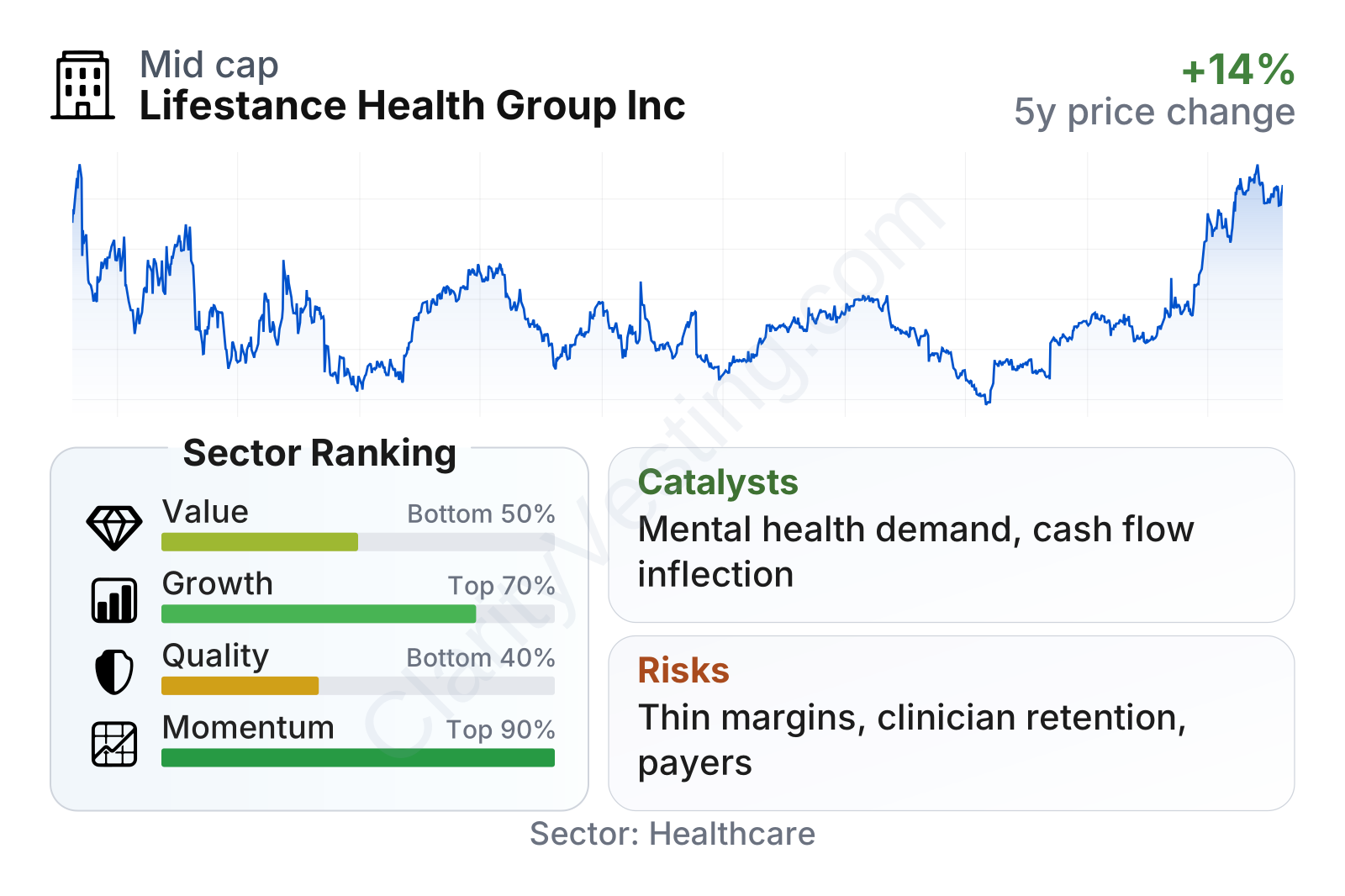
LifeStance is now a mid-cap healthcare company with a stock that has been much more volatile than the average defensive healthcare name. Recent market momentum has been very strong relative to the sector, and free cash flow metrics look better than the median healthcare peer. Growth also screens well, especially on recent revenue expansion. The weaker area is business quality: returns on capital and margins remain below many sector peers even after the recent turnaround.
The share price history reflects that transition. After a steep decline following the public listing period, the stock later recovered as operating results improved. That kind of pattern often appears when a company moves from “prove the model” to “show sustainable profits,” but it also means expectations can reset quickly if execution weakens.
Growth
Behavioral health is widely seen as a structurally growing part of healthcare. Demand has been supported by rising public awareness, long wait times for treatment, clinician shortages, broader acceptance of telehealth, and increasing recognition from employers and insurers that untreated mental health conditions create wider medical and productivity costs. That backdrop gives LifeStance exposure to a favorable long-term demand trend.
The company’s strategy is straightforward and easy to follow. It is trying to grow by adding clinicians, improving scheduling and productivity, opening new centers selectively, and using technology to support both virtual and in-person care. In theory, this makes sense: a larger clinician base increases visit capacity, and a centralized platform can spread administrative costs across a bigger revenue base.
Revenue growth has stayed notably above the sector median and has recently re-accelerated into the low-to-mid 20% range year over year. That is important because it suggests the business is not only bigger than it was a few years ago, but still expanding at a pace that stands out within healthcare services.
Cash generation has improved even more dramatically than accounting profits. Free cash flow moved from clearly negative territory to strongly positive over the last two years, reaching roughly $179 million on a trailing basis by early 2026 and about $210 million on the latest trailing measure. For a company that spent several years proving it could turn scale into cash, that shift is one of the most meaningful developments.
A key catalyst is the basic supply-demand imbalance in outpatient mental health. The United States still faces clinician shortages in many markets, and large scaled platforms have an advantage in recruiting, contracting with payers, and offering hybrid care. Another catalyst is operating leverage: if visit growth and clinician utilization remain strong, a larger portion of incremental revenue can potentially fall to profit than in earlier years.
Recent company updates have also highlighted continued expansion in clinician count, center footprint, and patient access initiatives. None of these alone changes the investment case overnight, but together they support the idea that LifeStance is still in a scaling phase rather than a mature low-growth phase.
Risks
This article is for informational purposes only and does not constitute financial advice. Some content is AI-generated. See Disclaimer


