Stock Analysis · La Française des Jeux Société anonyme (LFDJF)
Overview
La Française des Jeux Société anonyme, usually known as FDJ and now operating under the FDJ UNITED branding, is one of Europe’s largest gambling operators. The group runs France’s national lottery activities and also has major positions in sports betting, online betting and gaming, and payment-related services. Its business is built around licensed or highly regulated activities, which matters because regulation creates barriers to entry and gives established operators a stronger position than many other consumer businesses.
The company’s revenue mix has changed in recent years, especially after acquisitions that expanded its online footprint outside traditional lottery operations. Based on recent company reporting, the business can be understood through the following main revenue sources, from largest to smallest:
- Lottery: roughly 60% to 70% of group revenue. This includes draw games and instant games sold through retail points of sale and digital channels in France. This remains the core profit engine thanks to scale, a dense distribution network, and long-established customer habits.
- Online betting and gaming: roughly 20% to 30%. This includes sports betting, poker, casino-style online gaming where permitted, and other digital gaming activities, particularly after the Kindred transaction broadened the group’s international reach.
- Point-of-sale sports betting and related gaming activities: roughly 5% to 10%. This covers sports wagering activity outside the fully online segment and other betting operations linked to the French network.
- Payments and services: generally a small single-digit share of revenue. This includes transactional and payment-related services developed around the retail network.
What stands out is the combination of defensive cash generation from lottery operations and the faster-moving digital betting segment. Over the last several years, revenue has moved up meaningfully overall, while operating income has remained solid even as the business mix became more international and more digital. That combination makes FDJ different from a pure lottery operator but also less predictable than it used to be.
The long-term picture shows a business that expanded materially from 2021 to 2025, with revenue rising from a little above €2.2 billion to around €3.7 billion. Operating income stayed resilient through that expansion, but net income became much more volatile, suggesting that financing costs, acquisition effects, and accounting items increasingly matter when judging underlying performance.
Key Figures
| Metric | Value | Sector ⓘ |
|---|---|---|
| Date | Oct 03, 2026 | |
| Context | ||
| Sector | Consumer Cyclical | |
| Industry | Gambling | |
| Market Cap ⓘ | $4.46B | |
| Beta ⓘ | 0.63 | |
Value (Cheapness) | ||
| P/E Ratio ⓘ | 160.93 | 17.04 |
| P/B Ratio ⓘ | 7.74 | 1.61 |
| FCF Yield ⓘ | 18.87% | 9.02% |
| Dividend Yield ⓘ | 8.70% | 2.75% |
| EBIT / EV ⓘ | N/A | 6.69% |
| PEG ⓘ | N/A | |
Growth (Business expansion) | ||
| Revenue Growth ⓘ | -4.50% | 5.60% |
| RPS Growth (5Y CAGR) ⓘ | 13.86% | 9.04% |
| EPS Growth (5Y CAGR) ⓘ | 12.85% | -17.44% |
| BVPS Growth (5Y CAGR) ⓘ | 4.93% | 5.73% |
| Margin Growth (5Y Trend) ⓘ | -2.05% | -0.26% |
| FCF Growth (5Y CAGR) ⓘ | -1.53% | 4.91% |
| DPS Growth (5Y CAGR) ⓘ | 23.71% | 10.48% |
Quality (Business durability) | ||
| ROIC (Latest) ⓘ | 26.58% | 12.38% |
| ROA (Latest) ⓘ | 5.79% | 5.54% |
| ROIC (5Y Median) ⓘ | 19.68% | 10.63% |
| ROA (5Y Median) ⓘ | 9.47% | 5.44% |
| Net Debt / EBIT (Latest) ⓘ | 1.66 | 2.16 |
| Net Debt / EBIT (5Y Median) ⓘ | 1.38 | 2.31 |
| Net Debt / EBITDA (Latest) ⓘ | 1.04 | 1.52 |
| Net Debt / Assets ⓘ | 33.29% | 21.74% |
| EBITDA / Interest ⓘ | 11.25 | 9.06 |
| Operating Margin (Latest) ⓘ | 15.27% | 9.12% |
| Operating Margin (5Y Median) ⓘ | 17.43% | 9.56% |
| Debt to Equity (Latest) ⓘ | 382.32% | 76.18% |
| Profit Margin (Latest) ⓘ | 0.67% | 5.30% |
| Free Cash Flow (Latest) ⓘ | $841.98M | |
Momentum (Price trend) | ||
| 3Y Return ⓘ | -2.70% | +11.77% |
| 12M Return (excl. last month) ⓘ | -14.34% | +0.61% |
| 6M Return ⓘ | -7.47% | +1.32% |
| Price vs. 200-Day MA ⓘ | -6.18% | -3.47% |
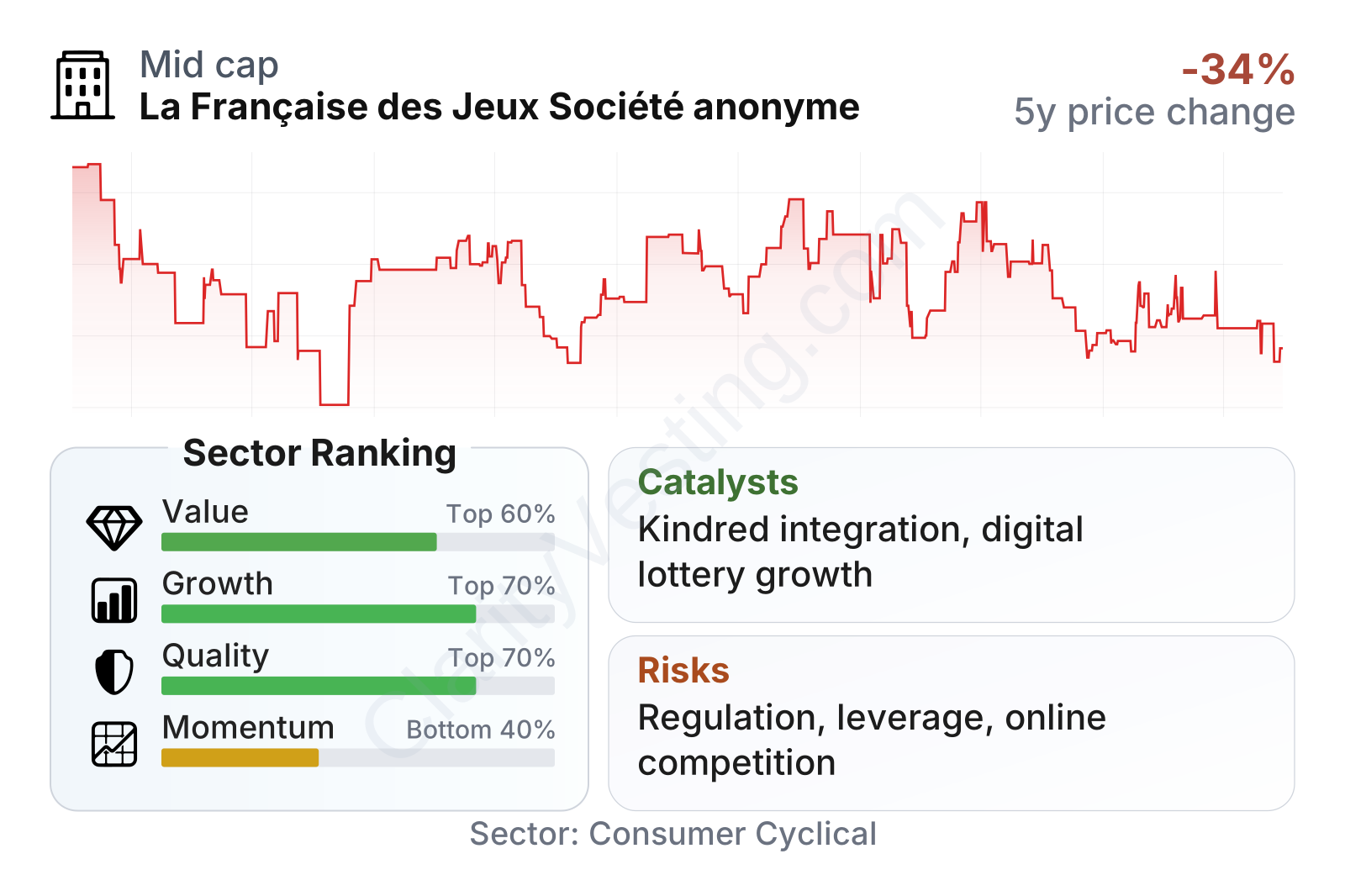
FDJ is a mid-sized listed company with relatively low share-price volatility, as shown by a beta well below 1. On profitability and capital efficiency, the business still looks strong compared with much of the broader sector: operating margins remain above sector norms, return on invested capital is high, and free cash flow generation is substantial. Dividend yield and free cash flow yield also stand out on the favorable side.
At the same time, the table points to a more mixed picture beneath the surface. Growth metrics are uneven, with a recent year-over-year revenue decline even though five-year revenue and earnings growth remain positive. Momentum is weak, reflecting a share price that has lagged the sector over multiple timeframes. The apparent valuation multiples also look demanding on earnings and book value, although those ratios are likely distorted by unusually low recent net profit and by balance-sheet effects after acquisitions.
Growth
FDJ operates in a sector with two different growth profiles. Traditional lottery is usually a mature market, growing gradually through pricing, game innovation, and digital migration rather than through explosive volume expansion. Online betting and gaming, by contrast, is still structurally growing in many markets as customers shift toward mobile channels and as regulation clarifies country by country. That means FDJ’s future growth depends less on selling more paper lottery tickets and more on combining its protected French franchise with a broader digital platform.
The company’s strategy broadly follows that logic. Its domestic lottery base produces recurring cash flows, while acquisitions and digital investment are aimed at building a larger online presence in Europe. In strategic terms, that makes sense: lottery provides stability, and online betting offers a larger addressable market and a faster growth rate. The trade-off is that online operations are usually more competitive, more heavily marketed, and more exposed to regulatory shifts.
The longer-term record remains constructive even if the latest period looks softer. Over five years, revenue per share has compounded in the low-teens and earnings per share also show strong multi-year progress. More recently, however, revenue growth turned negative on a year-over-year basis, which indicates that the growth path is not linear. For a company in transition, that matters: the market is likely weighing the durability of acquired growth against the steadiness of the legacy business.
A major catalyst is the enlargement of the online business through M&A, most notably the expansion brought by Kindred. If integration goes well, FDJ could emerge with a much larger digital scale across several European markets. Another useful catalyst is continued digitalization of lottery sales in France, which can lift engagement without needing major physical expansion. Major sporting events can also temporarily support betting activity, though that is more cyclical than structural.
Recent company communications have also emphasized a broader pan-European profile rather than a purely French lottery identity. If that repositioning translates into stronger cross-selling, better technology sharing, and cost synergies, it could support growth beyond the traditional domestic base. The opportunity is real, but it now depends more on execution than before.
Risks
This article is for informational purposes only and does not constitute financial advice. Some content is AI-generated. See Disclaimer