Stock Analysis · Lincoln Electric Holdings Inc (LECO)
Overview
Lincoln Electric Holdings is an industrial manufacturing company best known for welding equipment, welding consumables, and automation systems used in factories, construction, infrastructure, energy, shipbuilding, and repair work. In simple terms, it helps customers join, cut, and automate metal production. The company has been in business for more than a century and operates globally, with a particularly strong presence in North America.
Its business is organized around welding and cutting products, while automation has become a larger part of the strategy over time. Based on recent company disclosures, revenue is mainly generated from the following sources:
- Americas Welding: about 61% of revenue. This includes welding equipment, consumables such as electrodes and wires, cutting products, and related solutions sold mainly in North and Latin America.
- International Welding: about 26% of revenue. This covers similar products sold across Europe, Asia-Pacific, and other international markets.
- The Harris Products Group: about 13% of revenue. This segment focuses on metal joining, cutting, and gas regulation equipment, including products used in HVAC, plumbing, and specialty gas applications.
That mix matters because Lincoln Electric is not only selling machines one time. A meaningful portion of the business comes from consumables and replacement demand, which can create recurring revenue even when customers slow down large equipment purchases. Over the last several years, the company has also expanded its higher-value automation offering, aiming to become more integrated into customer production lines rather than remaining only a product supplier.
The overall financial picture shows a business that converts a large share of sales into gross profit and operating income, with margins holding up well even through mixed industrial demand. Revenue dipped in 2024 before recovering in 2025, while operating profit remained comparatively resilient, suggesting disciplined pricing and cost control.
Key Figures
| Metric | Value | Sector ⓘ |
|---|---|---|
| Date | Oct 24, 2026 | |
| Context | ||
| Sector | Industrials | |
| Industry | Tools & Accessories | |
| Market Cap ⓘ | $14.18B | |
| Beta ⓘ | 1.22 | |
Value (Cheapness) | ||
| P/E Ratio ⓘ | 25.98 | 22.29 |
| P/B Ratio ⓘ | 9.33 | 1.98 |
| FCF Yield ⓘ | 3.65% | 6.26% |
| Dividend Yield ⓘ | 1.20% | 1.92% |
| EBIT / EV ⓘ | 5.15% | 4.83% |
| PEG ⓘ | 1.48 | |
Growth (Business expansion) | ||
| Revenue Growth ⓘ | 12.00% | 9.30% |
| RPS Growth (5Y CAGR) ⓘ | 8.89% | 7.76% |
| EPS Growth (5Y CAGR) ⓘ | -10.59% | -13.17% |
| BVPS Growth (5Y CAGR) ⓘ | 16.28% | 6.13% |
| Margin Growth (5Y Trend) ⓘ | -0.96% | 0.74% |
| FCF Growth (5Y CAGR) ⓘ | 15.27% | 10.79% |
| DPS Growth (5Y CAGR) ⓘ | 10.37% | 9.41% |
Quality (Business durability) | ||
| ROIC (Latest) ⓘ | 22.07% | 10.75% |
| ROA (Latest) ⓘ | 14.51% | 5.41% |
| ROIC (5Y Median) ⓘ | 23.99% | 9.37% |
| ROA (5Y Median) ⓘ | 14.27% | 4.95% |
| Net Debt / EBIT (Latest) ⓘ | 1.16 | 2.04 |
| Net Debt / EBIT (5Y Median) ⓘ | 1.32 | 2.27 |
| Net Debt / EBITDA (Latest) ⓘ | 1.02 | 1.39 |
| Net Debt / Assets ⓘ | 23.80% | 19.27% |
| EBITDA / Interest ⓘ | 15.38 | 9.58 |
| Operating Margin (Latest) ⓘ | 17.53% | 10.49% |
| Operating Margin (5Y Median) ⓘ | 17.41% | 10.30% |
| Debt to Equity (Latest) ⓘ | 74.00% | 64.82% |
| Profit Margin (Latest) ⓘ | 12.35% | 6.67% |
| Free Cash Flow (Latest) ⓘ | $516.86M | |
Momentum (Price trend) | ||
| 3Y Return ⓘ | +59.52% | +67.77% |
| 12M Return (excl. last month) ⓘ | +9.79% | +12.05% |
| 6M Return ⓘ | +1.71% | 0.00% |
| Price vs. 200-Day MA ⓘ | -0.30% | +0.67% |
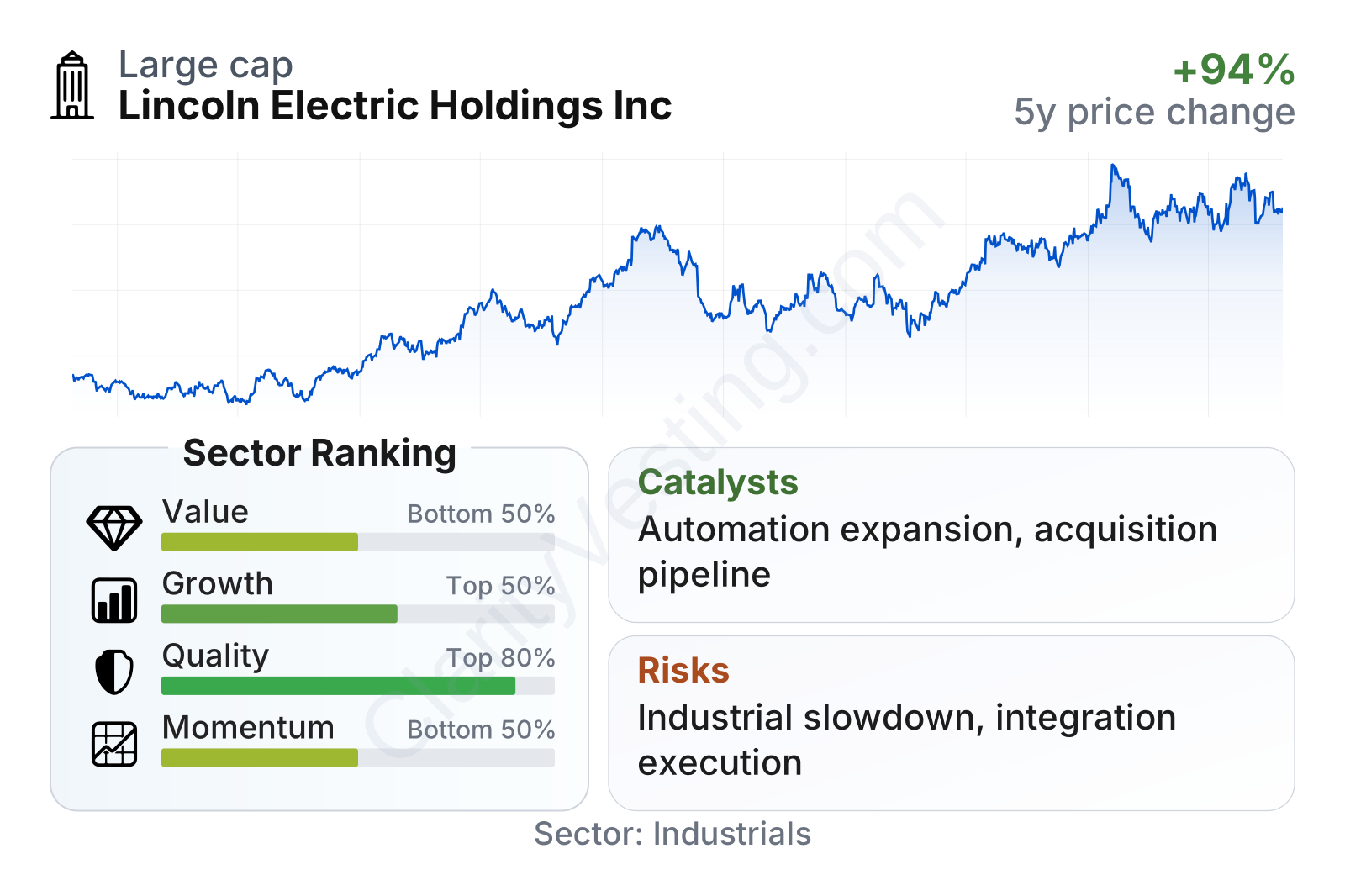
Lincoln Electric sits in the large mid-cap to lower large-cap range and its share price has been more volatile than the broad market, with a beta a little above 1. On fundamentals, the company stands out more for business quality than for cheapness. Profitability metrics are clearly above the industry median, growth metrics are generally solid, and balance-sheet coverage looks healthy. By contrast, traditional valuation measures look less attractive, with a higher earnings multiple, a much higher price-to-book ratio, and a lower free cash flow yield than the sector median.
The stock chart also shows a strong move over the past several years despite periods of industrial weakness. That suggests the market has increasingly treated Lincoln Electric as a high-quality industrial compounder rather than a deeply cyclical manufacturer.
Growth
Lincoln Electric operates in a sector with durable long-term drivers. Welding, cutting, and automated joining are essential to manufacturing, energy infrastructure, transportation, heavy equipment, and construction. These end markets do not grow in a straight line, but the need for metal fabrication remains deeply embedded in the economy. Another important trend is labor scarcity in skilled welding. That supports demand for automation, robotic cells, and productivity-enhancing systems, which is one of the most important parts of Lincoln Electric’s growth plan.
The company’s strategy appears coherent for that environment. It combines a large installed base of welding products with consumables, then builds on top of that position through automation, system integration, and acquisitions. This can deepen customer relationships and raise switching costs. Lincoln Electric has repeatedly emphasized automation, advanced solutions, and higher-margin applications as areas of focus, which makes sense in a market where customers increasingly want productivity and labor-saving tools rather than just standalone hardware.
Recent sales trends show a business that went through a temporary downturn and then regained momentum. Revenue growth turned negative during 2024, reflecting softer industrial demand, but returned to positive territory through 2025 and strengthened further into 2026, with year-over-year growth recently running around the low-teens. That pattern points to a recovery rather than a purely flat business.
Cash generation has also been strong over a multiyear period, although not perfectly smooth. Free cash flow rose meaningfully from 2022 through 2024, then moderated afterward while remaining substantial. This is important because it gives Lincoln Electric flexibility to fund acquisitions, invest in automation capacity and technology, pay dividends, and repurchase shares without relying heavily on outside capital.
A recent opportunity to watch is the continued push into automation and advanced manufacturing solutions. Company updates in 2026 have continued to highlight acquisitions and product development aimed at broadening automation capabilities. That is strategically significant because automation generally carries stronger differentiation than basic welding hardware and aligns well with customers trying to offset labor shortages and improve throughput.
Risks
This article is for informational purposes only and does not constitute financial advice. Some content is AI-generated. See Disclaimer


