Stock Analysis · Land Securities Group PLC (LDSCY)
Overview
Land Securities Group PLC is one of the largest listed real estate owners and developers in the United Kingdom. It owns, manages, and develops commercial property, with a portfolio centered on major London destinations, office buildings, retail assets, and mixed-use urban projects. As a REIT, its business model is built around collecting rent, improving and repositioning properties, and creating additional value through development and asset management.
The company’s revenue is mainly tied to recurring rental income, but reported profit can move sharply from year to year because property valuations, development gains or losses, and financing costs can materially affect accounting earnings. That makes Land Securities easier to understand through its property mix, occupancy, rent collection, and balance sheet discipline than through net income alone.
Based on recent annual reporting and portfolio disclosures, the business is broadly supported by the following sources:
- Office and mixed-use properties in London: approximately 45% to 55% of portfolio value. This includes large campus-style and central London assets where income comes from office leases, retail units within mixed-use schemes, and related occupier services.
- Retail destinations: approximately 35% to 45% of portfolio value. This includes shopping centers, retail parks, and outlet-style assets, with revenue primarily from tenant rents and lease-related income.
- Other urban and development-related activities: approximately 5% to 15%. This includes residential-led or regeneration projects, asset sales, development management, and smaller ancillary revenue lines.
The latest yearly flow of revenue and profit points to a clearer operational recovery. Revenue has moved upward over the last several years, gross profit has also improved, and reported earnings returned to positive territory after valuation-driven losses in earlier periods. Interest expense has risen, however, showing that financing costs remain an important part of the investment case for any property company operating in a higher-rate environment.
Key Figures
| Metric | Value | Sector ⓘ |
|---|---|---|
| Date | Oct 17, 2026 | |
| Context | ||
| Sector | Real Estate | |
| Industry | REIT - Diversified | |
| Market Cap ⓘ | $7.03B | |
| Beta ⓘ | 1.17 | |
Value (Cheapness) | ||
| P/E Ratio ⓘ | 13.48 | 17.38 |
| P/B Ratio ⓘ | 0.98 | 0.85 |
| FCF Yield ⓘ | 6.55% | 7.38% |
| Dividend Yield ⓘ | 6.76% | 4.85% |
| EBIT / EV ⓘ | N/A | 3.78% |
| PEG ⓘ | 11.96 | |
Growth (Business expansion) | ||
| Revenue Growth ⓘ | 0.40% | 5.30% |
| RPS Growth (5Y CAGR) ⓘ | 7.31% | 6.02% |
| EPS Growth (5Y CAGR) ⓘ | N/A | -11.37% |
| BVPS Growth (5Y CAGR) ⓘ | -4.84% | 0.45% |
| Margin Growth (5Y Trend) ⓘ | -4.01% | -0.22% |
| FCF Growth (5Y CAGR) ⓘ | 16.00% | 5.40% |
| DPS Growth (5Y CAGR) ⓘ | 10.96% | 5.02% |
Quality (Business durability) | ||
| ROIC (Latest) ⓘ | 8.09% | 5.69% |
| ROE (Latest) ⓘ | 11.40% | 7.56% |
| ROA (Latest) ⓘ | 6.69% | 2.85% |
| ROIC (5Y Median) ⓘ | 3.32% | 4.22% |
| ROE (5Y Median) ⓘ | 5.35% | 6.03% |
| ROA (5Y Median) ⓘ | 3.01% | 2.44% |
| Net Debt / EBIT (Latest) ⓘ | 4.57 | 7.59 |
| Net Debt / EBIT (5Y Median) ⓘ | 9.17 | 8.40 |
| Net Debt / EBITDA (Latest) ⓘ | 4.54 | 5.27 |
| Net Debt / Assets ⓘ | 37.94% | 37.76% |
| EBITDA / Interest ⓘ | N/A | 4.10 |
| Operating Margin (Latest) ⓘ | 55.07% | 35.29% |
| Operating Margin (5Y Median) ⓘ | 52.69% | 37.31% |
| Debt to Equity (Latest) ⓘ | 68.76% | 88.87% |
| Profit Margin (Latest) ⓘ | 38.45% | 19.61% |
| Free Cash Flow (Latest) ⓘ | $460.92M | |
Momentum (Price trend) | ||
| 3Y Return ⓘ | +46.93% | +30.75% |
| 12M Return (excl. last month) ⓘ | +19.52% | +4.36% |
| 6M Return ⓘ | +9.52% | -2.52% |
| Price vs. 200-Day MA ⓘ | +1.83% | -2.34% |
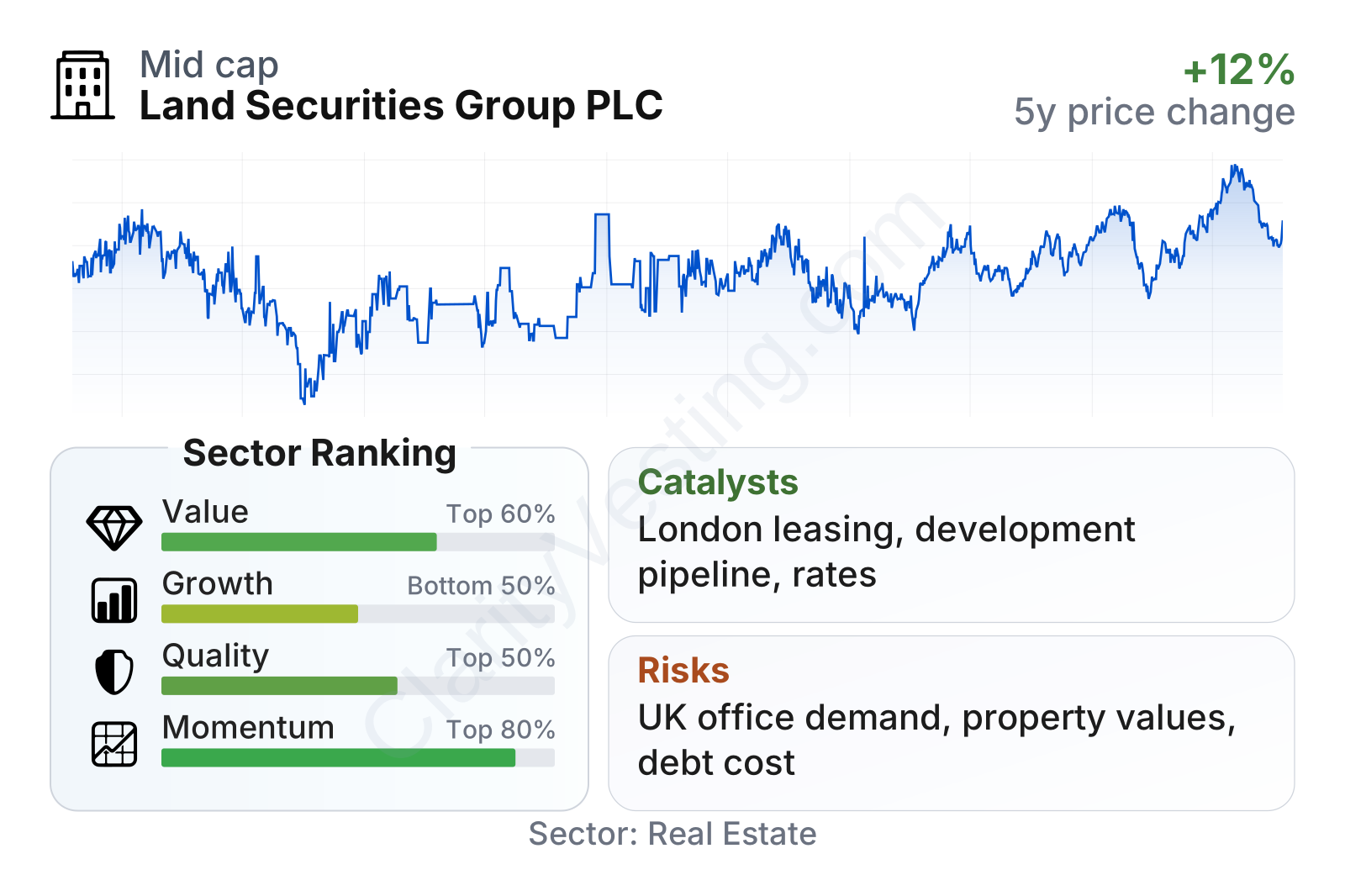
Land Securities is a large real estate company, though still smaller than the very biggest global property groups. The stock has shown stronger recent price momentum than much of its sector, while profitability and returns on assets currently look healthier than the median real estate peer. On valuation, earnings and cash flow measures do not look stretched relative to the sector, and the dividend yield stands notably above the sector median. The weaker area is short-term growth: recent year-over-year revenue expansion has been modest, even if the longer-term trend in revenue per share and free cash flow has been more encouraging.
Growth
Land Securities operates in parts of real estate that are mature rather than high-growth, so the long-term case depends less on rapid sector expansion and more on asset quality, redevelopment opportunities, rental growth, and capital allocation. That said, some of the company’s chosen segments do have meaningful structural support. Prime London office space with strong environmental credentials remains in limited supply, while well-located retail parks and dominant shopping destinations have held up better than weaker secondary retail assets. In both areas, quality and location matter far more than broad sector averages.
The company’s strategy appears aimed at exactly those higher-quality pockets. Management has increasingly focused the portfolio on major London assets and resilient retail formats, while also advancing mixed-use developments and selective regeneration projects. That approach makes strategic sense in a market where older, lower-specification offices face pressure, but well-located buildings with better energy performance can still attract occupiers and rental growth.
Revenue per share has generally trended upward over the last five years. The path has not been dramatic, but it does indicate that the portfolio is producing more income per share over time, which is a more useful signal for a property owner than looking only at headline profit in any single year.
The dividend trend has also been favorable over the medium term, with a strong rebound from earlier lower levels and only a modest recent pullback. For a REIT, that matters because it suggests cash generation has been resilient enough to support distributions while the company continues to invest in the portfolio.
Recent company updates have highlighted active leasing, development progress, and continued portfolio reshaping. The clearest opportunity is the combination of redevelopment upside and the possibility of lower financing pressure if interest rates stabilize or fall. For a property owner with high-quality urban assets, even a moderate improvement in financing conditions can support valuations, transaction activity, and demand from tenants.
Risks
This article is for informational purposes only and does not constitute financial advice. Some content is AI-generated. See Disclaimer


