Stock Analysis · Lancashire Holdings Ltd (LCSHF)
Overview
Lancashire Holdings Ltd is a specialty insurer and reinsurer. In simple terms, it underwrites difficult or unusual risks that many standard insurance companies do not focus on, and it also provides reinsurance, which is insurance for other insurers. The group is known for concentrating on areas where pricing can be attractive after major market disruptions, natural catastrophes, or periods when industry capacity becomes tight.
Its business is organized around specialty insurance and specialty reinsurance lines. Based on the company’s recent annual reporting structure, revenue is mainly generated from gross premiums written and earned premiums across a focused set of classes rather than a very broad retail insurance platform. Investment income also supports results, but underwriting performance remains the main driver over time.
The main revenue sources can be summarized as follows:
- Property and property catastrophe reinsurance: a major source of business, covering insurers against large losses from hurricanes, earthquakes, and other catastrophes.
- Specialty reinsurance: includes other reinsurance classes written for insurers, often in niche or less commoditized areas.
- Specialty insurance: includes classes such as marine, energy, aviation, political risk, and other bespoke commercial risks written through the Lloyd’s market and company platforms.
- Investment income: income earned on the float and capital base, helped by bond yields and portfolio income.
Recent company disclosures indicate that reinsurance is the larger earnings engine, while insurance lines add diversification and access to specialized commercial customers. Exact percentages can shift materially from one year to another because Lancashire actively reallocates capital toward the best-priced markets, especially after major loss events. That flexibility is an important part of how the group operates.
The long-term pattern shows a sharp rebound from weak profitability in 2021–2022 to much stronger revenue and earnings in 2023–2025. Revenue has expanded substantially, while operating income and net income moved from losses to strong profitability, highlighting how sensitive results are to underwriting conditions and catastrophe activity.
Key Figures
| Metric | Value | Sector ⓘ |
|---|---|---|
| Date | Oct 31, 2026 | |
| Context | ||
| Sector | Financial Services | |
| Industry | Insurance - Specialty | |
| Market Cap ⓘ | $2.25B | |
| Beta ⓘ | 0.41 | |
Value (Cheapness) | ||
| P/E Ratio ⓘ | 7.16 | 12.20 |
| P/B Ratio ⓘ | 1.56 | 1.26 |
| FCF Yield ⓘ | 15.25% | 9.87% |
| Dividend Yield ⓘ | 2.44% | 2.87% |
| EBIT / EV ⓘ | N/A | 8.17% |
| PEG ⓘ | N/A | |
Growth (Business expansion) | ||
| Revenue Growth ⓘ | -5.40% | 8.40% |
| RPS Growth (5Y CAGR) ⓘ | 37.96% | 12.31% |
| EPS Growth (5Y CAGR) ⓘ | 30.76% | -4.03% |
| BVPS Growth (5Y CAGR) ⓘ | 8.76% | 4.96% |
| Margin Growth (5Y Trend) ⓘ | 20.70% | -4.14% |
| FCF Growth (5Y CAGR) ⓘ | 18.04% | 4.70% |
| DPS Growth (5Y CAGR) ⓘ | 80.40% | 8.85% |
Quality (Business durability) | ||
| ROIC (Latest) ⓘ | N/A | 9.35% |
| ROE (Latest) ⓘ | 21.73% | 13.95% |
| ROA (Latest) ⓘ | 6.85% | 1.57% |
| ROIC (5Y Median) ⓘ | 17.10% | 7.78% |
| ROE (5Y Median) ⓘ | 19.96% | 12.12% |
| ROA (5Y Median) ⓘ | 6.53% | 1.28% |
| Net Debt / EBIT (Latest) ⓘ | N/A | 0.99 |
| Net Debt / EBIT (5Y Median) ⓘ | -0.69 | 0.73 |
| Net Debt / EBITDA (Latest) ⓘ | -14.76 | 0.79 |
| Operating Margin (Latest) ⓘ | N/A | 22.61% |
| Operating Margin (5Y Median) ⓘ | 16.71% | 24.52% |
| Debt to Equity (Latest) ⓘ | 30.05% | 58.76% |
| Profit Margin (Latest) ⓘ | 21.44% | 26.18% |
| Free Cash Flow (Latest) ⓘ | $342.80M | |
Momentum (Price trend) | ||
| 3Y Return ⓘ | +115.76% | +95.34% |
| 12M Return (excl. last month) ⓘ | +20.84% | +16.22% |
| 6M Return ⓘ | +29.78% | +7.41% |
| Price vs. 200-Day MA ⓘ | +50.81% | +5.48% |
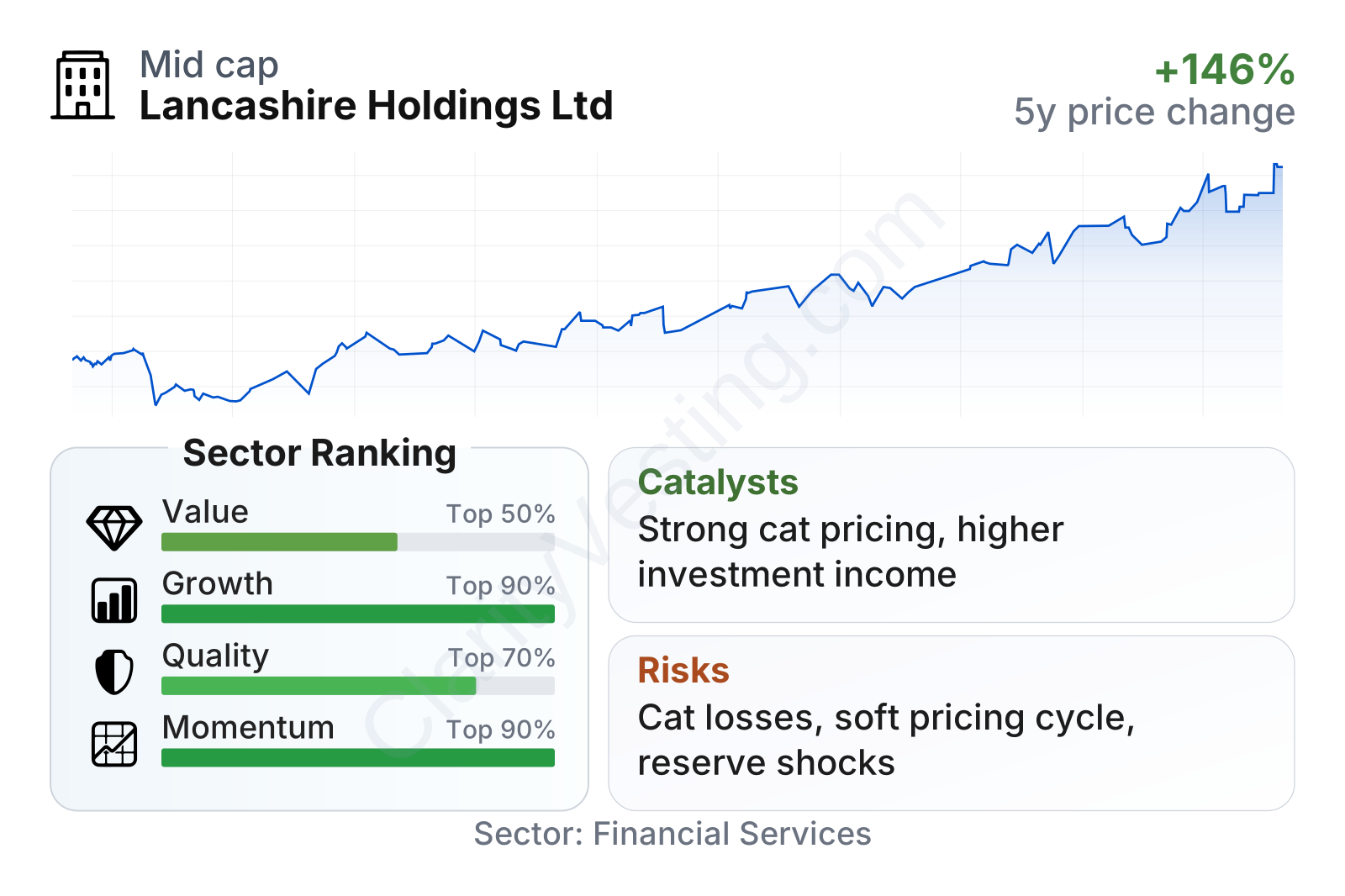
Lancashire stands out on growth, momentum, and overall profitability, while valuation is mixed rather than plainly cheap. The earnings multiple is below the sector median, but the price-to-book ratio is above some insurance peers, suggesting the market is recognizing stronger recent returns and balance sheet rebuilding. The company is mid-sized, has relatively low share-price volatility, and currently shows stronger free cash flow generation than many companies in its sector.
The share-price trend has been strong over the last several years, reflecting the company’s recovery in underwriting performance and favorable specialty pricing. At the same time, some near-term revenue comparisons have cooled, which is common in insurance when prior periods benefited from especially favorable market conditions.
Growth
Specialty insurance and reinsurance remain attractive long-term markets because risk is becoming more complex and expensive to insure. Climate-related catastrophe losses, geopolitical disruptions, marine and energy exposures, and tighter capital across the insurance industry all support demand for specialist underwriters. That does not mean growth is linear, but it does mean disciplined players can find profitable expansion opportunities when weaker competitors pull back.
Lancashire’s strategy is built around underwriting discipline, selective growth, and rapid capital reallocation. That approach makes strategic sense for a niche insurer. Rather than chasing volume in soft markets, the company tends to expand when pricing improves enough to justify the risk. This is one reason its results can look uneven year to year but strong across a full market cycle.
Earnings per share have been volatile, which is normal for a catastrophe-exposed insurer, but the broader trend over the last five years has been favorable. The company’s five-year EPS growth rate is far ahead of the sector median, even though individual annual results can swing sharply depending on losses and reserve movements.
Book value per share is especially important for insurers because it reflects how effectively management is compounding shareholder capital through underwriting and investments. Lancashire’s book value has not risen in a straight line, but the five-year compound growth rate remains ahead of the sector median. The rebound after weaker periods suggests the company has been able to restore capital through profitable underwriting rather than relying on constant balance sheet expansion.
A meaningful catalyst is the continued strength in specialty and catastrophe pricing after years of elevated global insured losses. Higher interest rates have also improved investment income, which provides another support for returns. Public company updates in 2026 continued to point to a healthy balance sheet and a willingness to write business only where pricing remains attractive, which preserves optionality if market conditions stay firm.
Risks
This article is for informational purposes only and does not constitute financial advice. Some content is AI-generated. See Disclaimer


