Stock Analysis · Lifestyle Communities Limited (LCOMF)
Overview
Lifestyle Communities Limited is an Australian real estate company focused on land-lease communities for older residents, mainly people aged 50 and above. It develops, owns, and manages residential communities that combine private homes with shared facilities such as clubhouses, pools, fitness spaces, and social areas. The model is different from a traditional retirement village: residents generally buy the home and then pay ongoing site-related charges, while the company keeps ownership of the land and community infrastructure.
This business creates a mix of development income and recurring community cash flow. In practice, revenue can move around from year to year because home settlements, project timing, and accounting treatment can have a large effect on reported numbers.
The main revenue sources are broadly:
- Home sales and development-related revenue: the largest source in most years, coming from the delivery and settlement of new homes within Lifestyle Communities developments.
- Site rental and recurring community income: ongoing fees linked to land-lease living and community operations, which tend to be more stable than development revenue.
- Other property-related income: smaller items such as resale participation, deferred management-style arrangements, finance-related items, and ancillary community income, depending on the period and project mix.
Because the latest publicly available company information shows meaningful volatility in annual revenue, a precise source split is not reliable enough to present as a stable percentage without risking a misleading picture. What is clear is that the company remains primarily driven by new home delivery, with recurring community income providing a steadier underlying base.
Profitability has also been uneven recently. Revenue fell sharply in fiscal 2025 and then rebounded in fiscal 2026, while gross profit recovered from a very weak 2025 level. That pattern suggests the core business is still highly influenced by development timing and project execution rather than behaving like a fully stabilized rental platform.
The longer-term picture shows a business with solid revenue generation from community development, but also one where margins can swing materially when settlements slow, costs rise, or asset values are reassessed.
Key Figures
| Metric | Value | Sector ⓘ |
|---|---|---|
| Date | Oct 10, 2026 | |
| Context | ||
| Sector | Real Estate | |
| Industry | Real Estate - Diversified | |
| Market Cap ⓘ | $1.48B | |
| Beta ⓘ | 1.01 | |
Value (Cheapness) | ||
| P/E Ratio ⓘ | 25.31 | 17.21 |
| P/B Ratio ⓘ | 1.52 | 0.86 |
| FCF Yield ⓘ | 6.21% | 7.55% |
| Dividend Yield ⓘ | N/A | 4.84% |
| EBIT / EV ⓘ | N/A | 3.81% |
| PEG ⓘ | N/A | |
Growth (Business expansion) | ||
| Revenue Growth ⓘ | 194.80% | 5.30% |
| RPS Growth (5Y CAGR) ⓘ | 3.31% | 6.02% |
| EPS Growth (5Y CAGR) ⓘ | 31.67% | -11.37% |
| BVPS Growth (5Y CAGR) ⓘ | 16.84% | 0.61% |
| Margin Growth (5Y Trend) ⓘ | 20.95% | 0.40% |
| FCF Growth (5Y CAGR) ⓘ | N/A | 5.35% |
| DPS Growth (5Y CAGR) ⓘ | -2.06% | 5.05% |
Quality (Business durability) | ||
| ROIC (Latest) ⓘ | N/A | 5.69% |
| ROE (Latest) ⓘ | -19.42% | 7.56% |
| ROA (Latest) ⓘ | -10.48% | 2.85% |
| ROIC (5Y Median) ⓘ | 3.19% | 4.21% |
| ROE (5Y Median) ⓘ | 7.37% | 6.03% |
| ROA (5Y Median) ⓘ | 3.69% | 2.44% |
| Net Debt / EBIT (Latest) ⓘ | N/A | 7.66 |
| Net Debt / EBIT (5Y Median) ⓘ | 8.49 | 8.42 |
| Net Debt / EBITDA (Latest) ⓘ | 17.64 | 5.27 |
| Net Debt / Assets ⓘ | 21.58% | 37.76% |
| EBITDA / Interest ⓘ | 0.64 | 4.10 |
| Operating Margin (Latest) ⓘ | N/A | 35.18% |
| Operating Margin (5Y Median) ⓘ | 15.65% | 37.31% |
| Debt to Equity (Latest) ⓘ | 42.99% | 88.87% |
| Profit Margin (Latest) ⓘ | 22.91% | 19.61% |
| Free Cash Flow (Latest) ⓘ | $91.82M | |
Momentum (Price trend) | ||
| 3Y Return ⓘ | +22.11% | +30.71% |
| 12M Return (excl. last month) ⓘ | 0.00% | +6.58% |
| 6M Return ⓘ | 0.00% | -1.74% |
| Price vs. 200-Day MA ⓘ | 0.00% | -3.29% |
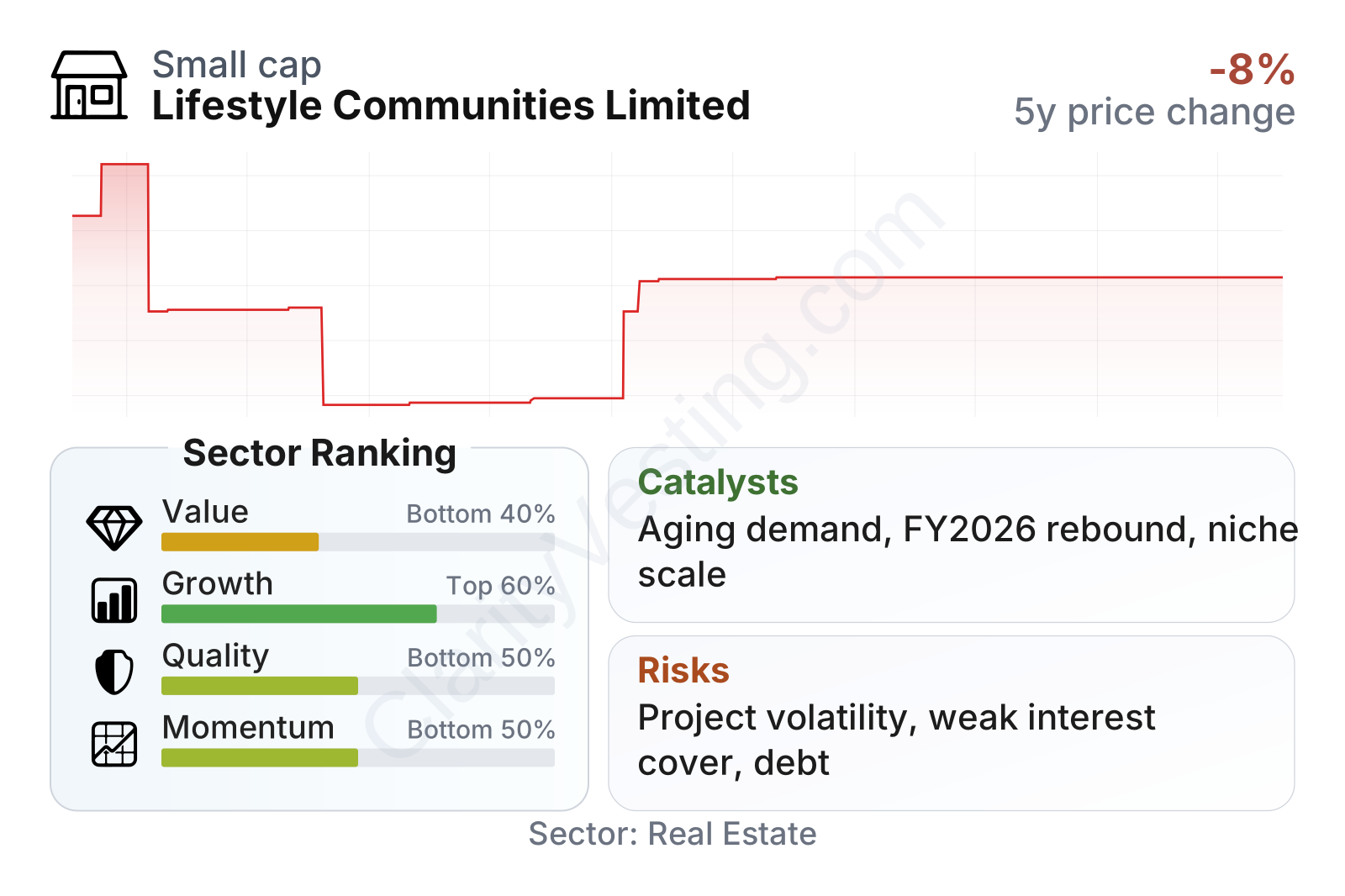
Lifestyle Communities is a mid-sized real estate company with a share price history that has been volatile over the last several years and then notably flat more recently. In the latest factor breakdown, valuation looks weaker than much of the sector, quality is mixed, growth is above the sector median overall, and momentum is below average.
Two points stand out. First, the company’s recent growth metrics are distorted by a very weak fiscal 2025 followed by a rebound in fiscal 2026, so the strong year-over-year revenue growth should be read in that context. Second, leverage deserves attention: debt relative to EBITDA is high and interest coverage is low, even though debt relative to equity and assets appears more moderate than many real estate peers.
Growth
Lifestyle Communities operates in a part of housing that has attractive long-term demand drivers. Australia’s population is aging, housing affordability remains an issue in many markets, and lower-maintenance community living has growing appeal for older households. That gives the land-lease model structural support over time, especially when compared with more expensive conventional housing options.
The company’s strategy also makes sense on paper. It develops communities in corridors where population growth and downsizer demand can support new projects, then adds recurring cash flow as each site matures. This can create a useful combination: development profits during expansion and more stable fee income as the installed resident base grows.
Revenue per share shows why the growth case needs nuance. The broad trend over several years is positive, but there was a clear dip in fiscal 2025 before a strong recovery in fiscal 2026 to a level above prior years. That points to a business with underlying expansion potential, but not a smooth compounding profile year after year.
The dividend trend is less encouraging. After improving through fiscal 2023, distributions softened and then fell sharply in fiscal 2025. For a real estate company, that signals management has had to preserve flexibility during a more difficult operating period rather than steadily lifting shareholder payouts.
A notable catalyst is the rebound visible in the latest annual numbers. Revenue, operating income, and net income recovered after the difficult prior year, which may indicate that part of the 2025 weakness was cyclical or project-timing related rather than a permanent break in the business model. If future communities are delivered on time and sales absorption remains healthy, earnings could remain very sensitive to improved execution.
Another positive factor is the company’s niche specialization. Land-lease communities for older Australians are not as crowded as mainstream apartment or detached-home development. Scale, brand recognition, planning experience, and resident referrals can all matter in this segment, and those advantages can strengthen as more communities are added.
Risks
This article is for informational purposes only and does not constitute financial advice. Some content is AI-generated. See Disclaimer