Stock Analysis · Liberty Broadband Corporation (LBRDB)
Overview
Liberty Broadband Corporation is a holding company whose value is tied mainly to its ownership stake in Charter Communications, one of the largest broadband and cable operators in the United States. In simple terms, Liberty Broadband is not a traditional operating telecom company with a broad set of its own consumer services. Instead, it is largely a listed vehicle that gives shareholders exposure to Charter and, through that, to U.S. residential and business broadband, video, mobile, and related connectivity services.
This structure matters because Liberty Broadband’s financial profile is very different from an ordinary telecom business. Its reported earnings, asset values, and cash generation are heavily influenced by the market value of its Charter stake, changes in ownership structure, and financing decisions at the parent-company level. That can make the company look unusually profitable in some periods and sharply unprofitable in others, even when the underlying broadband business is relatively stable.
Based on recent company filings, Liberty Broadband’s economic exposure is concentrated in a small number of sources:
- Charter Communications equity interest: by far the dominant source of value, representing the vast majority of Liberty Broadband’s business exposure. Charter generates revenue from residential Internet, video, mobile, voice, advertising, and commercial services.
- GCI Holdings: a much smaller operating business focused on telecommunications services in Alaska, including wireless, broadband, data, and video.
- Corporate and other items: a limited contribution that mainly reflects parent-company activities rather than a large standalone business line.
For readers looking for a practical takeaway, Liberty Broadband is best understood as a concentrated broadband-related holding company rather than a diversified telecom operator. That concentration can create a clearer investment case, but it also raises dependence on Charter’s execution and valuation.
The long-term shift in the company’s reported financial flow reflects its transition toward a more asset-based holding structure. Earlier years showed a more conventional revenue and expense profile, while more recent periods are shaped far more by investment-related accounting and parent-level costs than by recurring operating sales.
Key Figures
| Metric | Value | Sector ⓘ |
|---|---|---|
| Date | Oct 31, 2026 | |
| Context | ||
| Sector | Communication Services | |
| Industry | Telecom Services | |
| Market Cap ⓘ | $5.49B | |
| Beta ⓘ | 0.63 | |
Value (Cheapness) | ||
| P/E Ratio ⓘ | N/A | 18.47 |
| FCF Yield ⓘ | -7.08% | 14.23% |
| Dividend Yield ⓘ | N/A | 2.78% |
| EBIT / EV ⓘ | N/A | 4.73% |
| PEG ⓘ | N/A | |
Growth (Business expansion) | ||
| Revenue Growth ⓘ | 6.10% | 6.10% |
| RPS Growth (5Y CAGR) ⓘ | N/A | 4.57% |
| EPS Growth (5Y CAGR) ⓘ | N/A | -17.96% |
| Margin Growth (5Y Trend) ⓘ | N/A | 1.32% |
| FCF Growth (5Y CAGR) ⓘ | N/A | 5.75% |
| DPS Growth (5Y CAGR) ⓘ | N/A | 5.19% |
Quality (Business durability) | ||
| ROIC (Latest) ⓘ | N/A | 9.19% |
| ROIC (5Y Median) ⓘ | N/A | 8.24% |
| Net Debt / EBIT (Latest) ⓘ | N/A | 1.92 |
| Net Debt / EBIT (5Y Median) ⓘ | N/A | 2.88 |
| Net Debt / EBITDA (Latest) ⓘ | N/A | 1.22 |
| Net Debt / Assets ⓘ | 20.76% | 18.63% |
| EBITDA / Interest ⓘ | N/A | 8.36 |
| Operating Margin (Latest) ⓘ | N/A | 15.68% |
| Operating Margin (5Y Median) ⓘ | N/A | 13.39% |
| Debt to Equity (Latest) ⓘ | N/A | 59.65% |
| Profit Margin (Latest) ⓘ | N/A | 8.74% |
| Free Cash Flow (Latest) ⓘ | -$389.00M | |
Momentum (Price trend) | ||
| 3Y Return ⓘ | -53.71% | +46.16% |
| 12M Return (excl. last month) ⓘ | -69.66% | +1.26% |
| 6M Return ⓘ | -32.27% | 0.00% |
| Price vs. 200-Day MA ⓘ | -12.91% | +0.87% |
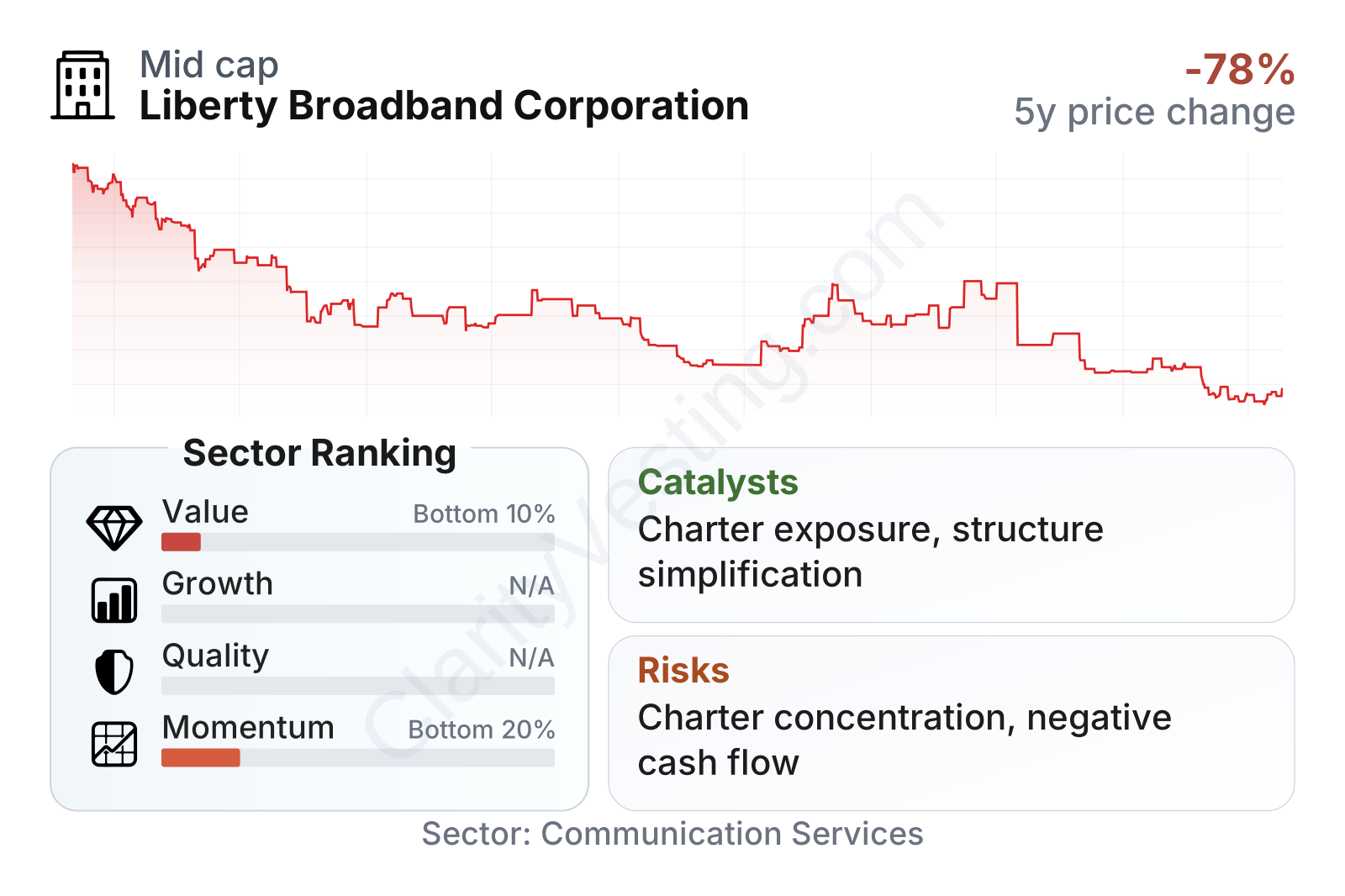
Liberty Broadband stands out as a mid-sized company with relatively low share-price volatility, but the broader picture is mixed. Revenue growth has been modestly ahead of the sector median recently, yet value and momentum indicators are weak. The current profile also shows negative free cash flow and a market performance that has trailed much of the communications sector over both short and multi-year periods. That combination suggests the market is assigning a discount for complexity, concentration, and uncertainty around cash realization.
The weak momentum is especially visible in the stock’s large decline from 2021 levels. While that does not by itself determine business quality, it shows that market confidence has deteriorated sharply over time.
Growth
Liberty Broadband sits in a sector with durable long-term demand. Broadband connectivity remains a foundational service for households and businesses, and usage trends continue to be supported by streaming, cloud applications, connected devices, hybrid work, and mobile data offload. Those are favorable structural conditions, especially for companies linked to large cable broadband networks.
The main question is not whether demand for connectivity exists, but whether Liberty Broadband can translate that demand into growing value per share. Since its exposure is primarily through Charter, the growth case depends heavily on Charter’s ability to defend broadband market share, expand mobile, improve network economics, and deploy capital efficiently through buybacks, debt management, and operating improvements.
Recent revenue trends have been positive but not explosive. Growth appears to be in the low-single-digit range, roughly in line with a mature infrastructure business rather than an early-stage growth company. That is not surprising given Liberty Broadband’s structure: this is an asset tied to a large established operator, so steady compounding matters more than rapid top-line expansion.
Free cash flow is a more challenging area. Recent trailing figures remain negative and have worsened, which limits financial flexibility at the parent-company level. For a holding company, sustained negative free cash flow can matter more than accounting earnings because it affects debt capacity, share repurchases, and the timing of value realization.
A meaningful catalyst is the simplification of the corporate structure. Liberty entities have periodically pursued mergers, combinations, and restructurings designed to reduce complexity and narrow the gap between underlying asset value and the stock market price. If the structure becomes easier to understand and more directly linked to Charter ownership, that could improve market perception over time.
Another notable opportunity comes from Charter’s business mix itself. Broadband remains the core, but mobile has become more important across the cable industry. If Charter continues to expand mobile relationships and bundle services effectively, Liberty Broadband benefits indirectly through its ownership stake. That is one of the clearest operational paths to better long-term economics.
Risks
This article is for informational purposes only and does not constitute financial advice. Some content is AI-generated. See Disclaimer


