Stock Analysis · LandBridge Company LLC (LB)
Overview
LandBridge Company LLC is a land and resource company focused on the Permian Basin, one of the most active oil-producing regions in the United States. Rather than operating as a traditional exploration and production company that drills wells itself, LandBridge owns large acreage positions and earns money by giving other operators access to its land, resources, and related infrastructure opportunities. That business model can be attractive because it is tied to development activity in a major energy basin while generally requiring less direct commodity drilling risk than a producer would face.
Its revenue base is spread across several land-linked activities. Based on recent company disclosures, the mix can shift from period to period depending on drilling activity, produced water handling, surface use, and resource sales, but the main sources of revenue are broadly the following:
- Surface use royalties and fees: payments tied to well sites, roads, pipelines, power infrastructure, easements, and other rights-of-way on LandBridge acreage. This appears to be a major contributor.
- Produced water and water-related revenue: income connected to saltwater disposal, produced water gathering, recycling, and broader water infrastructure activity supporting Permian operations. This has become an increasingly important part of the business.
- Resource sales and royalties: revenue from oil and gas royalties, caliche, sand, and other materials or subsurface-related uses where applicable.
- Other land-use income: smaller contributions from miscellaneous agreements, including commercial and industrial land access arrangements.
Because LandBridge’s filings emphasize a diversified stream of land monetization rather than a single product line, precise percentages by category are not always presented in a stable way across all periods. What stands out is that the company is building a platform around scarce land access in the Permian, with cash generation linked to regional drilling intensity and infrastructure buildout.
The business flow also shows a meaningful scale-up over the last few years. Revenue has risen sharply, and profitability has improved after a volatile 2024 period marked by heavier operating expenses. By 2025, the company was converting a much larger revenue base into positive operating income and net income, which suggests the underlying land platform is gaining traction as utilization increases.
The progression over time points to a business that moved from relatively modest revenue into a much larger gross profit base. The most important takeaway is not the exact annual swings in overhead, but that LandBridge’s land-position model appears to have expanded quickly as activity on its acreage intensified.
Key Figures
| Metric | Value | Sector ⓘ |
|---|---|---|
| Date | Oct 17, 2026 | |
| Context | ||
| Sector | Energy | |
| Industry | Oil & Gas E&P | |
| Market Cap ⓘ | $6.84B | |
| Beta ⓘ | 0.18 | |
Value (Cheapness) | ||
| P/E Ratio ⓘ | 77.28 | 15.44 |
| P/B Ratio ⓘ | 6.37 | 1.73 |
| FCF Yield ⓘ | 2.49% | 8.20% |
| Dividend Yield ⓘ | 0.50% | 3.59% |
| EBIT / EV ⓘ | 4.57% | 7.46% |
| PEG ⓘ | N/A | |
Growth (Business expansion) | ||
| Revenue Growth ⓘ | 40.60% | 26.90% |
| RPS Growth (5Y CAGR) ⓘ | 26.04% | 6.90% |
| EPS Growth (5Y CAGR) ⓘ | N/A | -15.73% |
| BVPS Growth (5Y CAGR) ⓘ | -5.49% | 6.07% |
| Margin Growth (5Y Trend) ⓘ | 63.31% | 0.58% |
| FCF Growth (5Y CAGR) ⓘ | 92.09% | 1.86% |
| DPS Growth (5Y CAGR) ⓘ | 207.99% | 16.79% |
Quality (Business durability) | ||
| ROIC (Latest) ⓘ | 14.38% | 11.40% |
| ROA (Latest) ⓘ | 3.38% | 6.06% |
| ROIC (5Y Median) ⓘ | 10.74% | 10.30% |
| ROA (5Y Median) ⓘ | 2.54% | 5.42% |
| Net Debt / EBIT (Latest) ⓘ | 3.70 | 1.64 |
| Net Debt / EBIT (5Y Median) ⓘ | N/A | 1.83 |
| Net Debt / EBITDA (Latest) ⓘ | 3.33 | 1.08 |
| Net Debt / Assets ⓘ | 36.01% | 17.29% |
| EBITDA / Interest ⓘ | 4.19 | 9.64 |
| Operating Margin (Latest) ⓘ | 59.41% | 16.27% |
| Operating Margin (5Y Median) ⓘ | 25.69% | 20.39% |
| Debt to Equity (Latest) ⓘ | 150.68% | 54.76% |
| Profit Margin (Latest) ⓘ | 16.48% | 8.82% |
| Free Cash Flow (Latest) ⓘ | $170.05M | |
Momentum (Price trend) | ||
| 3Y Return ⓘ | N/A | +67.38% |
| 12M Return (excl. last month) ⓘ | +62.88% | +49.19% |
| 6M Return ⓘ | +25.46% | +7.07% |
| Price vs. 200-Day MA ⓘ | +15.66% | +9.56% |
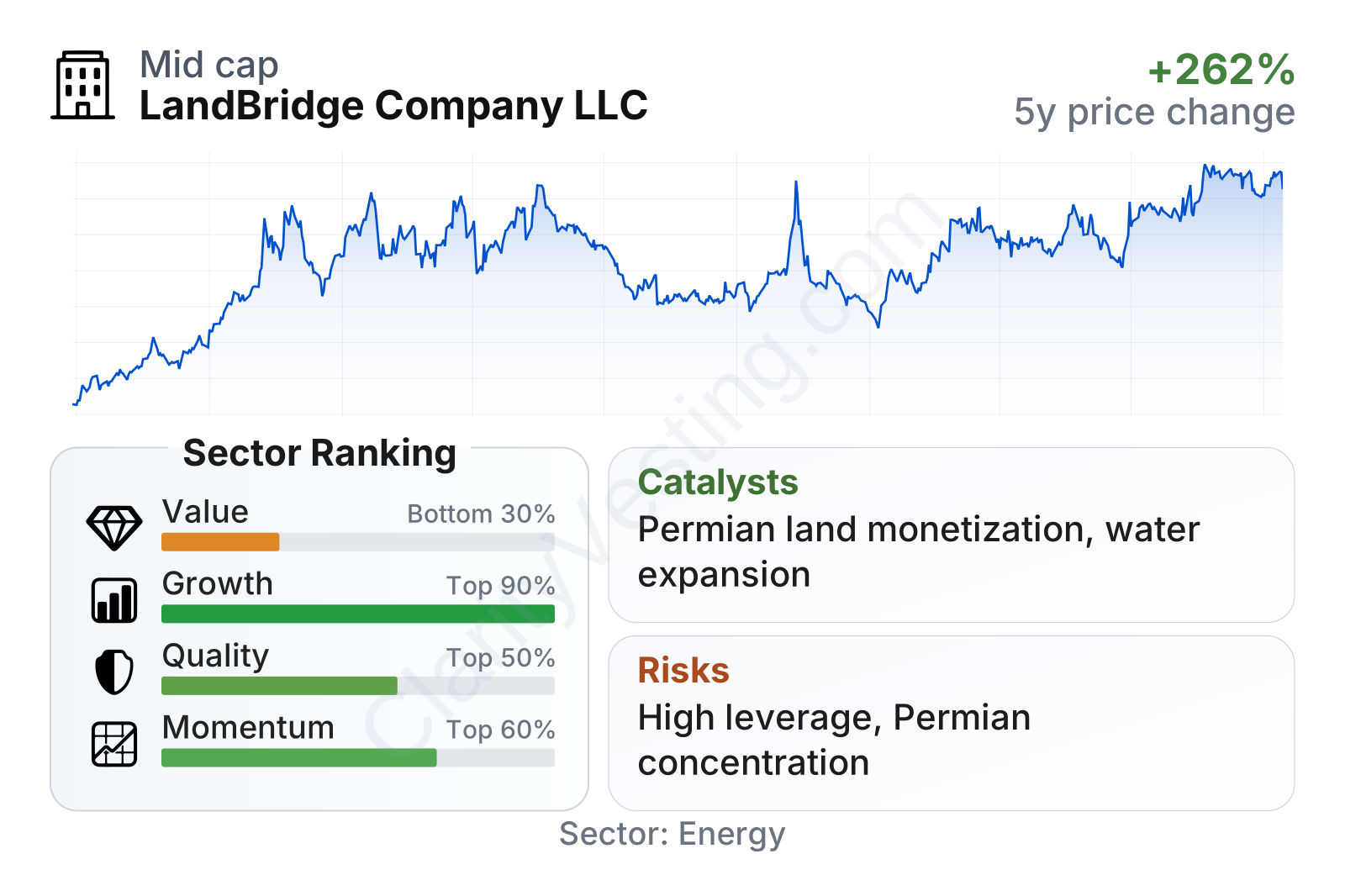
LandBridge is now a mid-sized public company within the energy space, with unusually low share-price volatility for the sector based on its beta. The broader metric profile is mixed but clear: growth ranks near the top of the peer group, quality is around the middle to better-than-average range, momentum is solid, and valuation looks demanding. In simple terms, the market has rewarded the company for rapid expansion and improving margins, but it is also assigning a much richer multiple than is typical in energy.
Growth
LandBridge operates in a part of the energy market that still has structural importance. The Permian Basin remains one of North America’s most important oil and gas regions, and it also needs land, water handling, disposal capacity, roads, power connections, and pipeline access. That creates a long runway for companies that control strategically located acreage. In that sense, LandBridge is not just exposed to commodity production; it is also exposed to the infrastructure layer that supports production.
The company’s strategy makes sense if management continues converting acreage ownership into multiple revenue streams. A key strength of this model is that the same land can potentially be monetized several times: through royalties, water services, easements, industrial use, and materials. That can produce compounding economics if development density rises over time.
Recent revenue growth has stayed strong even after very high comparison periods. Growth cooled from extraordinary levels in 2025, but it still remains well above the sector median, which suggests that expansion is continuing rather than disappearing after a one-time step-up.
Cash generation also improved substantially. Free cash flow has moved from moderate levels to a much stronger run rate, which matters because it shows the business is not relying only on accounting profits. For a land-based platform, that is an encouraging sign: more of the operating momentum is now showing up as actual cash.
One notable catalyst is the broader buildout of water and infrastructure solutions in the Permian. Produced water handling, disposal, and reuse are becoming more important as basin activity matures and environmental constraints become more relevant. If LandBridge keeps expanding along these services, it could deepen its role in the local operating ecosystem without needing to become a full-scale driller.
Another favorable point is that LandBridge’s recent profitability trend has improved sharply. Profit margin turned from negative territory in late 2024 and early 2025 to clearly positive levels in 2026, while operating margin remains far above the sector median. That combination indicates operating leverage: once land and infrastructure are in place, incremental activity can be highly profitable.
Risks
This article is for informational purposes only and does not constitute financial advice. Some content is AI-generated. See Disclaimer


