Stock Analysis · Lazard Ltd (LAZ)
Overview
Lazard Ltd is a global financial advisory and asset management firm. In simple terms, it helps large organizations make major financial decisions and also manages money on behalf of institutions and other clients. The company is best known for advising corporations and governments on mergers, acquisitions, restructurings, capital raising, and other strategic matters. It also runs an asset management business offering equity, fixed income, multi-asset, and alternative investment strategies.
Its revenue base is mainly split between advisory work and asset management fees. Based on the latest annual mix disclosed by the company, the business is centered on two large engines, with advisory slightly ahead.
- Financial Advisory: about 58% of net revenue. This includes advice on mergers and acquisitions, restructuring, capital structure matters, shareholder advisory, sovereign advisory, and fundraising-related assignments.
- Asset Management: about 42% of net revenue. This comes primarily from management fees earned on client assets, with some performance-related revenue depending on mandates and market conditions.
This structure matters for long-term analysis. Advisory revenue can be very cyclical because deal activity rises and falls with markets, confidence, and interest rates. Asset management is also market-sensitive, but it tends to provide a steadier recurring fee base as long as client assets and net flows remain resilient.
Lazard is not a giant universal bank. That is an important distinction. It does not rely on lending, trading, or consumer banking in the same way as large Wall Street banks. Its business is more specialized and built around advice, reputation, relationships, and investment performance.
The business mix over recent years shows how sensitive Lazard can be to market cycles. Revenue rebounded after the weak 2023 period, but profitability has not fully returned to earlier highs, which suggests the firm is still balancing recovery in activity with a cost base that remains meaningful.
Key Figures
| Metric | Value | Sector ⓘ |
|---|---|---|
| Date | Oct 24, 2026 | |
| Context | ||
| Sector | Financial Services | |
| Industry | Capital Markets | |
| Market Cap ⓘ | $3.68B | |
| Beta ⓘ | 1.46 | |
Value (Cheapness) | ||
| P/E Ratio ⓘ | 17.97 | 12.46 |
| P/B Ratio ⓘ | 4.38 | 1.25 |
| FCF Yield ⓘ | 18.95% | 9.82% |
| Dividend Yield ⓘ | 5.45% | 2.94% |
| EBIT / EV ⓘ | 8.44% | 8.11% |
| PEG ⓘ | 1.00 | |
Growth (Business expansion) | ||
| Revenue Growth ⓘ | 0.10% | 9.10% |
| RPS Growth (5Y CAGR) ⓘ | 1.04% | 12.31% |
| EPS Growth (5Y CAGR) ⓘ | -31.47% | -6.97% |
| BVPS Growth (5Y CAGR) ⓘ | -14.97% | 5.02% |
| Margin Growth (5Y Trend) ⓘ | -11.59% | -4.00% |
| FCF Growth (5Y CAGR) ⓘ | -11.57% | 4.71% |
| DPS Growth (5Y CAGR) ⓘ | 0.44% | 8.92% |
Quality (Business durability) | ||
| ROIC (Latest) ⓘ | N/A | 9.18% |
| ROE (Latest) ⓘ | 27.27% | 13.93% |
| ROA (Latest) ⓘ | 5.04% | 1.57% |
| ROIC (5Y Median) ⓘ | 15.87% | 7.80% |
| ROE (5Y Median) ⓘ | 36.48% | 12.15% |
| ROA (5Y Median) ⓘ | 5.50% | 1.28% |
| Net Debt / EBIT (Latest) ⓘ | 2.81 | 1.02 |
| Net Debt / EBIT (5Y Median) ⓘ | 1.74 | 0.72 |
| Net Debt / EBITDA (Latest) ⓘ | 2.58 | 0.88 |
| Operating Margin (Latest) ⓘ | 11.39% | 22.30% |
| Operating Margin (5Y Median) ⓘ | 15.38% | 24.50% |
| Debt to Equity (Latest) ⓘ | 235.48% | 59.34% |
| Profit Margin (Latest) ⓘ | 7.09% | 26.42% |
| Free Cash Flow (Latest) ⓘ | $696.96M | |
Momentum (Price trend) | ||
| 3Y Return ⓘ | +51.46% | +95.73% |
| 12M Return (excl. last month) ⓘ | -32.40% | +17.30% |
| 6M Return ⓘ | -19.55% | +6.07% |
| Price vs. 200-Day MA ⓘ | -15.20% | +5.36% |
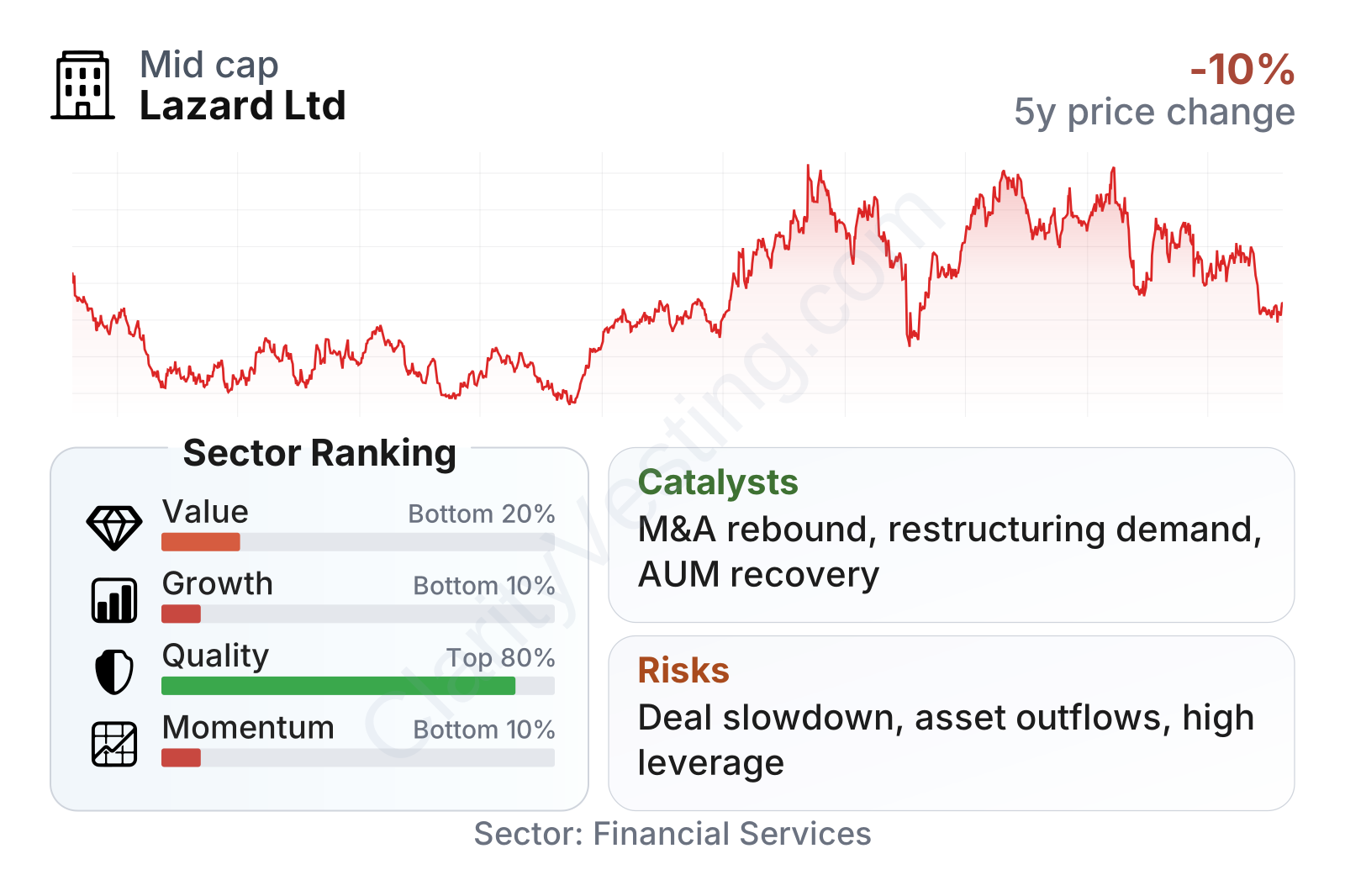
Lazard sits in the mid-cap range and its share price has been more volatile than the broader market, which fits the company’s exposure to deal cycles and market sentiment. The table points to a mixed profile: profitability ratios remain strong versus much of the sector, cash generation is solid, and the dividend yield is notably above the sector median. At the same time, growth and share-price momentum are weak, while valuation multiples are not especially low relative to peers despite that slower growth backdrop.
Growth
Lazard operates in areas that should remain relevant over the long run. Companies will continue to merge, divest assets, refinance, defend against shareholder pressure, and reorganize when balance sheets become stressed. Governments and sovereign entities also need restructuring and strategic advice from time to time. On the asset management side, global wealth pools and institutional savings continue to expand over time, even if flows move unevenly between active and passive products.
The more difficult question is not whether these markets exist, but whether Lazard can grow faster than the broader industry. Advisory is a reputation business where scale helps, but there is still room for firms with strong franchises in cross-border deals, restructuring, and board-level strategic advice. Lazard’s brand is well established in these niches. In periods when restructuring activity rises, the company can benefit because that work often increases when traditional M&A slows.
Management has also been working on broadening the platform, including selective hiring of senior bankers and continued development of specialized capabilities. For a firm like Lazard, adding high-producing teams can support revenue growth without requiring the balance sheet intensity of a lending-driven bank model. If M&A activity normalizes further and capital markets remain open, that operating model can create meaningful upside in earnings.
Earnings illustrate the issue clearly: Lazard has shown recovery after a very weak 2023, but the path has been uneven rather than consistently upward. That makes the company more dependent on a favorable market backdrop than businesses with steadier organic expansion.
Book value per share has also been pressured over the last several years, although it improved after the 2023 low point. For a financial firm, that pattern suggests the recovery is real but incomplete, and it helps explain why the market remains selective in assigning a premium.
One visible catalyst is the possibility of a stronger multiyear advisory cycle if lower financing friction supports dealmaking and sponsor activity. Another is restructuring demand, which can offset weaker merger volumes in tougher periods. In asset management, any improvement in investment performance and net client flows could lift fee-related revenue without requiring dramatic changes to the business model.
Risks
This article is for informational purposes only and does not constitute financial advice. Some content is AI-generated. See Disclaimer


