Stock Analysis · Kymera Therapeutics Inc (KYMR)
Overview
Kymera Therapeutics is a clinical-stage biotechnology company focused on a newer type of drug design called targeted protein degradation. Instead of only blocking a disease-causing protein, this approach aims to remove the protein from the cell altogether. Kymera is developing medicines mainly for immunology, inflammation, and cancer, with several programs moving through clinical development. The company does not yet have an approved product on the market, so it is still in the stage where scientific progress and partnership execution matter more than traditional product sales.
Its revenue comes primarily from collaboration and license agreements with larger pharmaceutical companies. That means reported sales can move sharply from one period to another depending on milestone timing, upfront payments, research support, and accounting recognition rather than demand from commercial products.
- Collaboration and license revenue: nearly 100% of total revenue in recent years. This includes upfront payments, milestone-related recognition, and research funding tied to partnerships such as Sanofi, Gilead, and other strategic collaborators.
- Product revenue: 0%. Kymera has no approved medicines generating recurring commercial sales at this stage.
- Other revenue: minimal to none based on current public filings.
This revenue structure makes Kymera very different from a mature pharmaceutical company. The business is built around platform value, drug pipeline progress, and the ability to turn clinical data into larger partnership economics over time. Operating costs are dominated by research and development, which has climbed materially over the past several years as the company has expanded its pipeline.
The financial profile shows a familiar biotech pattern: limited and uneven revenue, very high research spending, and sizable losses as the company invests ahead of any commercial launch. Research expense has become the largest cost by far, which fits the company’s stage and strategy.
Key Figures
| Metric | Value | Sector ⓘ |
|---|---|---|
| Date | Oct 24, 2026 | |
| Context | ||
| Sector | Healthcare | |
| Industry | Biotechnology | |
| Market Cap ⓘ | $9.26B | |
| Beta ⓘ | 1.98 | |
Value (Cheapness) | ||
| P/E Ratio ⓘ | N/A | 25.42 |
| P/B Ratio ⓘ | 7.21 | 3.08 |
| FCF Yield ⓘ | -2.57% | 3.12% |
| Dividend Yield ⓘ | N/A | 1.85% |
| EBIT / EV ⓘ | -3.34% | 0.56% |
| PEG ⓘ | N/A | |
Growth (Business expansion) | ||
| Revenue Growth ⓘ | 466.40% | 7.50% |
| RPS Growth (5Y CAGR) ⓘ | -25.62% | 8.60% |
| EPS Growth (5Y CAGR) ⓘ | -18.63% | -17.73% |
| BVPS Growth (5Y CAGR) ⓘ | 18.24% | 3.72% |
| Margin Growth (5Y Trend) ⓘ | N/A | -0.57% |
| FCF Growth (5Y CAGR) ⓘ | N/A | 0.96% |
| DPS Growth (5Y CAGR) ⓘ | N/A | 6.69% |
Quality (Business durability) | ||
| ROIC (Latest) ⓘ | -16.77% | 3.17% |
| ROA (Latest) ⓘ | -21.81% | 2.98% |
| ROIC (5Y Median) ⓘ | -25.40% | 4.56% |
| ROA (5Y Median) ⓘ | -24.93% | 1.87% |
| Net Debt / EBIT (Latest) ⓘ | N/A | 1.34 |
| Net Debt / EBIT (5Y Median) ⓘ | N/A | 1.86 |
| Net Debt / EBITDA (Latest) ⓘ | N/A | 1.00 |
| Net Debt / Assets ⓘ | -2.57% | 5.06% |
| EBITDA / Interest ⓘ | N/A | 9.55 |
| Operating Margin (Latest) ⓘ | -285.42% | 9.25% |
| Operating Margin (5Y Median) ⓘ | -330.23% | 7.33% |
| Debt to Equity (Latest) ⓘ | 5.45% | 26.68% |
| Profit Margin (Latest) ⓘ | -285.33% | 3.34% |
| Free Cash Flow (Latest) ⓘ | -$237.96M | |
Momentum (Price trend) | ||
| 3Y Return ⓘ | +829.95% | +51.61% |
| 12M Return (excl. last month) ⓘ | +139.29% | +19.90% |
| 6M Return ⓘ | +24.87% | +10.10% |
| Price vs. 200-Day MA ⓘ | +16.58% | +6.44% |
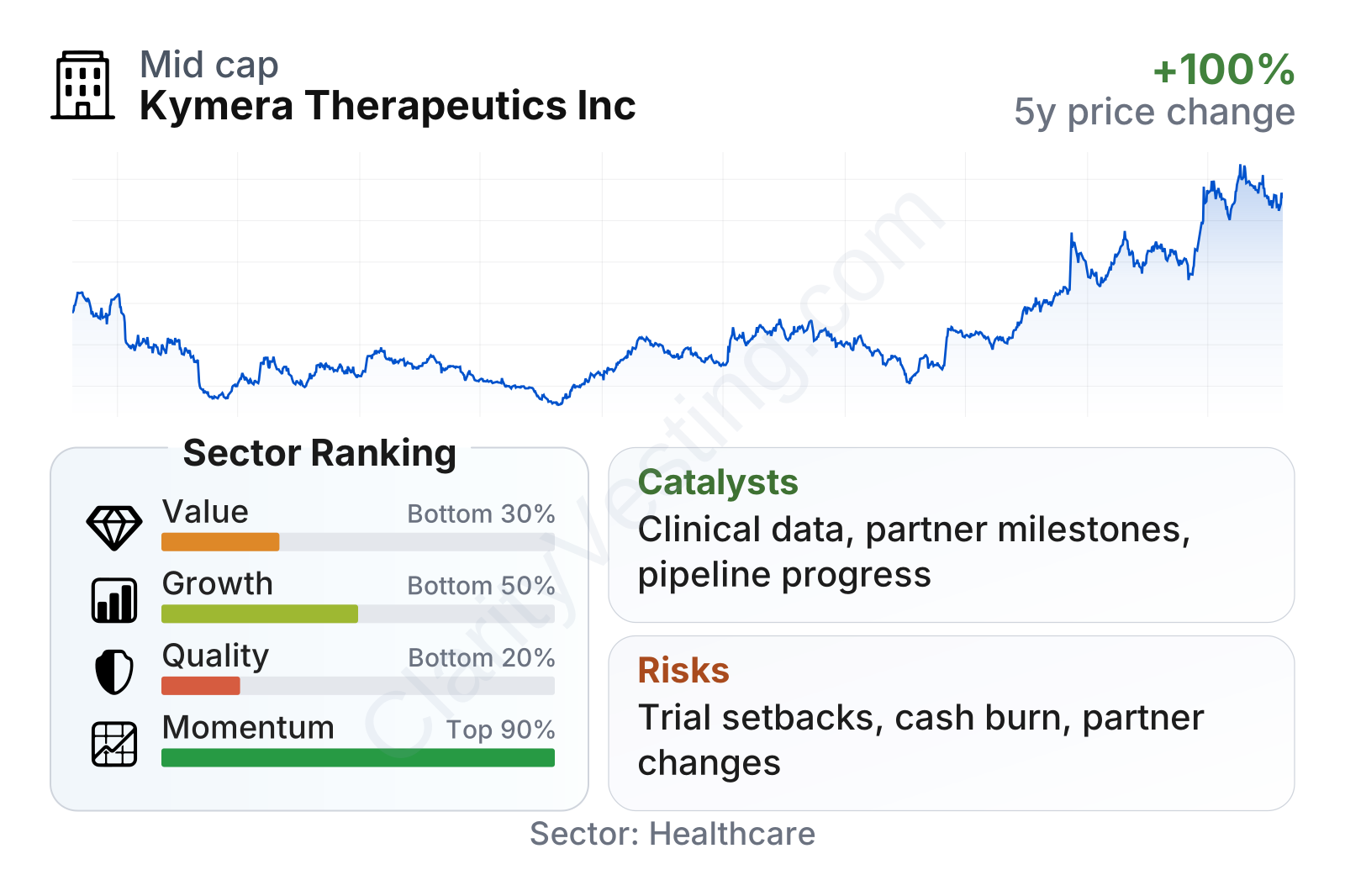
Kymera’s current profile is unusual but easy to interpret. The market value is large for a company without marketed products, which signals that the market is placing meaningful worth on the platform and pipeline. On the positive side, share-price momentum has been exceptionally strong versus much of the healthcare sector. On the weaker side, value, quality, and profitability metrics remain poor, which is normal for a development-stage biotech but still important. Price-to-book is well above the sector median, free cash flow remains negative, and returns on capital and assets are also negative. In short, the stock is being valued more on future expectations than on present operating performance.
Growth
Kymera operates in one of the more promising parts of biotechnology. Targeted protein degradation has attracted major industry interest because it could expand the number of disease drivers that drug developers can address, including targets that have historically been difficult to drug with standard approaches. If this field continues to mature, companies with validated chemistry and human clinical proof could become strategically important.
Kymera’s strategy is coherent for long-term growth. It combines two engines: internal drug development and external partnerships. The internal side gives the company upside if one of its wholly or largely controlled programs succeeds. The partnership side helps fund research, validate the platform, and reduce some development burden. This model is common in biotech, but it works best when a company can repeatedly generate convincing data across more than one program. That is the standard Kymera is trying to meet.
Revenue growth has been extremely volatile, which is expected because milestone-based collaboration revenue does not behave like normal product sales. Some recent periods show very sharp year-over-year increases, but those jumps should not be read as a stable demand trend. For Kymera, the more important growth indicators are pipeline advancement, additional partnering potential, and whether clinical results support larger future economics.
Cash generation remains negative, and free cash flow has stayed deeply below zero as the company invests aggressively in research. That is not surprising for a clinical-stage biotech, but it means growth depends on continued access to existing cash, partnerships, or future financing rather than self-funded expansion.
Recent company updates have kept attention on the pipeline, especially in immunology and inflammation. Programs aimed at validated pathways can matter a great deal because they lower the scientific hurdle: the biology may already be well understood, while Kymera’s main challenge becomes proving that degradation can deliver a better efficacy, safety, dosing, or convenience profile than existing treatment approaches. Positive clinical readouts, dose expansion, or broader development plans with partners would all qualify as meaningful growth catalysts.
Risks
This article is for informational purposes only and does not constitute financial advice. Some content is AI-generated. See Disclaimer


