Stock Analysis · Quaker Chemical Corporation (KWR)
Overview
Quaker Chemical Corporation, which operates under the Quaker Houghton name, is a specialty chemicals company focused on industrial process fluids and related services. Its products are used to help manufacturers make metal parts, form steel and aluminum, protect equipment from corrosion, keep machinery running, and improve reliability in demanding production environments. The company serves a wide set of end markets, including steel, aluminum, automotive, aerospace, can manufacturing, mining, and general industrial production.
A key point for long-term analysis is that Quaker Houghton is not a commodity chemical producer in the usual sense. It sells application-specific formulations, technical support, and process know-how that are often embedded into a customer’s production line. That tends to create recurring business, because switching suppliers can disrupt manufacturing quality, uptime, and cost control.
Based on recent annual reporting, revenue is concentrated in a few broad operating groups and end uses rather than many separately disclosed product lines.
- Industrial process fluids and lubricants: the largest source of revenue, estimated at well above 50% of sales. This includes metalworking fluids, rolling lubricants, hydraulic fluids, corrosion preventives, and greases used in metal production and machining.
- Surface treatment, coatings, and specialized chemistries: a meaningful secondary contributor, likely around 15% to 25%. These products support cleaning, pretreatment, and protection of metal surfaces.
- Maintenance services, equipment, and other solutions: a smaller but still important category, likely below 15%. This includes fluid management services, monitoring, and related equipment tied to customer operations.
Geographically, the business is broadly diversified across the Americas, EMEA, and Asia-Pacific, which reduces dependence on any single economy but also ties results closely to global industrial output.
The business mix has another important feature: many products are sold into essential production steps for steel, auto parts, beverage cans, and industrial machinery. That gives Quaker Houghton exposure to manufacturing activity rather than direct consumer demand.
Over the past several years, revenue has stayed near the same general range, but profitability has been more volatile. Gross profit has held up better than operating income and net income, which suggests that the main pressure has come from operating costs, integration expenses, and financing costs rather than a collapse in core demand alone.
Key Figures
| Metric | Value | Sector ⓘ |
|---|---|---|
| Date | Oct 24, 2026 | |
| Context | ||
| Sector | Basic Materials | |
| Industry | Specialty Chemicals | |
| Market Cap ⓘ | $2.72B | |
| Beta ⓘ | 1.40 | |
Value (Cheapness) | ||
| P/E Ratio ⓘ | 28.16 | 16.92 |
| P/B Ratio ⓘ | 1.97 | 1.66 |
| FCF Yield ⓘ | 3.32% | 5.83% |
| Dividend Yield ⓘ | 1.30% | 2.07% |
| EBIT / EV ⓘ | 4.60% | 6.38% |
| PEG ⓘ | 1.86 | |
Growth (Business expansion) | ||
| Revenue Growth ⓘ | 10.20% | 11.25% |
| RPS Growth (5Y CAGR) ⓘ | 2.31% | 4.49% |
| EPS Growth (5Y CAGR) ⓘ | -10.83% | -15.24% |
| BVPS Growth (5Y CAGR) ⓘ | 0.23% | 5.49% |
| Margin Growth (5Y Trend) ⓘ | -6.91% | -1.54% |
| FCF Growth (5Y CAGR) ⓘ | 30.87% | 0.37% |
| DPS Growth (5Y CAGR) ⓘ | 5.29% | 5.91% |
Quality (Business durability) | ||
| ROIC (Latest) ⓘ | 5.51% | 9.59% |
| ROA (Latest) ⓘ | 3.45% | 4.92% |
| ROIC (5Y Median) ⓘ | 5.86% | 7.91% |
| ROA (5Y Median) ⓘ | 4.07% | 3.92% |
| Net Debt / EBIT (Latest) ⓘ | 4.71 | 1.36 |
| Net Debt / EBIT (5Y Median) ⓘ | 4.52 | 1.69 |
| Net Debt / EBITDA (Latest) ⓘ | 2.90 | 0.93 |
| Net Debt / Assets ⓘ | 26.52% | 13.69% |
| EBITDA / Interest ⓘ | 6.10 | 12.38 |
| Operating Margin (Latest) ⓘ | 8.12% | 13.24% |
| Operating Margin (5Y Median) ⓘ | 9.61% | 11.82% |
| Debt to Equity (Latest) ⓘ | 66.16% | 40.30% |
| Profit Margin (Latest) ⓘ | 4.95% | 6.38% |
| Free Cash Flow (Latest) ⓘ | $90.34M | |
Momentum (Price trend) | ||
| 3Y Return ⓘ | +13.15% | +73.47% |
| 12M Return (excl. last month) ⓘ | +13.54% | +27.59% |
| 6M Return ⓘ | +10.67% | -4.02% |
| Price vs. 200-Day MA ⓘ | +5.12% | -0.65% |
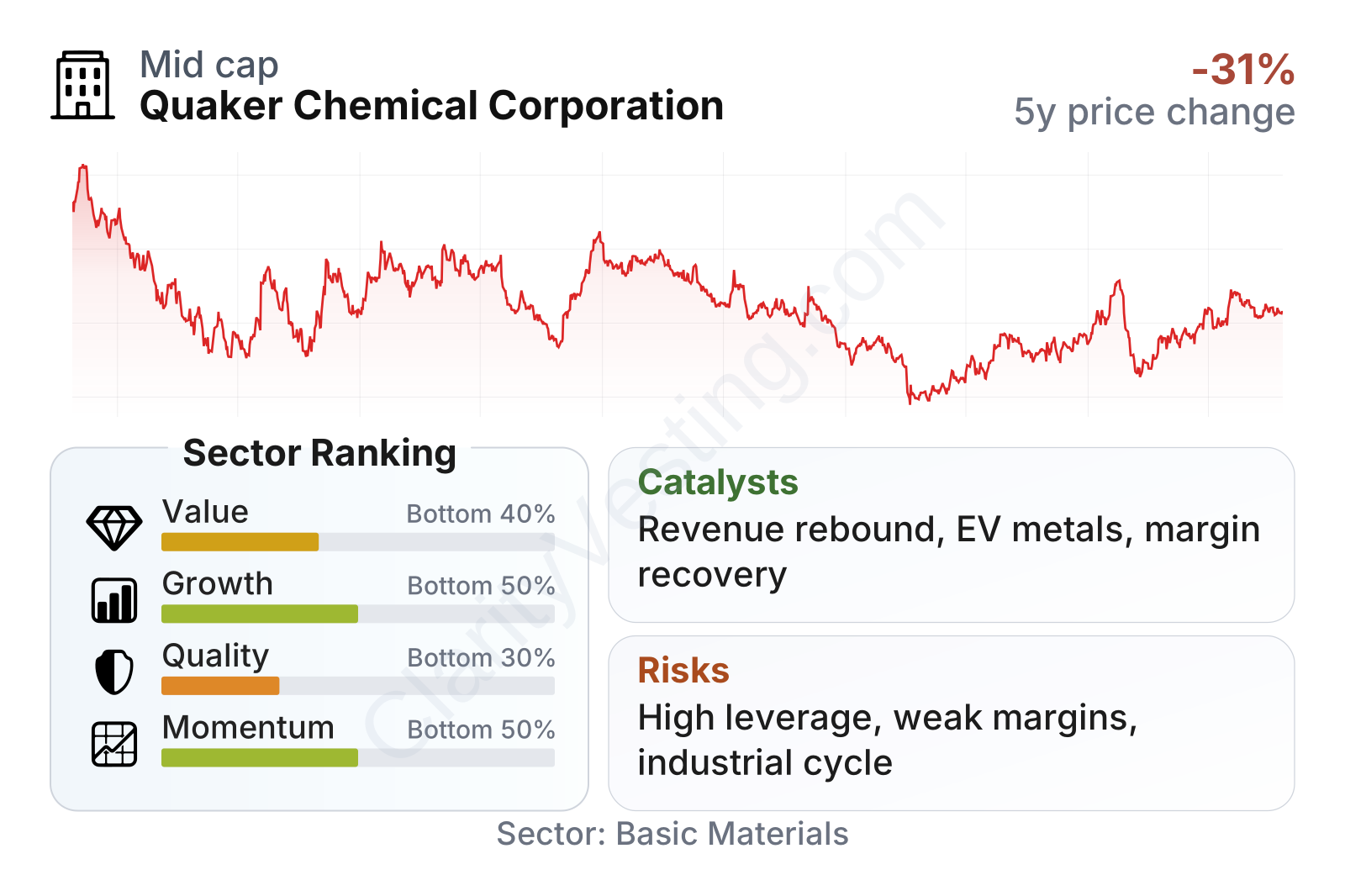
Quaker Chemical is a mid-sized specialty chemicals company with above-average share price volatility, as shown by a beta around 1.4. The overall factor profile is mixed. Valuation metrics sit weaker than much of the sector, growth ranks around the lower half, quality is below many peers, and momentum is also below average despite a better recent six-month recovery. In practical terms, the market is not pricing the company like a top-tier compounder, but it is also not placing it among the cheapest industrial chemical names.
Growth
Quaker Houghton operates in a sector with long-term relevance rather than explosive expansion. Specialty chemicals tied to industrial production usually grow with manufacturing volumes, product complexity, tighter environmental standards, and customer demand for efficiency. That means the company’s end markets can expand over time, but they are cyclical and usually do not deliver smooth year-after-year growth.
The company’s strategy is sensible for this kind of business. It emphasizes technical intimacy with customers, global scale, high switching costs in mission-critical applications, and selective acquisitions. This approach can work well over long periods because customers often value performance consistency more than the lowest purchase price. If Quaker Houghton helps reduce scrap, downtime, energy use, or maintenance needs, its products become a small but important part of the customer’s economics.
Recent revenue trends point to a business coming out of a weaker period. Year-over-year revenue growth turned negative through much of 2024 and then moved back into positive territory through late 2025 and into 2026, recently reaching around 10%. That improvement matters because it suggests industrial demand, pricing, volume, or mix has started to recover after a softer stretch.
Cash generation remains one of the more constructive elements in the profile, although it has not been perfectly steady. Free cash flow improved sharply from earlier low levels, peaked in 2024, and then cooled, but it remains positive. Over a five-year view, free cash flow growth has been much stronger than the sector median, which suggests the company still has the ability to convert earnings into cash when operations normalize.
Potential catalysts for future growth are fairly clear. Quaker Houghton has exposure to lightweight metals, electric vehicle manufacturing processes, aerospace recovery, and efficiency-focused industrial customers. Regulations and customer cost pressure can also support demand for longer-lasting fluids, lower-emission processes, and outsourced fluid management. In addition, the company’s broad installed base gives it opportunities to cross-sell products and services across global accounts.
Recent company updates have also emphasized portfolio optimization, cost discipline, and commercial execution. Those are not dramatic one-time events, but they can matter in a business where modest margin improvement has a large effect on profits.
Risks
This article is for informational purposes only and does not constitute financial advice. Some content is AI-generated. See Disclaimer


