Stock Analysis · Kumba Iron Ore Limited (KUMBF)
Overview
Kumba Iron Ore Limited is a South Africa-based mining company focused almost entirely on iron ore. Its main operations are the Sishen and Kolomela mines in the Northern Cape, and the company sells lump and fine iron ore to steel producers in seaborne export markets as well as to a smaller domestic customer base. Kumba is controlled by Anglo American and is one of the best-known suppliers of high-grade iron ore from South Africa.
The business model is relatively simple: Kumba mines iron ore, processes it, moves it largely by rail to port, and exports it to steelmakers. This means results depend heavily on three things: the iron ore price, export volumes, and the reliability of logistics infrastructure in South Africa.
Revenue is highly concentrated, which makes the company easy to understand but also more cyclical than diversified miners.
- Iron ore sales: approximately 100% of revenue. This includes export iron ore sold into international seaborne markets and a smaller portion sold locally in South Africa.
- By geography, export markets account for the clear majority of sales, with China typically the largest end-market, alongside customers in other parts of Asia, Europe, and the Middle East.
- By product, lump and fine ore are the core commercial categories. Lump ore can be especially valuable because it can be used in blast furnaces with less processing.
Kumba does not have the multi-commodity mix of larger global miners. That concentration gives it strong exposure to periods of favorable iron ore pricing, but it also means earnings can swing sharply when prices, rail performance, or demand from steelmakers weaken.
The profit flow over the last several years shows a business that can remain highly profitable even after a decline from the exceptional conditions seen in 2021. Revenue and earnings eased meaningfully after the peak, but operating profitability has stayed solid by industry standards, reflecting the value of Kumba’s ore quality and disciplined cost base.
Key Figures
| Metric | Value | Sector ⓘ |
|---|---|---|
| Date | Oct 03, 2026 | |
| Context | ||
| Sector | Basic Materials | |
| Industry | Steel | |
| Market Cap ⓘ | $6.33B | |
| Beta ⓘ | 0.96 | |
Value (Cheapness) | ||
| P/E Ratio ⓘ | 8.83 | 17.61 |
| P/B Ratio ⓘ | 0.17 | 1.77 |
| FCF Yield ⓘ | 452.35% | 5.87% |
| Dividend Yield ⓘ | 7.00% | 2.06% |
| EBIT / EV ⓘ | N/A | 6.43% |
| PEG ⓘ | N/A | |
Growth (Business expansion) | ||
| Revenue Growth ⓘ | -10.60% | 11.30% |
| RPS Growth (5Y CAGR) ⓘ | -8.46% | 4.46% |
| EPS Growth (5Y CAGR) ⓘ | -3.06% | -13.11% |
| BVPS Growth (5Y CAGR) ⓘ | -4.24% | 5.51% |
| Margin Growth (5Y Trend) ⓘ | -21.37% | -1.57% |
| FCF Growth (5Y CAGR) ⓘ | -20.62% | 0.55% |
| DPS Growth (5Y CAGR) ⓘ | -24.89% | 6.02% |
Quality (Business durability) | ||
| ROIC (Latest) ⓘ | 65.80% | 9.31% |
| ROA (Latest) ⓘ | 26.17% | 4.94% |
| ROIC (5Y Median) ⓘ | 39.47% | 7.91% |
| ROA (5Y Median) ⓘ | 18.19% | 3.93% |
| Net Debt / EBIT (Latest) ⓘ | -0.24 | 1.40 |
| Net Debt / EBIT (5Y Median) ⓘ | -0.36 | 1.70 |
| Net Debt / EBITDA (Latest) ⓘ | -0.19 | 0.91 |
| Net Debt / Assets ⓘ | -11.75% | 13.69% |
| EBITDA / Interest ⓘ | 67.43 | 11.93 |
| Operating Margin (Latest) ⓘ | 36.42% | 13.07% |
| Operating Margin (5Y Median) ⓘ | 39.63% | 11.86% |
| Debt to Equity (Latest) ⓘ | 0.33% | 40.43% |
| Profit Margin (Latest) ⓘ | 17.54% | 6.57% |
| Free Cash Flow (Latest) ⓘ | $28.63B | |
Momentum (Price trend) | ||
| 3Y Return ⓘ | +23.33% | +65.06% |
| 12M Return (excl. last month) ⓘ | +16.51% | +36.05% |
| 6M Return ⓘ | +11.32% | +1.89% |
| Price vs. 200-Day MA ⓘ | +35.84% | +1.03% |
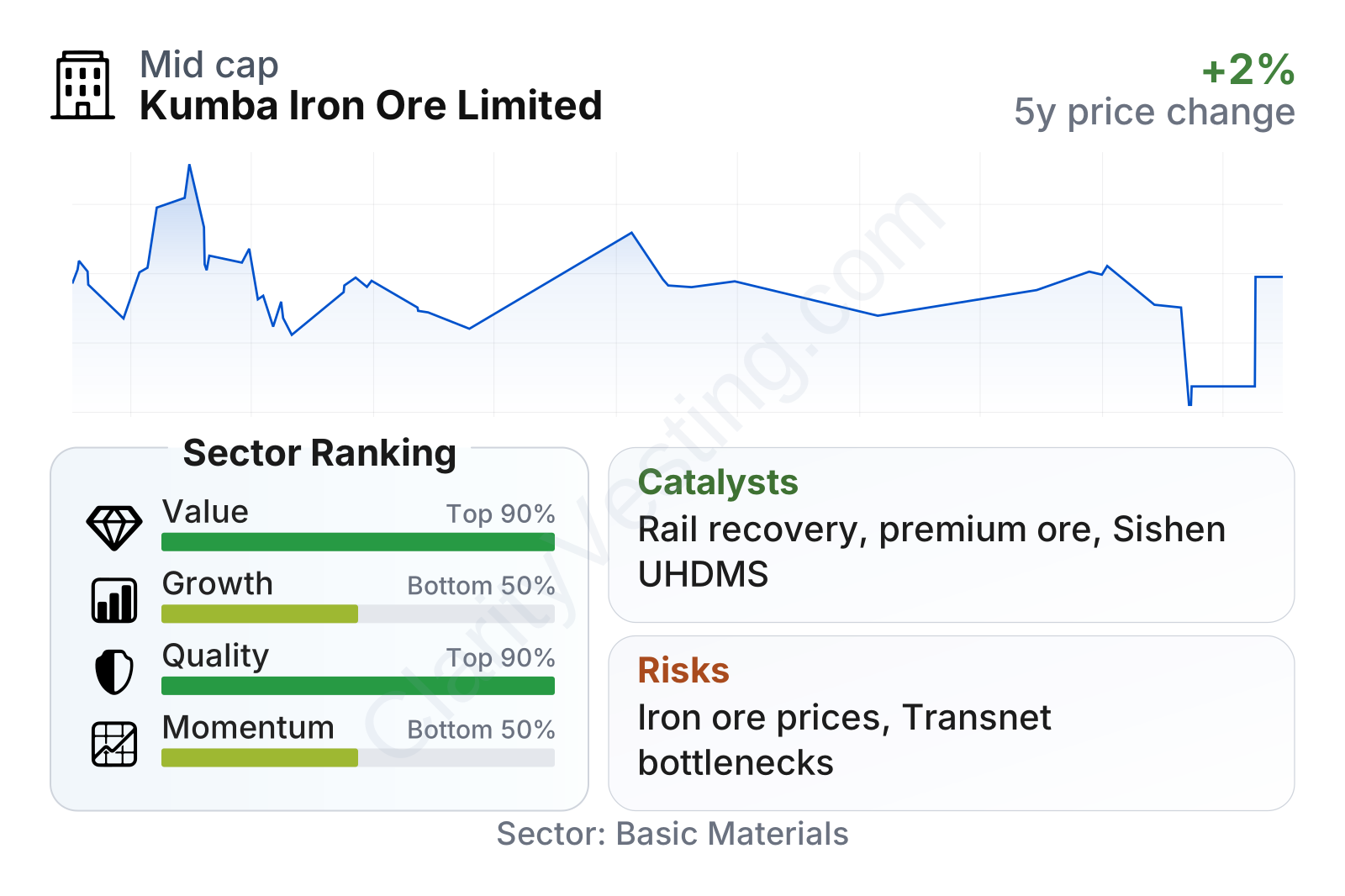
Kumba stands out on profitability and balance sheet strength. Returns on capital and assets are far above most companies in its sector, operating margins remain strong, and the balance sheet is unusually conservative, with net cash rather than meaningful net debt. Interest coverage is very high, which indicates little financial strain.
Valuation measures also look low versus the broader sector, with earnings and book-based multiples well below typical peers, while the dividend yield is materially above the sector median. The main reason the market appears cautious is growth: revenue, free cash flow, and distributions have been weaker over multi-year periods, and the company ranks below average on growth and only middling on longer-term share price performance despite a strong recent rebound.
Growth
Iron ore sits in a mature rather than fast-growing industry, so Kumba is not tied to a classic high-growth theme. Long-term demand is linked to global steel production, especially in China, as well as infrastructure, construction, and industrial activity more broadly. That said, Kumba has an attractive position within this mature market because ore quality matters. Higher-grade iron ore can help steelmakers improve blast furnace efficiency and reduce emissions intensity per ton of steel, which gives premium products strategic relevance even when total steel demand is not expanding rapidly.
Kumba’s strategy for future growth is less about building a completely new business and more about protecting volume, extending mine life, improving product quality, and restoring logistics reliability. In practice, that means maintaining stable operations at Sishen and Kolomela, advancing life-extension work such as the UHDMS project at Sishen, and benefiting if South Africa’s rail and port network improves. If logistics constraints ease, the company has room to translate existing mining capacity into higher export sales without needing a transformational acquisition.
A key catalyst is exactly that operating leverage to logistics normalization. Kumba has repeatedly shown that it can generate strong cash flow when production and export channels function more smoothly. Another potential support comes from the company’s premium ore profile, which can attract better realized pricing than lower-grade material, particularly when steelmakers focus more on efficiency and emissions.
Recent corporate updates have continued to emphasize production discipline, cost control, and work with logistics partners in South Africa. The broader opportunity is clear: if rail performance improves and seaborne iron ore prices remain supportive, Kumba’s earnings capacity can recover faster than revenue trends alone might suggest because the company already operates with high margins and a light debt burden.
Risks
This article is for informational purposes only and does not constitute financial advice. Some content is AI-generated. See Disclaimer