Stock Analysis · Kratos Defense & Security Solutions (KTOS)
Overview
Kratos Defense & Security Solutions is a U.S. defense technology company focused on systems that are cheaper and faster to field than many traditional military platforms. Its activities are centered on unmanned aerial systems, tactical drones, propulsion and jet engine work, satellite and space communications, microwave electronics, missile-defense related hardware, and training or simulation systems. In simple terms, Kratos is trying to position itself where defense customers want lower-cost, attritable, software-enabled, and production-scalable solutions rather than only a small number of very expensive legacy platforms.
The business is organized around two main segments in the company’s recent filings: Kratos Government Solutions and Unmanned Systems. Based on the latest full-year filing and management disclosures, revenue is still led by the broader government solutions segment, while unmanned systems has become the main growth engine.
Main revenue sources, from largest to smallest, are approximately:
- Kratos Government Solutions: about 75% to 80% of revenue. This includes C5ISR-related work, satellite communications, microwave electronics, space and missile-defense support, training systems, and other defense and national security engineering services and products.
- Unmanned Systems: about 20% to 25% of revenue. This includes tactical drones, target drones, related aircraft systems, and development or production programs tied to affordable air combat and defense missions.
That mix matters because the larger segment brings scale and established defense relationships, while the smaller segment carries much of the excitement around future programs. Over the last several years, the company has also increased total revenue steadily, but margins have remained relatively thin, showing that growth has come before strong profitability.
The financial picture shows a company whose revenue has expanded from a little over $800 million in 2021 to roughly $1.35 billion in 2025, with gross profit rising as well. However, operating costs have also climbed, especially selling, general, and administrative expenses, which helps explain why earnings improvement has been slower than revenue growth.
Key Figures
| Metric | Value | Sector ⓘ |
|---|---|---|
| Date | Oct 03, 2026 | |
| Context | ||
| Sector | Industrials | |
| Industry | Aerospace & Defense | |
| Market Cap ⓘ | $8.07B | |
| Beta ⓘ | 1.11 | |
Value (Cheapness) | ||
| P/E Ratio ⓘ | 253.24 | 22.45 |
| P/B Ratio ⓘ | 2.37 | 1.98 |
| FCF Yield ⓘ | -1.60% | 6.31% |
| Dividend Yield ⓘ | N/A | 1.96% |
| EBIT / EV ⓘ | 0.38% | 4.81% |
| PEG ⓘ | 34.12 | |
Growth (Business expansion) | ||
| Revenue Growth ⓘ | 30.50% | 9.10% |
| RPS Growth (5Y CAGR) ⓘ | 5.26% | 7.75% |
| EPS Growth (5Y CAGR) ⓘ | 2.75% | -13.59% |
| BVPS Growth (5Y CAGR) ⓘ | 11.80% | 6.22% |
| Margin Growth (5Y Trend) ⓘ | -0.16% | 0.72% |
| FCF Growth (5Y CAGR) ⓘ | N/A | 10.98% |
| DPS Growth (5Y CAGR) ⓘ | N/A | 9.48% |
Quality (Business durability) | ||
| ROIC (Latest) ⓘ | 0.95% | 10.92% |
| ROA (Latest) ⓘ | 0.95% | 5.41% |
| ROIC (5Y Median) ⓘ | 0.60% | 9.21% |
| ROA (5Y Median) ⓘ | -0.13% | 4.94% |
| Net Debt / EBIT (Latest) ⓘ | -44.27 | 2.07 |
| Net Debt / EBIT (5Y Median) ⓘ | -0.74 | 2.28 |
| Net Debt / EBITDA (Latest) ⓘ | -10.50 | 1.43 |
| Net Debt / Assets ⓘ | -30.42% | 19.27% |
| EBITDA / Interest ⓘ | N/A | 9.53 |
| Operating Margin (Latest) ⓘ | 1.85% | 10.50% |
| Operating Margin (5Y Median) ⓘ | 3.30% | 10.27% |
| Debt to Equity (Latest) ⓘ | 5.65% | 65.48% |
| Profit Margin (Latest) ⓘ | 2.03% | 6.62% |
| Free Cash Flow (Latest) ⓘ | -$128.90M | |
Momentum (Price trend) | ||
| 3Y Return ⓘ | +184.22% | +58.56% |
| 12M Return (excl. last month) ⓘ | -22.57% | +15.63% |
| 6M Return ⓘ | -39.46% | +4.19% |
| Price vs. 200-Day MA ⓘ | -38.37% | +0.93% |
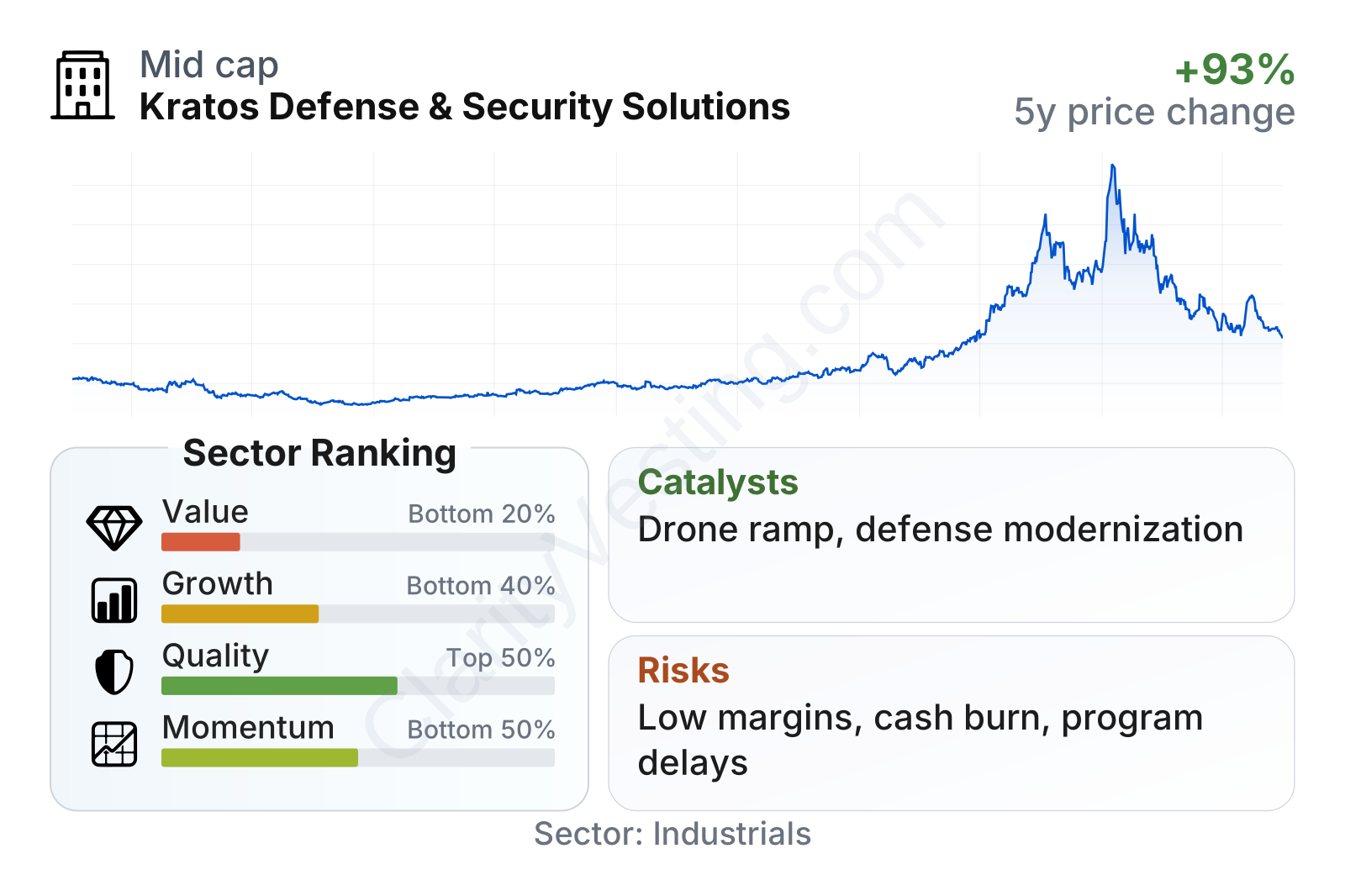
Kratos is now a mid-sized defense company with a stock that has been unusually volatile. The share price surged sharply through 2025 and then pulled back heavily into 2026, which fits a business that is being valued more on future program potential than on mature, stable earnings. In the factor breakdown, valuation stands out as weak versus the sector, largely because earnings and free cash flow remain too small for the current market value. Quality is mixed: the balance sheet looks unusually conservative for defense, but returns on capital and margins are still well below industry norms. Growth is uneven as well, with very strong recent sales expansion but more modest long-term per-share progress and limited operating margin improvement.
Growth
Kratos operates in a part of the defense market that has clear structural support. The U.S. and allied militaries are putting more attention on autonomous systems, layered air defense, resilient communications, space-linked infrastructure, and lower-cost platforms that can be produced at greater volume. That trend supports Kratos because the company is not trying to outmatch the biggest prime contractors across every category; instead, it is concentrated in niches where affordability, speed, and adaptability matter.
The strategy also makes sense in the current defense environment. Large contractors remain dominant in major aircraft, ships, and missile systems, but defense agencies increasingly want complementary systems: target drones, tactical unmanned aircraft, propulsion components, satellite-ground infrastructure, and electronics that fit modern command-and-control networks. Kratos has built around those categories for years, which gives it a clearer industrial identity than many smaller defense suppliers.
Recent revenue momentum has been strong. Year-over-year growth moved from low single digits in late 2024 to well above 20% in the most recent periods, reaching around 30% by mid-2026. That is far ahead of the sector median and suggests that program activity, production ramp-up, or both have accelerated materially. For a defense company, that kind of top-line reacceleration is notable because the industry often grows at a much slower pace.
The caution is that cash generation has not followed the same upward path. Free cash flow has been inconsistent and recently turned sharply negative again. That does not automatically mean the underlying business is deteriorating; for companies ramping manufacturing capacity or funding working capital for larger contracts, cash flow can be lumpy. Still, sustained growth ultimately needs to convert into cash, especially when the market already assigns a premium to future prospects.
A major catalyst is Kratos’s role in lower-cost jet-powered unmanned aircraft and related defense systems. Company releases and management commentary in 2026 continued to highlight opportunities tied to tactical drone programs, propulsion, and defense modernization initiatives. The broader policy backdrop also helps: U.S. defense priorities increasingly emphasize production capacity, autonomous systems, and affordable force multiplication rather than relying exclusively on exquisite high-cost assets.
Another important opportunity is that Kratos can benefit even when it is not the headline prime contractor. In many defense programs, suppliers with the right subsystems, engines, electronics, command links, or specialized platforms can still capture meaningful revenue as a program scales. That makes the company’s addressable opportunity larger than a simple reading of its current size might suggest.
Risks
This article is for informational purposes only and does not constitute financial advice. Some content is AI-generated. See Disclaimer