Stock Analysis · Krystal Biotech Inc (KRYS)
Overview
Krystal Biotech is a biotechnology company focused on genetic medicines delivered through an engineered herpes simplex virus type 1 platform. In simple terms, it develops treatments that aim to deliver working copies of genes directly to patients’ cells. The company’s best-known product is Vyjuvek, a topical gene therapy approved for dystrophic epidermolysis bullosa, a rare genetic skin disease that causes fragile skin and severe wounds.
What makes Krystal unusual in biotech is that it has already moved beyond the pure research stage. Many biotech companies spend heavily for years before producing any commercial revenue. Krystal now has a marketed product, growing sales, positive earnings, and positive free cash flow, while still funding additional programs.
Based on recent company reporting, revenue is still highly concentrated in one product and one core business line.
- Product revenue from Vyjuvek: approximately the vast majority of total revenue. This includes sales in the United States and early international commercialization tied to the approved skin-disease treatment.
- Collaboration, license, or other revenue: a small minority of revenue when present. This can include partnership-related activity or other non-core commercial items, but it is not currently the main earnings engine.
The larger financial pattern is clear: Krystal has transformed from a pre-revenue biotech into a commercial-stage company built primarily around one approved therapy, while using the cash generated from that therapy to support a broader pipeline in dermatology, respiratory disease, oncology, and ophthalmology.
The business mix has changed dramatically in a short period. Revenue was effectively absent a few years ago, then climbed rapidly after Vyjuvek’s launch, while operating profit and net income turned strongly positive. That shift matters because it lowers dependence on external financing compared with many biotech peers.
Key Figures
| Metric | Value | Sector ⓘ |
|---|---|---|
| Date | Oct 24, 2026 | |
| Context | ||
| Sector | Healthcare | |
| Industry | Biotechnology | |
| Market Cap ⓘ | $9.47B | |
| Beta ⓘ | 0.50 | |
Value (Cheapness) | ||
| P/E Ratio ⓘ | 40.08 | 25.42 |
| P/B Ratio ⓘ | 7.22 | 3.08 |
| FCF Yield ⓘ | 2.72% | 3.12% |
| Dividend Yield ⓘ | N/A | 1.85% |
| EBIT / EV ⓘ | 2.30% | 0.56% |
| PEG ⓘ | N/A | |
Growth (Business expansion) | ||
| Revenue Growth ⓘ | 24.10% | 7.50% |
| RPS Growth (5Y CAGR) ⓘ | N/A | 8.60% |
| EPS Growth (5Y CAGR) ⓘ | N/A | -17.73% |
| BVPS Growth (5Y CAGR) ⓘ | 11.08% | 3.72% |
| Margin Growth (5Y Trend) ⓘ | 240.46% | -0.57% |
| FCF Growth (5Y CAGR) ⓘ | N/A | 0.96% |
| DPS Growth (5Y CAGR) ⓘ | N/A | 6.69% |
Quality (Business durability) | ||
| ROIC (Latest) ⓘ | 18.27% | 3.17% |
| ROA (Latest) ⓘ | 17.62% | 2.98% |
| ROIC (5Y Median) ⓘ | -11.99% | 4.56% |
| ROA (5Y Median) ⓘ | 1.59% | 1.87% |
| Net Debt / EBIT (Latest) ⓘ | -1.96 | 1.34 |
| Net Debt / EBIT (5Y Median) ⓘ | N/A | 1.86 |
| Net Debt / EBITDA (Latest) ⓘ | -1.90 | 1.00 |
| Net Debt / Assets ⓘ | -27.91% | 5.06% |
| EBITDA / Interest ⓘ | N/A | 9.55 |
| Operating Margin (Latest) ⓘ | 48.43% | 9.25% |
| Operating Margin (5Y Median) ⓘ | 35.52% | 7.33% |
| Debt to Equity (Latest) ⓘ | 0.65% | 26.68% |
| Profit Margin (Latest) ⓘ | 54.82% | 3.34% |
| Free Cash Flow (Latest) ⓘ | $257.78M | |
Momentum (Price trend) | ||
| 3Y Return ⓘ | +184.91% | +51.61% |
| 12M Return (excl. last month) ⓘ | +112.11% | +19.90% |
| 6M Return ⓘ | +16.01% | +10.10% |
| Price vs. 200-Day MA ⓘ | +4.29% | +6.44% |
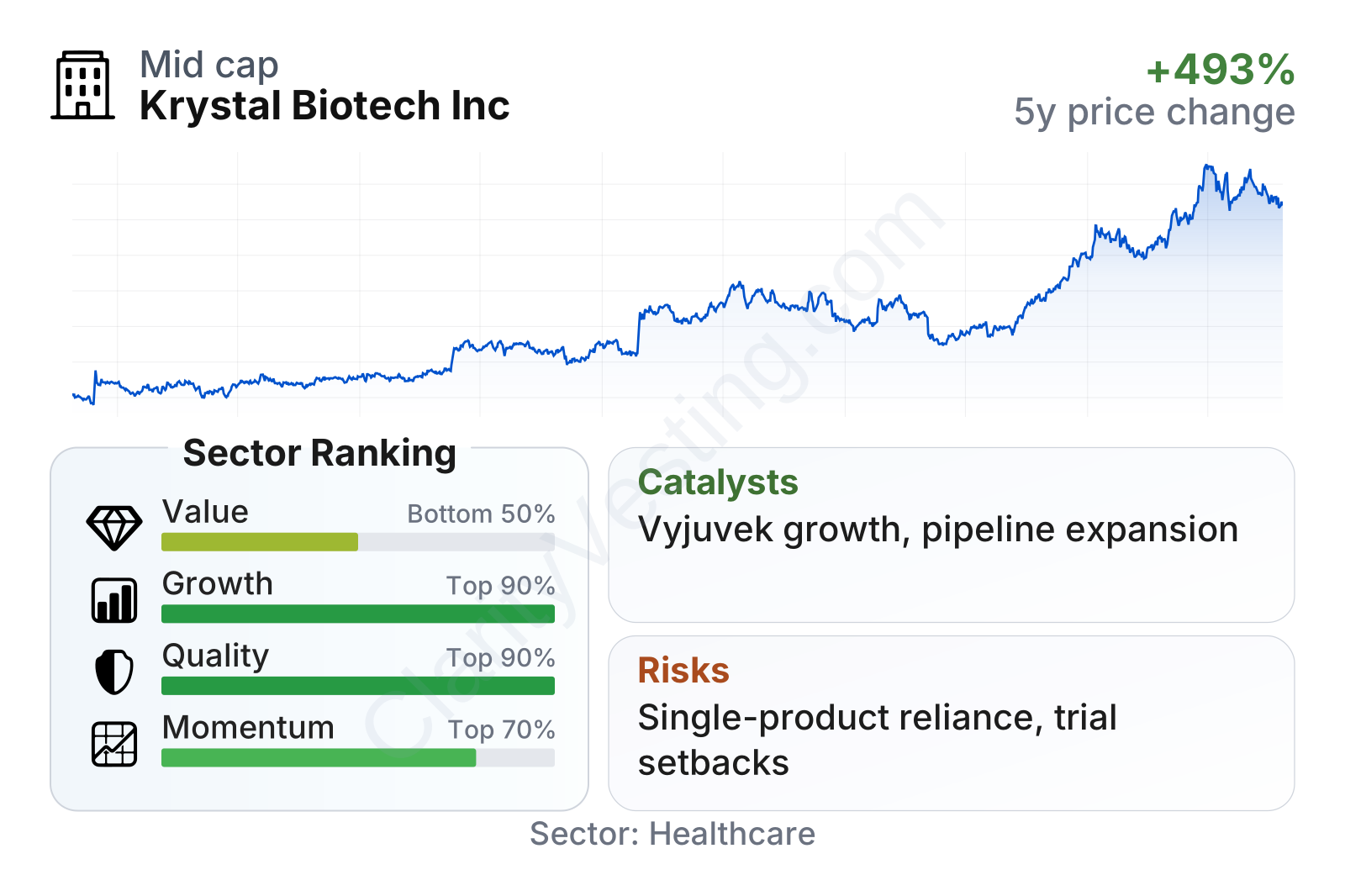
Krystal sits in the large end of biotech by market value, but with lower share-price volatility than many companies in the sector. The table points to a rare combination in biotechnology: top-tier growth and top-tier quality, supported by strong profitability and very low leverage. The weaker area is valuation, where the stock trades above sector medians on earnings and book value multiples, reflecting the market’s expectation that recent commercial progress can continue.
Growth
Krystal operates in one of healthcare’s most attractive long-term niches: genetic medicine for rare diseases. This area tends to benefit from high unmet need, premium pricing, orphan-drug incentives, and relatively focused commercial efforts. That does not make growth automatic, but it does create a supportive backdrop for companies that can move from research into real patient treatment.
The company’s strategy is coherent. It is using its approved dermatology product as a commercial base while expanding the same underlying delivery platform into new indications. That approach can be more efficient than building unrelated drug programs from scratch because manufacturing, regulatory know-how, and scientific expertise can potentially be reused across several candidates.
Revenue growth has stayed strong even after the first launch surge. Growth rates have naturally moderated from the earliest post-launch quarters, but they remain well above the healthcare sector median. That suggests Vyjuvek is still in an expansion phase rather than a mature plateau.
Cash generation is another major change. Krystal moved from negative free cash flow to clearly positive territory over the last two years. For a biotech company, that is important because it means future pipeline development may be funded increasingly by internal cash rather than by frequent share issuance or debt.
Several catalysts could shape the next phase. Continued adoption of Vyjuvek remains the most immediate one, especially as physician awareness, treatment logistics, and reimbursement processes improve. International expansion is another opportunity, since rare-disease products often broaden geographically over time after initial approval. Beyond the marketed product, pipeline updates matter because Krystal is trying to prove that its delivery technology has value in more than one disease setting.
Recent company communications have also highlighted progress in additional programs, including respiratory and oncology-related candidates, which helps support the argument that Krystal is not intended to remain a single-product company forever. For long-term analysis, the main point is that the business already has a commercial foundation, while still retaining pipeline upside that could materially expand its addressable market if future trials work.
Risks
This article is for informational purposes only and does not constitute financial advice. Some content is AI-generated. See Disclaimer


