Stock Analysis · Kerry Group plc (KRYAF)
Overview
Kerry Group plc is an Ireland-based food and beverage ingredients company that helps other businesses develop, improve, and manufacture products. Rather than being mainly a consumer brand owner, Kerry is primarily a business-to-business supplier. Its customers include food manufacturers, beverage companies, foodservice operators, and pharmaceutical and biotechnology companies. The company focuses on taste, nutrition, preservation, and formulation solutions that help customers make products with better flavor, cleaner labels, improved shelf life, and more efficient production.
In recent years, Kerry has become more concentrated around its ingredients and solutions activities after reshaping the business through portfolio changes. That matters for long-term analysis because ingredients businesses often have deeper customer integration and higher switching costs than standard packaged food brands.
The latest annual reporting shows revenue is now heavily centered on the Taste & Nutrition platform, with a much smaller contribution from legacy branded consumer activities and other remaining operations. Based on recent group disclosures and the post-transaction shape of the company, revenue can be understood approximately as follows:
- Taste & Nutrition / Ingredients and solutions: about 95%+ of group revenue. This includes taste systems, functional ingredients, nutrition solutions, preservation, reformulation support, beverage systems, and application expertise sold to food, beverage, and health-related customers.
- Residual consumer-facing and other activities: less than 5% of group revenue. This reflects the much smaller remainder after the disposal of major consumer brands operations.
Kerry also describes its commercial structure geographically. On that basis, the business is spread across major food markets in the Americas, Europe, and Asia-Pacific, which helps reduce dependence on any one country. Its revenue mix is therefore more driven by category exposure and customer demand trends than by a single domestic economy.
One notable financial pattern over the last several years is that reported revenue has come down from earlier peaks, while operating profit has held up better than sales. That suggests the company has been moving toward a more focused and margin-stronger model rather than simply chasing volume.
The broad picture is a business with lower sales than a few years ago, but with a steadier operating result and still solid net income generation. That is consistent with a portfolio shift toward more specialized, higher-value ingredients and solutions.
Key Figures
| Metric | Value | Sector ⓘ |
|---|---|---|
| Date | Oct 17, 2026 | |
| Context | ||
| Sector | Consumer Defensive | |
| Industry | Packaged Foods | |
| Market Cap ⓘ | $15.20B | |
| Beta ⓘ | 0.55 | |
Value (Cheapness) | ||
| P/E Ratio ⓘ | 20.88 | 17.88 |
| P/B Ratio ⓘ | 2.64 | 1.29 |
| FCF Yield ⓘ | 6.73% | 12.39% |
| Dividend Yield ⓘ | 1.51% | 2.85% |
| EBIT / EV ⓘ | N/A | 6.43% |
| PEG ⓘ | 1.37 | |
Growth (Business expansion) | ||
| Revenue Growth ⓘ | -3.70% | 4.10% |
| RPS Growth (5Y CAGR) ⓘ | -0.27% | 6.18% |
| EPS Growth (5Y CAGR) ⓘ | -39.91% | -13.59% |
| BVPS Growth (5Y CAGR) ⓘ | 3.40% | 3.20% |
| Margin Growth (5Y Trend) ⓘ | 1.22% | -0.15% |
| FCF Growth (5Y CAGR) ⓘ | -6.79% | 4.10% |
| DPS Growth (5Y CAGR) ⓘ | 10.11% | 6.79% |
Quality (Business durability) | ||
| ROIC (Latest) ⓘ | N/A | 12.34% |
| ROA (Latest) ⓘ | 10.42% | 6.30% |
| ROIC (5Y Median) ⓘ | 8.22% | 10.49% |
| ROA (5Y Median) ⓘ | 6.07% | 5.44% |
| Net Debt / EBIT (Latest) ⓘ | 1.42 | 1.96 |
| Net Debt / EBIT (5Y Median) ⓘ | 2.42 | 2.35 |
| Net Debt / EBITDA (Latest) ⓘ | 1.02 | 1.38 |
| Net Debt / Assets ⓘ | 20.02% | 21.51% |
| EBITDA / Interest ⓘ | 15.73 | 9.46 |
| Operating Margin (Latest) ⓘ | 13.76% | 8.87% |
| Operating Margin (5Y Median) ⓘ | 12.08% | 9.53% |
| Debt to Equity (Latest) ⓘ | 43.96% | 72.35% |
| Profit Margin (Latest) ⓘ | 9.62% | 5.40% |
| Free Cash Flow (Latest) ⓘ | $1.02B | |
Momentum (Price trend) | ||
| 3Y Return ⓘ | +27.21% | +20.92% |
| 12M Return (excl. last month) ⓘ | -3.77% | +2.13% |
| 6M Return ⓘ | +35.02% | +1.26% |
| Price vs. 200-Day MA ⓘ | +12.82% | +1.39% |
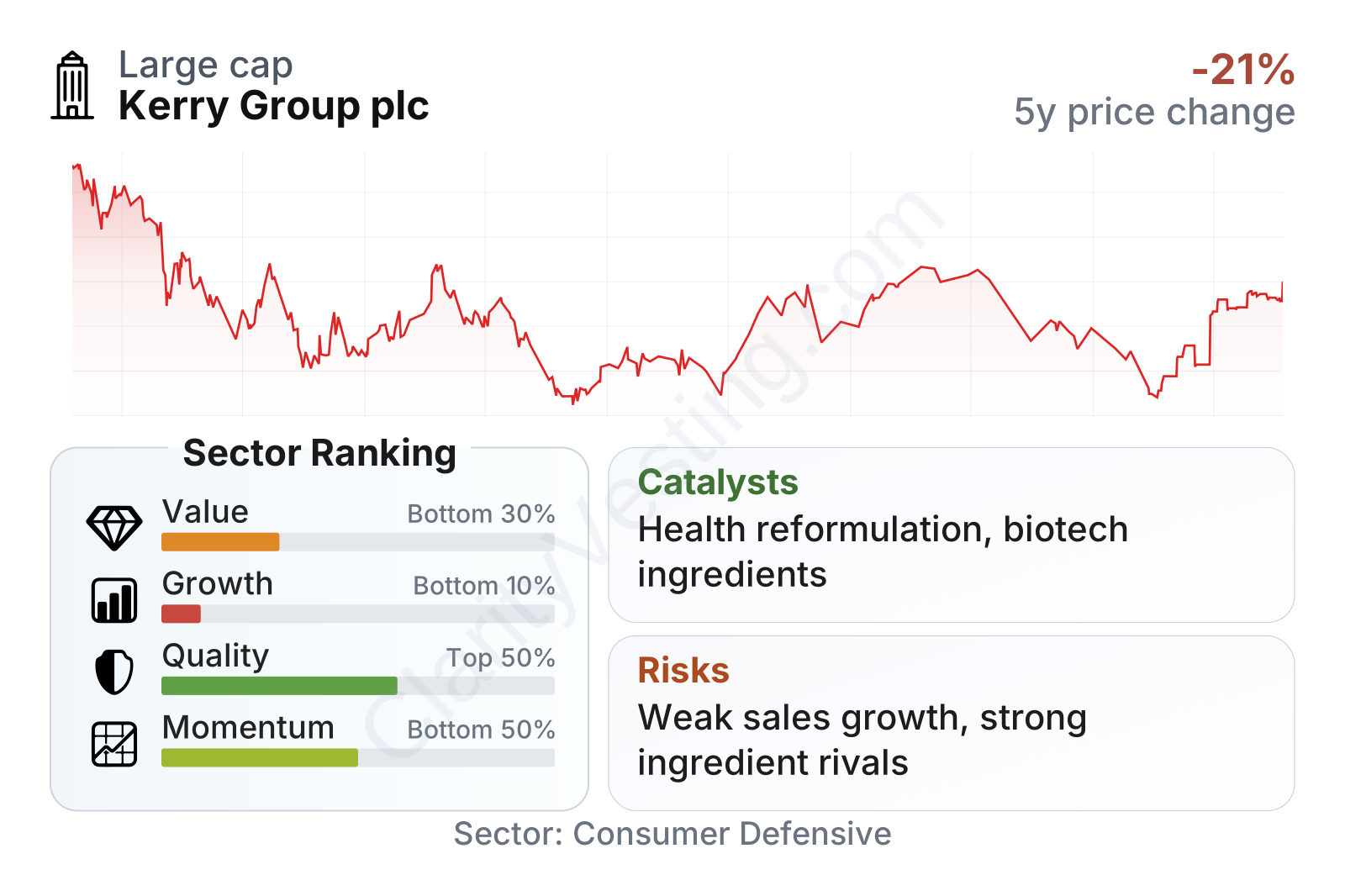
Kerry is a large packaged foods and ingredients company with a comparatively low share-price volatility profile, as shown by its beta well below 1. On profitability and balance-sheet quality, it stands up reasonably well against the sector: operating margin is around 14% versus a sector median near 9%, profit margin is near 10% versus roughly 5% for the median peer, and leverage looks controlled with debt-to-equity around 44% against a sector median near 71%. Interest coverage is also comfortably above the industry midpoint.
The weaker area is growth. Recent year-over-year revenue declined by about 4% while the sector median still showed positive growth, and multi-year revenue per share, earnings, and free cash flow growth have been soft. On valuation, the shares do not look obviously cheap relative to the sector, with earnings and book multiples above median while dividend yield and free-cash-flow yield are below median. In short, the metrics point to a quality business, but not one currently receiving a deep discount.
Growth
Kerry operates in parts of the food industry that are still supported by durable long-term demand. Consumers continue to look for better taste, healthier formulations, convenience, lower sugar, higher protein, cleaner labels, and products that travel well through complex supply chains. Those needs create demand for exactly the kind of formulation and application support Kerry sells. This is not a fast-changing technology market, but it is a structurally relevant one because food and beverage companies continuously reformulate products in response to regulation, input costs, and consumer preferences.
Kerry’s strategy also fits these trends. The company has spent years building a more specialized ingredients and solutions portfolio instead of relying on lower-margin consumer products. That strategy can make sense for future growth because specialized ingredients tend to involve closer customer relationships, technical know-how, and recurring reformulation work. It also gives Kerry the chance to grow with customer innovation pipelines rather than only with population or grocery volume.
Near-term growth has been less impressive than the long-term industry backdrop. Reported revenue has been under pressure, and the five-year growth record is weak compared with the broader consumer defensive group. Still, margin improvement has been more favorable than many peers, which suggests the company is trying to improve the quality of growth rather than maximizing headline sales.
A meaningful catalyst is Kerry’s continued expansion in higher-value categories such as taste modulation, health and nutrition solutions, beverage systems, and pharmaceutical excipients. The company has also highlighted investment in biotechnology and precision fermentation capabilities through acquisitions and partnerships in recent years. These areas are still developing, but they could strengthen Kerry’s role in next-generation food and health applications if adoption broadens.
Another potential support is the company’s broad customer exposure. Large multinational food groups, regional brands, and foodservice operators all face pressure to renovate products. Kerry can benefit when clients reduce sodium or sugar, improve texture, add functional benefits, or simplify ingredient labels. That creates many smaller opportunities across a large customer base rather than reliance on one breakthrough product.
Risks
This article is for informational purposes only and does not constitute financial advice. Some content is AI-generated. See Disclaimer


