Stock Analysis · Karat Packaging Inc (KRT)
Overview
Karat Packaging Inc is a specialty distributor and supplier of disposable foodservice products used mainly by restaurants, beverage shops, food delivery operators, and other foodservice businesses. Its catalog includes cups, lids, straws, cutlery, containers, bags, and related supplies. In simple terms, the company sells many of the everyday items that food and drink businesses need to serve customers and run takeout or delivery operations.
The business is built around a broad product range, import and sourcing capabilities, distribution infrastructure, and relationships with small and mid-sized foodservice customers as well as distributors. Karat also has exposure to custom printing, which can help customers brand cups and packaging, and this adds a more specialized layer to a product category that can otherwise look commoditized.
Based on company filings, revenue is generated primarily from foodservice disposables and related packaging products sold across several product families. Exact percentages by product line are not always disclosed in the most recent public filings, but the company indicates a business mix centered on beverage-related items and takeout packaging. A practical way to think about revenue is the following:
- Beverage supplies: cups, lids, straws, cup carriers, and accessories. This appears to be one of the largest categories because Karat has strong exposure to coffee, tea, smoothie, and boba shops.
- Takeout and food containers: clamshells, hinged containers, deli containers, trays, and related items used for prepared foods and delivery.
- Utensils and tabletop disposables: cutlery, napkins, portion cups, plates, bowls, and similar serving products.
- Bags, gloves, and other operating supplies: carryout bags, food handling items, and miscellaneous consumables.
- Custom printing and branded packaging: customized cups and packaging for customer branding, typically a smaller but strategically useful part of the mix.
Karat is still relatively small compared with global packaging groups, but it occupies a focused niche: supplying high-turnover consumables to foodservice businesses that reorder frequently. That makes the company less like a one-time equipment seller and more like a repeat-purchase distribution platform.
The business has expanded revenue meaningfully over the last several years, while gross profit has also grown. What stands out is that margins have held up better than many investors might expect for a packaging distributor, although selling and administrative costs have also risen as the company scales.
Key Figures
| Metric | Value | Sector ⓘ |
|---|---|---|
| Date | Oct 17, 2026 | |
| Context | ||
| Sector | Consumer Cyclical | |
| Industry | Packaging & Containers | |
| Market Cap ⓘ | $1.09B | |
| Beta ⓘ | 0.76 | |
Value (Cheapness) | ||
| P/E Ratio ⓘ | 21.80 | 16.89 |
| P/B Ratio ⓘ | 6.83 | 1.61 |
| FCF Yield ⓘ | 4.68% | 8.99% |
| Dividend Yield ⓘ | 3.30% | 2.73% |
| EBIT / EV ⓘ | 6.99% | 6.69% |
| PEG ⓘ | N/A | |
Growth (Business expansion) | ||
| Revenue Growth ⓘ | 9.90% | 5.60% |
| RPS Growth (5Y CAGR) ⓘ | 5.95% | 8.91% |
| EPS Growth (5Y CAGR) ⓘ | 8.25% | -17.41% |
| BVPS Growth (5Y CAGR) ⓘ | 3.18% | 5.62% |
| Margin Growth (5Y Trend) ⓘ | 1.28% | -0.17% |
| FCF Growth (5Y CAGR) ⓘ | N/A | 4.91% |
| DPS Growth (5Y CAGR) ⓘ | 50.18% | 9.86% |
Quality (Business durability) | ||
| ROIC (Latest) ⓘ | N/A | 12.38% |
| ROA (Latest) ⓘ | 16.20% | 5.49% |
| ROIC (5Y Median) ⓘ | 17.12% | 10.75% |
| ROA (5Y Median) ⓘ | 10.69% | 5.44% |
| Net Debt / EBIT (Latest) ⓘ | 0.48 | 2.17 |
| Net Debt / EBIT (5Y Median) ⓘ | 1.06 | 2.30 |
| Net Debt / EBITDA (Latest) ⓘ | 0.37 | 1.50 |
| Net Debt / Assets ⓘ | 10.83% | 21.57% |
| EBITDA / Interest ⓘ | 23.91 | 9.13 |
| Operating Margin (Latest) ⓘ | 14.57% | 9.10% |
| Operating Margin (5Y Median) ⓘ | 9.64% | 9.56% |
| Debt to Equity (Latest) ⓘ | 43.68% | 75.99% |
| Profit Margin (Latest) ⓘ | 10.18% | 5.31% |
| Free Cash Flow (Latest) ⓘ | $50.81M | |
Momentum (Price trend) | ||
| 3Y Return ⓘ | +190.85% | +15.94% |
| 12M Return (excl. last month) ⓘ | +109.28% | -2.82% |
| 6M Return ⓘ | +87.45% | -1.58% |
| Price vs. 200-Day MA ⓘ | +61.99% | -3.31% |
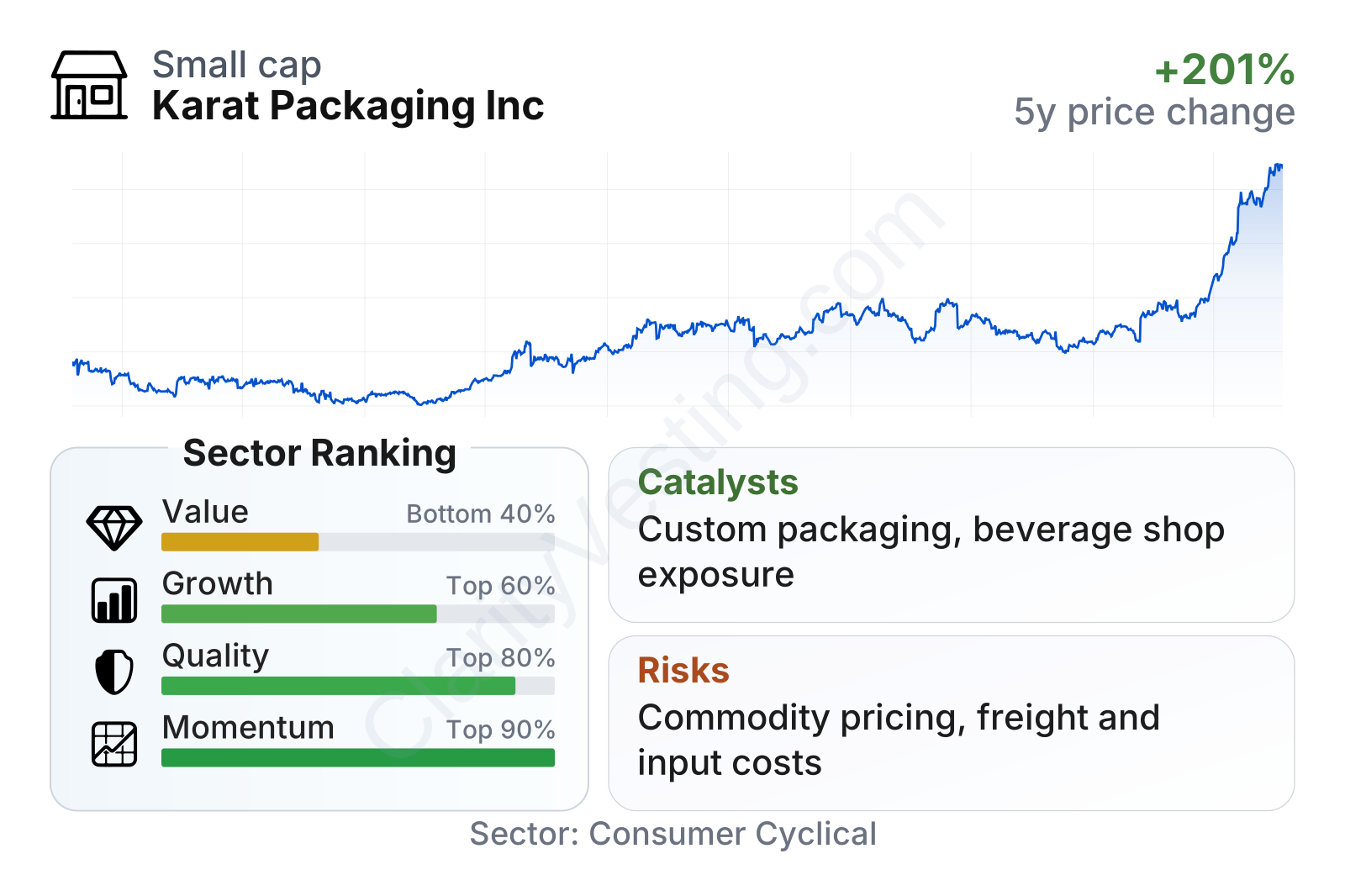
Karat currently sits in a mixed position on valuation, but a strong position on business quality, balance sheet strength, and share-price momentum. Growth metrics are generally above the sector median on recent revenue and earnings trends, while profitability and debt measures look notably better than many peers. The weak point is that the stock is no longer obviously cheap on common valuation ratios, especially after a strong run in the share price.
The stock chart shows a clear shift from a weak period in 2022 and early 2023 to a much stronger re-rating from mid-2023 onward. That suggests the market has increasingly rewarded the company for improved execution, steadier margins, and renewed sales growth.
Growth
Karat operates in a part of the market that benefits from several long-term consumer habits: takeout, delivery, specialty beverages, convenience dining, and independent foodservice expansion. This is not a hypergrowth technology market, but it is a durable and active end market with recurring demand. As long as restaurants and beverage chains continue serving drinks and prepared food in portable formats, demand for disposable packaging remains supported.
The company’s strategy appears sensible for future growth because it combines breadth of product assortment, direct relationships with foodservice operators, and a push into customized products. A customer that already buys basic cups and containers may also order branded packaging and adjacent supplies, which can deepen relationships and raise order value without changing the customer base entirely.
Recent revenue trends are encouraging. After a soft patch in 2023, year-over-year growth turned positive again and then accelerated into the low-double-digit range by late 2025 and the first half of 2026. That matters because it suggests the company is not only recovering from uneven demand conditions but also gaining traction fast enough to outpace the sector median.
Cash generation has also improved materially compared with earlier periods. Free cash flow turned positive after a negative reading in 2022 and has remained positive overall, although the level has moved around from period to period. For a distribution-heavy business, positive cash generation is important because it supports inventory investment, dividends, and flexibility for expansion without forcing the company to depend heavily on outside financing.
One meaningful catalyst is the company’s exposure to beverage shops and takeout-focused foodservice operators, where order frequency can be high and customized packaging can create stickier customer relationships. Another is operational scale: as volume rises, sourcing and logistics can become more efficient, which may help margins. The company has also highlighted new product development and cross-selling opportunities in its public communications, which fit well with its existing customer base rather than requiring a major shift in business model.
Recent corporate updates have generally pointed to continued sales expansion, product breadth, and customer demand resilience rather than a major one-off event. For long-term analysis, that is often more valuable than a headline-driven catalyst because it suggests growth is being built through operating execution.
Risks
This article is for informational purposes only and does not constitute financial advice. Some content is AI-generated. See Disclaimer


