Stock Analysis · Korsana Biosciences Inc (KRSA)
Overview
Korsana Biosciences Inc operates in biotechnology, a part of the healthcare sector focused on developing and commercializing therapies, platforms, and related medical innovations. Based on its financial profile, Korsana appears to be a small-cap biotech company still in a transition phase: revenue exists, but it remains limited, profitability is not yet established, and operating results depend heavily on how efficiently the company advances its programs and commercial efforts.
The business currently looks concentrated, with only a small revenue base and continued spending on operations. Public financial disclosures indicate that revenue has been modest in recent years, which usually means the company is either early in commercialization, relying on a narrow set of products or agreements, or still building scale.
Because detailed segment disclosure is not available in the information reviewed here, the clearest conclusion is that Korsana’s revenue stream is currently narrow rather than diversified. That matters for long-term analysis, because a biotech company with limited revenue sources is more exposed to execution setbacks than a broader pharmaceutical business.
- Product or collaboration-related revenue: likely the main source, representing the large majority of total revenue, based on the company’s small overall sales base.
- Other revenue: appears limited or immaterial in the recent financial profile available.
The broad financial flow shows a business that has significantly reduced operating expenses from the much higher levels seen several years ago, but it has not yet turned that cost reset into durable profitability. Revenue recovered from very low levels in 2024 and 2025, yet earnings remained negative.
Key Figures
| Metric | Value | Sector ⓘ |
|---|---|---|
| Date | Oct 17, 2026 | |
| Context | ||
| Sector | Healthcare | |
| Industry | Biotechnology | |
| Market Cap ⓘ | $1.56B | |
| Beta ⓘ | 1.73 | |
Value (Cheapness) | ||
| P/E Ratio ⓘ | N/A | 24.79 |
| P/B Ratio ⓘ | 4.02 | 3.08 |
| FCF Yield ⓘ | -0.28% | 3.15% |
| Dividend Yield ⓘ | N/A | 1.94% |
| EBIT / EV ⓘ | N/A | 0.57% |
| PEG ⓘ | N/A | |
Growth (Business expansion) | ||
| Revenue Growth ⓘ | N/A | 7.45% |
| RPS Growth (5Y CAGR) ⓘ | -15.70% | 8.61% |
| EPS Growth (5Y CAGR) ⓘ | -53.30% | -17.81% |
| BVPS Growth (5Y CAGR) ⓘ | -41.86% | 3.72% |
| Margin Growth (5Y Trend) ⓘ | N/A | -0.62% |
| FCF Growth (5Y CAGR) ⓘ | -45.12% | 1.04% |
| DPS Growth (5Y CAGR) ⓘ | N/A | 6.77% |
Quality (Business durability) | ||
| ROIC (Latest) ⓘ | N/A | 3.24% |
| ROA (Latest) ⓘ | -77.34% | 3.01% |
| ROIC (5Y Median) ⓘ | N/A | 4.60% |
| ROA (5Y Median) ⓘ | -36.07% | 1.89% |
| Net Debt / EBIT (Latest) ⓘ | N/A | 1.34 |
| Net Debt / EBIT (5Y Median) ⓘ | N/A | 1.84 |
| Net Debt / EBITDA (Latest) ⓘ | N/A | 1.00 |
| Net Debt / Assets ⓘ | -20.07% | 5.45% |
| EBITDA / Interest ⓘ | N/A | 9.64 |
| Operating Margin (Latest) ⓘ | N/A | 9.27% |
| Operating Margin (5Y Median) ⓘ | -1716.99% | 7.38% |
| Debt to Equity (Latest) ⓘ | N/A | 28.58% |
| Profit Margin (Latest) ⓘ | N/A | 3.59% |
| Free Cash Flow (Latest) ⓘ | -$4.45M | |
Momentum (Price trend) | ||
| 3Y Return ⓘ | +41.39% | +42.80% |
| 12M Return (excl. last month) ⓘ | +94.19% | +18.50% |
| 6M Return ⓘ | +58.65% | +7.57% |
| Price vs. 200-Day MA ⓘ | +61.54% | +5.12% |
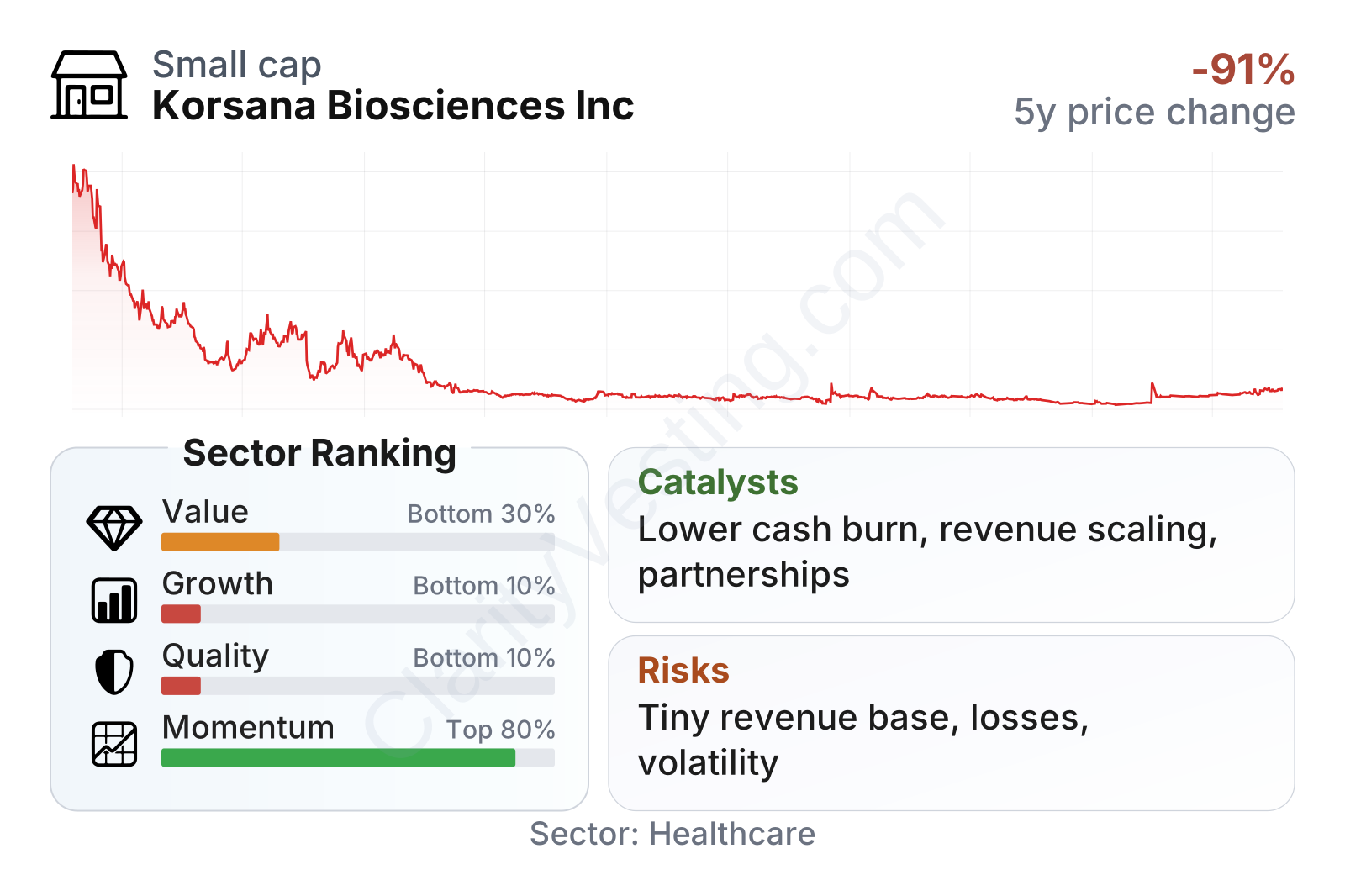
Korsana is a relatively small biotechnology company with a market value around the lower end of the public healthcare universe and a high beta, which points to above-average share price volatility. The stock’s recent momentum has been strong versus much of the sector, but the underlying fundamental profile remains weak. Growth and quality metrics rank near the bottom of the healthcare peer group, while value metrics also screen poorly because the company is not consistently profitable and still generates negative free cash flow. In short, market performance has improved much faster than operating fundamentals.
Growth
Biotechnology remains a structurally attractive sector over the long run because demand for new therapies, diagnostics, and specialized medical technologies continues to rise with aging populations, unmet medical needs, and ongoing scientific progress. That said, being in a promising sector is not enough on its own. For Korsana, the key question is whether the company can convert its platform, products, or development work into a larger and more stable revenue base.
Recent revenue patterns suggest an uneven path rather than a smooth expansion. There have been periods of sharp year-over-year improvement, but they came off a very small base and were followed by renewed declines. That kind of volatility is common in small biotech and life sciences businesses where milestone payments, customer timing, regulatory steps, or product rollout phases can heavily influence reported sales.
One constructive sign is that cash burn has improved meaningfully from the much deeper outflows recorded a few years ago. Free cash flow remains negative, but the business is consuming far less cash than before. For a company at this stage, that can matter as much as revenue growth, because extending financial runway gives management more time to execute without immediate dependence on new capital.
The main growth catalyst is likely tied to successful commercialization progress, product expansion, or new partnerships that can turn today’s modest revenue base into something more scalable. In small biotech companies, even one meaningful contract, licensing agreement, reimbursement improvement, or regulatory milestone can materially change the revenue outlook because the starting base is so low.
A second catalyst is operational leverage. Korsana has already brought expenses down substantially compared with earlier years. If revenue grows while the cost structure stays relatively controlled, the path toward breakeven could become much shorter than the historical losses alone would suggest.
The recent share price rebound indicates that the market may be anticipating better execution, better business visibility, or a company-specific development. Still, for long-term analysis, the more important point is not the stock’s recent strength but whether that strength becomes supported by repeatable commercial progress.
Risks
This article is for informational purposes only and does not constitute financial advice. Some content is AI-generated. See Disclaimer


