Stock Analysis · Kimbell Royalty Partners LP (KRP)
Overview
Kimbell Royalty Partners LP is an energy royalty company. Instead of operating drilling rigs itself, it owns mineral and royalty interests tied to oil and natural gas properties across many U.S. basins. When other operators drill and produce on those lands, Kimbell receives a share of the revenue. This makes it different from a traditional exploration and production company: it has broad exposure to commodity production with much lower direct operating responsibility.
The business is built around collecting royalty income from a very large portfolio of acreage and working with many third-party operators. That model can be attractive because capital spending needs are generally lighter than for producers that must fund drilling programs themselves. At the same time, cash generation still depends heavily on oil and gas prices, production volumes, and the pace of development by those operators.
Kimbell’s revenue mainly comes from the sale proceeds linked to oil, natural gas, and natural gas liquids produced on its acreage. Public filings indicate a diversified commodity mix, though the exact weighting moves with pricing and production. In practical terms, the main revenue streams can be described as follows:
- Oil royalties — typically the largest source, often around 45% to 55% of revenue, depending on commodity prices and basin mix.
- Natural gas royalties — generally around 25% to 35%, with exposure shaped by gas-heavy properties and market prices.
- Natural gas liquids royalties — usually around 15% to 25%, coming from liquids such as propane, butane, and related products.
- Other income — a small remainder from lease-related and miscellaneous items, usually a low-single share of total revenue when disclosed.
Kimbell’s portfolio is also diversified by geography and operator count, which reduces dependence on any single field or producer. That diversification is one of the main reasons the partnership stands out within the royalty space.
The multi-year earnings flow shows a business that can expand revenue sharply when commodity markets and acquisition activity are favorable, but with noticeable swings in net income after interest expense and non-cash items. Gross profit has remained substantial relative to revenue, which fits the royalty model, yet bottom-line results have been more uneven than top-line growth.
Key Figures
| Metric | Value | Sector ⓘ |
|---|---|---|
| Date | Oct 03, 2026 | |
| Context | ||
| Sector | Energy | |
| Industry | Oil & Gas E&P | |
| Market Cap ⓘ | $1.84B | |
| Beta ⓘ | 0.29 | |
Value (Cheapness) | ||
| P/E Ratio ⓘ | 16.82 | 14.47 |
| P/B Ratio ⓘ | 2.65 | 1.70 |
| FCF Yield ⓘ | 12.90% | 8.66% |
| Dividend Yield ⓘ | 11.07% | 3.77% |
| EBIT / EV ⓘ | 6.38% | 7.46% |
| PEG ⓘ | 2.29 | |
Growth (Business expansion) | ||
| Revenue Growth ⓘ | 37.80% | 27.35% |
| RPS Growth (5Y CAGR) ⓘ | -1.53% | 6.75% |
| EPS Growth (5Y CAGR) ⓘ | -24.63% | -15.45% |
| BVPS Growth (5Y CAGR) ⓘ | -1.87% | 5.85% |
| Margin Growth (5Y Trend) ⓘ | 10.81% | 0.75% |
| FCF Growth (5Y CAGR) ⓘ | 62.35% | 3.62% |
| DPS Growth (5Y CAGR) ⓘ | 7.03% | 16.85% |
Quality (Business durability) | ||
| ROIC (Latest) ⓘ | 10.64% | 11.33% |
| ROA (Latest) ⓘ | 6.91% | 6.03% |
| ROIC (5Y Median) ⓘ | 10.19% | 10.16% |
| ROA (5Y Median) ⓘ | 5.81% | 5.34% |
| Net Debt / EBIT (Latest) ⓘ | 3.63 | 1.62 |
| Net Debt / EBIT (5Y Median) ⓘ | 3.06 | 1.91 |
| Net Debt / EBITDA (Latest) ⓘ | 2.07 | 1.06 |
| Net Debt / Assets ⓘ | 33.05% | 17.29% |
| EBITDA / Interest ⓘ | 5.97 | 9.64 |
| Operating Margin (Latest) ⓘ | 32.77% | 16.32% |
| Operating Margin (5Y Median) ⓘ | 39.79% | 19.53% |
| Debt to Equity (Latest) ⓘ | 65.75% | 54.41% |
| Profit Margin (Latest) ⓘ | 25.85% | 8.79% |
| Free Cash Flow (Latest) ⓘ | $237.12M | |
Momentum (Price trend) | ||
| 3Y Return ⓘ | +25.83% | +62.93% |
| 12M Return (excl. last month) ⓘ | +19.43% | +44.83% |
| 6M Return ⓘ | +4.63% | -1.62% |
| Price vs. 200-Day MA ⓘ | +4.68% | +5.18% |
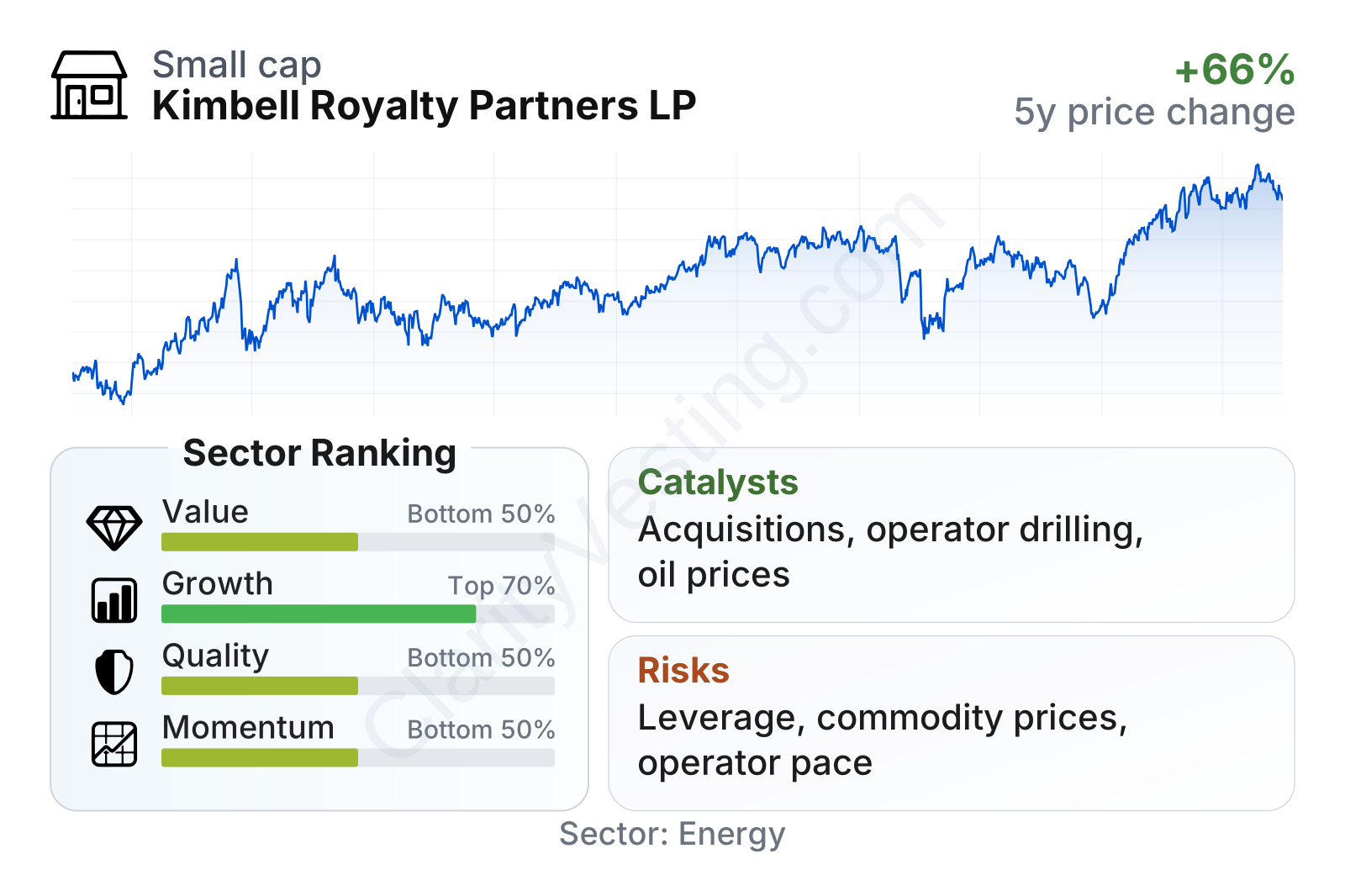
Kimbell is a small-to-mid-sized energy name with an unusually low beta for the sector, which suggests its shares have been less volatile than many upstream peers. The broader profile is mixed: growth metrics are relatively solid versus the sector, cash flow yield and distribution yield stand out, while valuation is not especially cheap on earnings or book value, and balance-sheet metrics are weaker than many peers.
Growth
Kimbell operates in a sector that still matters for long-term energy supply, especially in North America, where shale production remains a major source of oil and gas. That said, this is not a classic structural high-growth industry. Long-term growth depends less on rising end-market demand alone and more on disciplined acquisitions, high-quality acreage, operator activity, and commodity price support.
The partnership’s strategy is logical for its niche. It seeks to build scale by acquiring mineral and royalty interests across prolific basins while keeping direct operating exposure low. If management continues adding acreage tied to active operators and productive regions, Kimbell can grow production-linked income without taking on the full cost burden of drilling wells itself. This can be a powerful model when acquisition prices are reasonable and the underlying lands continue to attract development capital.
Revenue growth has been uneven, which is normal for a royalty business exposed to commodity prices, but the more recent pattern shows that growth can reaccelerate quickly after softer periods. The latest year-over-year pace is comfortably above the sector median, showing that Kimbell is still capable of expanding faster than many energy peers when conditions line up.
Free cash flow has also been volatile, including a sharp dip in one period and a strong rebound afterward. That rebound matters because it indicates the business can convert its royalty income into meaningful cash when commodity realizations and portfolio performance improve. Over a longer stretch, Kimbell’s free cash flow growth has been much stronger than the sector median, which supports the idea that the acquisition-driven model can work.
A practical catalyst is continued consolidation in U.S. minerals and royalties. Kimbell has used acquisitions to broaden its footprint, and a fragmented ownership landscape still creates room for further deals. Another important catalyst is operator development activity on Kimbell’s acreage: if major producers keep drilling in its core regions, royalty volumes can rise without Kimbell having to fund that drilling directly. Higher oil and natural gas prices would also flow through quickly to revenue and distributable cash generation.
Recent company communications have continued to emphasize portfolio scale, basin diversification, and exposure to active operators. Those are not short-term guarantees, but they do support the case that Kimbell remains positioned to benefit if upstream spending stays healthy in the basins where it owns interests.
Risks
This article is for informational purposes only and does not constitute financial advice. Some content is AI-generated. See Disclaimer