Stock Analysis · Kroger Company (KR)
Overview
Kroger is one of the largest food retailers in the United States. It operates supermarkets, multi-department stores, marketplace formats, pharmacies, fuel centers, and digital grocery services. Its store network includes well-known banners such as Kroger, Ralphs, Fred Meyer, King Soopers, Fry’s, Harris Teeter, Smith’s, Dillons, Mariano’s, and several regional chains. In practical terms, Kroger makes money by selling everyday essentials: food, household products, health and wellness items, and fuel. It also earns income from pharmacy services, alternative profit businesses such as retail media and data-related services, and private-label products sold under company-owned brands.
The business is still overwhelmingly driven by retail sales inside stores and through online grocery fulfillment. Based on company reporting and recent annual disclosures, the revenue mix is approximately as follows:
- Food and consumables retail sales: about 85% to 90% — fresh foods, packaged groceries, dairy, frozen products, beverages, cleaning products, beauty, and other daily essentials sold across stores and digital channels.
- Fuel sales: about 8% to 12% — gasoline sold at Kroger fuel centers. This category can move meaningfully with fuel prices even when gallons sold are steady.
- Pharmacy, health, and other general merchandise: about 3% to 6% — prescriptions, over-the-counter health products, home goods, seasonal items, and related categories.
- Alternative profit streams: likely below 3% — this includes retail media, data and loyalty monetization, and some financial or service-related income. The percentage is small in revenue terms, but these activities tend to carry higher margins than grocery sales.
Kroger’s model is built around large sales volume and very thin margins. That is normal in grocery retail. The company’s advantage is not high markups, but scale, purchasing power, private-label penetration, a large loyalty program, and the ability to combine stores, pharmacies, fuel, and digital ordering into a broad local ecosystem.
Kroger’s recent financial flow shows a business with stable revenue near $148 billion, gradually improving gross profit over several years, but a sharp drop in operating income and net income in the latest reported annual period. That combination matters: sales remain resilient, but profitability has become more pressured.
Key Figures
| Metric | Value | Sector ⓘ |
|---|---|---|
| Date | Oct 03, 2026 | |
| Context | ||
| Sector | Consumer Defensive | |
| Industry | Grocery Stores | |
| Market Cap ⓘ | $35.25B | |
| Beta ⓘ | 0.41 | |
Value (Cheapness) | ||
| P/E Ratio ⓘ | 31.75 | 18.16 |
| P/B Ratio ⓘ | 6.33 | 1.27 |
| FCF Yield ⓘ | 6.44% | 12.39% |
| Dividend Yield ⓘ | 2.45% | 2.83% |
| EBIT / EV ⓘ | 3.58% | 6.45% |
| PEG ⓘ | 0.57 | |
Growth (Business expansion) | ||
| Revenue Growth ⓘ | 2.00% | 3.80% |
| RPS Growth (5Y CAGR) ⓘ | 5.37% | 6.20% |
| EPS Growth (5Y CAGR) ⓘ | -12.27% | -14.64% |
| BVPS Growth (5Y CAGR) ⓘ | -7.86% | 3.26% |
| Margin Growth (5Y Trend) ⓘ | -0.66% | -0.25% |
| FCF Growth (5Y CAGR) ⓘ | -1.62% | 4.65% |
| DPS Growth (5Y CAGR) ⓘ | 14.68% | 6.86% |
Quality (Business durability) | ||
| ROIC (Latest) ⓘ | 6.92% | 12.58% |
| ROA (Latest) ⓘ | 2.15% | 6.35% |
| ROIC (5Y Median) ⓘ | 12.63% | 10.36% |
| ROA (5Y Median) ⓘ | 4.32% | 5.44% |
| Net Debt / EBIT (Latest) ⓘ | 11.96 | 1.91 |
| Net Debt / EBIT (5Y Median) ⓘ | 5.64 | 2.32 |
| Net Debt / EBITDA (Latest) ⓘ | 4.35 | 1.36 |
| Net Debt / Assets ⓘ | 48.41% | 21.25% |
| EBITDA / Interest ⓘ | 7.75 | 9.61 |
| Operating Margin (Latest) ⓘ | 1.34% | 8.96% |
| Operating Margin (5Y Median) ⓘ | 2.18% | 9.53% |
| Debt to Equity (Latest) ⓘ | 413.24% | 71.66% |
| Profit Margin (Latest) ⓘ | 0.73% | 5.40% |
| Free Cash Flow (Latest) ⓘ | $2.27B | |
Momentum (Price trend) | ||
| 3Y Return ⓘ | +45.25% | +15.25% |
| 12M Return (excl. last month) ⓘ | -12.99% | +2.63% |
| 6M Return ⓘ | -16.54% | +2.43% |
| Price vs. 200-Day MA ⓘ | -3.42% | +0.43% |
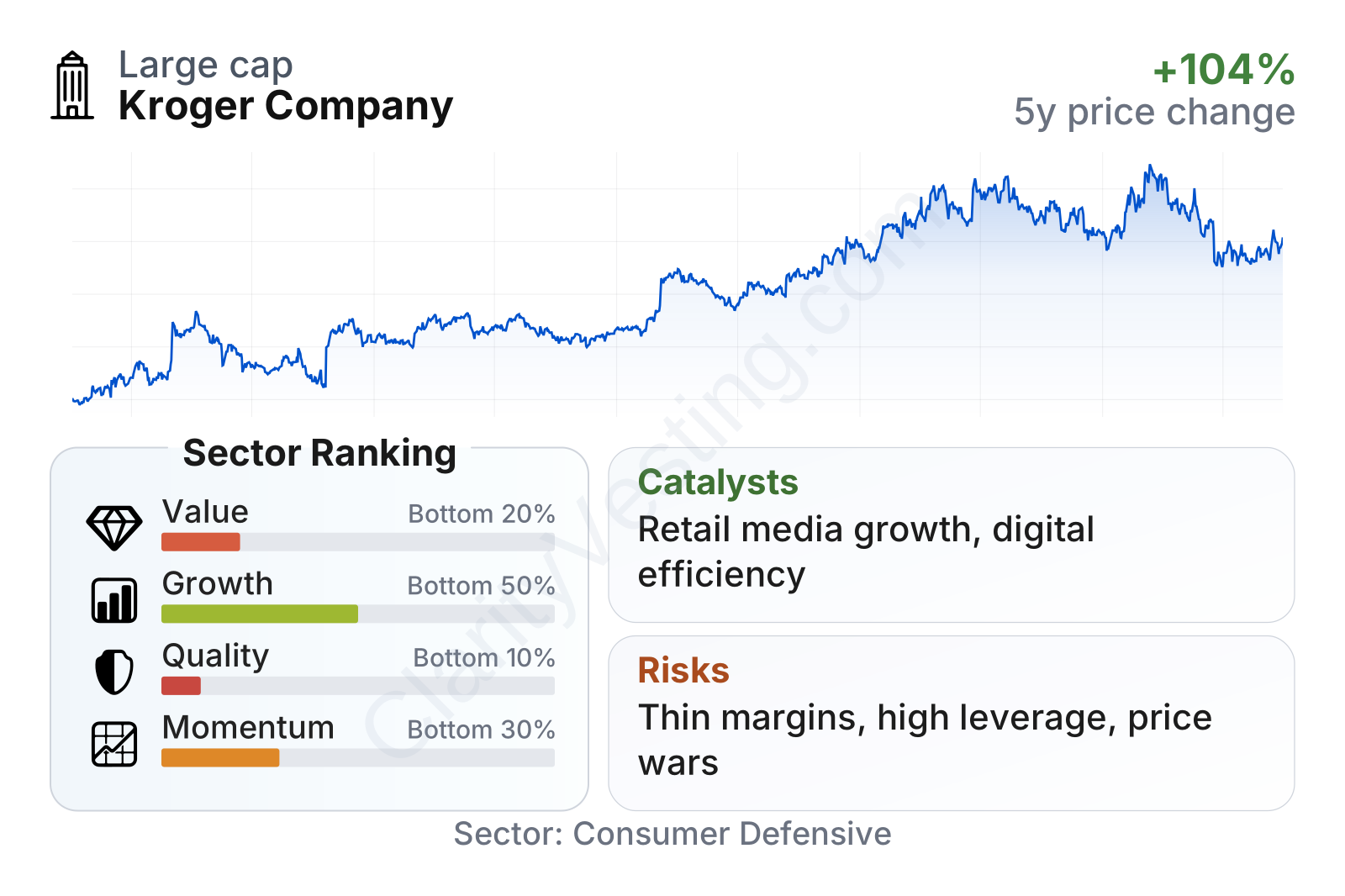
Kroger is a large defensive retailer with relatively low share-price volatility, reflected in a beta well below 1. That fits the nature of grocery demand, which tends to remain steady across economic cycles. At the same time, the latest factor summary is mixed. Value metrics look less attractive than the sector median because the current earnings multiple is elevated and the free cash flow yield and dividend yield are not especially high versus peers. Growth is moderate rather than strong, and quality metrics are held back by heavy leverage and very thin margins. The picture is not one of a fast-growing consumer company; it is one of a mature operator whose appeal depends on execution, resilience, and cash generation.
Growth
The grocery sector is not a high-growth industry, but it is a durable one. People keep buying food in strong and weak economies, which gives Kroger a stable demand base. Over the long run, growth usually comes from market share gains, digital expansion, private-label sales, pharmacy traffic, and higher-margin side businesses rather than from rapid industry expansion.
Kroger’s strategy for future growth is logical for its sector. Management has emphasized price competitiveness, fresh food, customer loyalty, digital fulfillment, automation, and higher-margin alternative profit businesses. This matters because traditional grocery retail on its own has limited margin expansion potential. If Kroger can use its data, delivery network, and private-label portfolio to raise customer retention and basket size, even modest revenue growth can translate into stronger cash generation over time.
Recent revenue growth has cooled sharply from the stronger post-inflation period. The current pace is around 2%, below the sector median. That does not indicate a shrinking franchise, but it does show that Kroger is operating in a mature market where progress is incremental. The more encouraging point is that recent quarterly trends appear to have returned to modest positive growth after a period of uneven comparisons.
Free cash flow has been volatile, which is common in retail because working capital, capital spending, and timing effects can move results from year to year. Even so, Kroger remains capable of producing multi-billion-dollar annual free cash flow. That cash supports dividends, debt service, technology investments, and store upgrades. For a long-term view, the key question is not whether free cash flow is perfectly smooth, but whether the business can keep generating meaningful cash after maintaining its store and logistics base. So far, the answer appears to be yes.
An important catalyst is Kroger’s effort to expand higher-margin revenue streams beyond basic grocery sales. Its retail media and loyalty ecosystem can become more valuable as advertisers look for measurable in-store and online consumer reach. Private-label brands are another useful lever because they can improve margins while also supporting customer value perception. In addition, pharmacy and health services can increase store traffic and deepen customer relationships.
Recent company updates have also kept attention on digital operations, e-commerce fulfillment efficiency, and store investments. These are not transformative overnight opportunities, but in a mature industry they are meaningful because small improvements in operating efficiency can have a noticeable effect on earnings.
Risks
This article is for informational purposes only and does not constitute financial advice. Some content is AI-generated. See Disclaimer