Stock Analysis · Keppel DC REIT (KPDCF)
Overview
Keppel DC REIT is a Singapore-listed real estate investment trust focused on data centers. In simple terms, it owns specialized buildings that store servers, networking equipment, and digital infrastructure used by cloud providers, telecom companies, enterprises, and IT service operators. Its portfolio spans Asia-Pacific and Europe, giving it exposure to markets where demand for data storage, cloud computing, and artificial intelligence workloads has been rising.
The trust makes most of its money from rental income generated by leasing space in data centers. Depending on the asset and lease structure, tenants may rent entire facilities, specific halls, or technical space with long-term contracts. Some leases also include built-in rent escalations, while certain arrangements can pass part of utilities or operating costs to tenants.
Based on portfolio disclosures in recent annual reporting, revenue is primarily supported by geography rather than many different business lines, because the REIT is largely a pure-play data center landlord. Approximate exposure by property value and portfolio contribution indicates the largest sources are:
- Asia-Pacific data centers: approximately 70% to 75% of portfolio value. This includes assets in Singapore, China, Malaysia, and other regional markets, generally serving colocation, enterprise, and hyperscale demand.
- European data centers: approximately 25% to 30% of portfolio value. These assets add diversification and exposure to developed connectivity markets.
At the property level, the trust’s income is also concentrated in a relatively small number of large data center assets and major tenants, which is common for infrastructure-focused REITs. That concentration can support stable occupancy and longer lease terms, but it also means individual tenant or asset events can have an outsized effect on results.
The business model is straightforward: raise capital, buy or develop data center properties, lease them out, collect rent, and distribute a large share of recurring cash flow to unitholders. This structure makes the trust more dependent on occupancy, financing costs, asset valuations, and acquisition discipline than on product innovation.
The financial flow over the last several years shows a business with high property-level profitability and relatively low administrative costs, which is typical for a landlord model. Revenue and gross profit have trended upward overall, while interest expense rose sharply in 2023 before easing in 2024 and 2025. That pattern matters because financing costs are one of the biggest moving parts for a REIT.
Key Figures
| Metric | Value | Sector ⓘ |
|---|---|---|
| Date | Oct 17, 2026 | |
| Context | ||
| Sector | Real Estate | |
| Industry | REIT - Office | |
| Market Cap ⓘ | $4.56B | |
| Beta ⓘ | 0.85 | |
Value (Cheapness) | ||
| P/E Ratio ⓘ | 11.86 | 17.38 |
| P/B Ratio ⓘ | 0.99 | 0.85 |
| FCF Yield ⓘ | N/A | 7.38% |
| Dividend Yield ⓘ | 6.63% | 4.85% |
| EBIT / EV ⓘ | 3.46% | 3.78% |
| PEG ⓘ | 1.40 | |
Growth (Business expansion) | ||
| Revenue Growth ⓘ | 14.60% | 5.30% |
| RPS Growth (5Y CAGR) ⓘ | 3.43% | 6.02% |
| EPS Growth (5Y CAGR) ⓘ | 26.51% | -11.37% |
| BVPS Growth (5Y CAGR) ⓘ | 5.83% | 0.45% |
| Margin Growth (5Y Trend) ⓘ | 38.68% | -0.22% |
| FCF Growth (5Y CAGR) ⓘ | 18.40% | 5.40% |
| DPS Growth (5Y CAGR) ⓘ | -5.78% | 5.02% |
Quality (Business durability) | ||
| ROIC (Latest) ⓘ | N/A | 5.69% |
| ROE (Latest) ⓘ | N/A | 7.56% |
| ROA (Latest) ⓘ | N/A | 2.85% |
| ROIC (5Y Median) ⓘ | 7.03% | 4.22% |
| ROE (5Y Median) ⓘ | 10.58% | 6.03% |
| ROA (5Y Median) ⓘ | 6.30% | 2.44% |
| Net Debt / EBIT (Latest) ⓘ | N/A | 7.59 |
| Net Debt / EBIT (5Y Median) ⓘ | 4.09 | 8.40 |
| Net Debt / EBITDA (Latest) ⓘ | N/A | 5.27 |
| Net Debt / Assets ⓘ | 29.31% | 37.76% |
| EBITDA / Interest ⓘ | N/A | 4.10 |
| Operating Margin (Latest) ⓘ | N/A | 35.29% |
| Operating Margin (5Y Median) ⓘ | 106.20% | 37.31% |
| Debt to Equity (Latest) ⓘ | N/A | 88.87% |
| Profit Margin (Latest) ⓘ | 94.16% | 19.61% |
| Free Cash Flow (Latest) ⓘ | N/A | |
Momentum (Price trend) | ||
| 3Y Return ⓘ | +40.12% | +30.75% |
| 12M Return (excl. last month) ⓘ | -6.84% | +4.36% |
| 6M Return ⓘ | -2.30% | -2.52% |
| Price vs. 200-Day MA ⓘ | -1.36% | -2.34% |
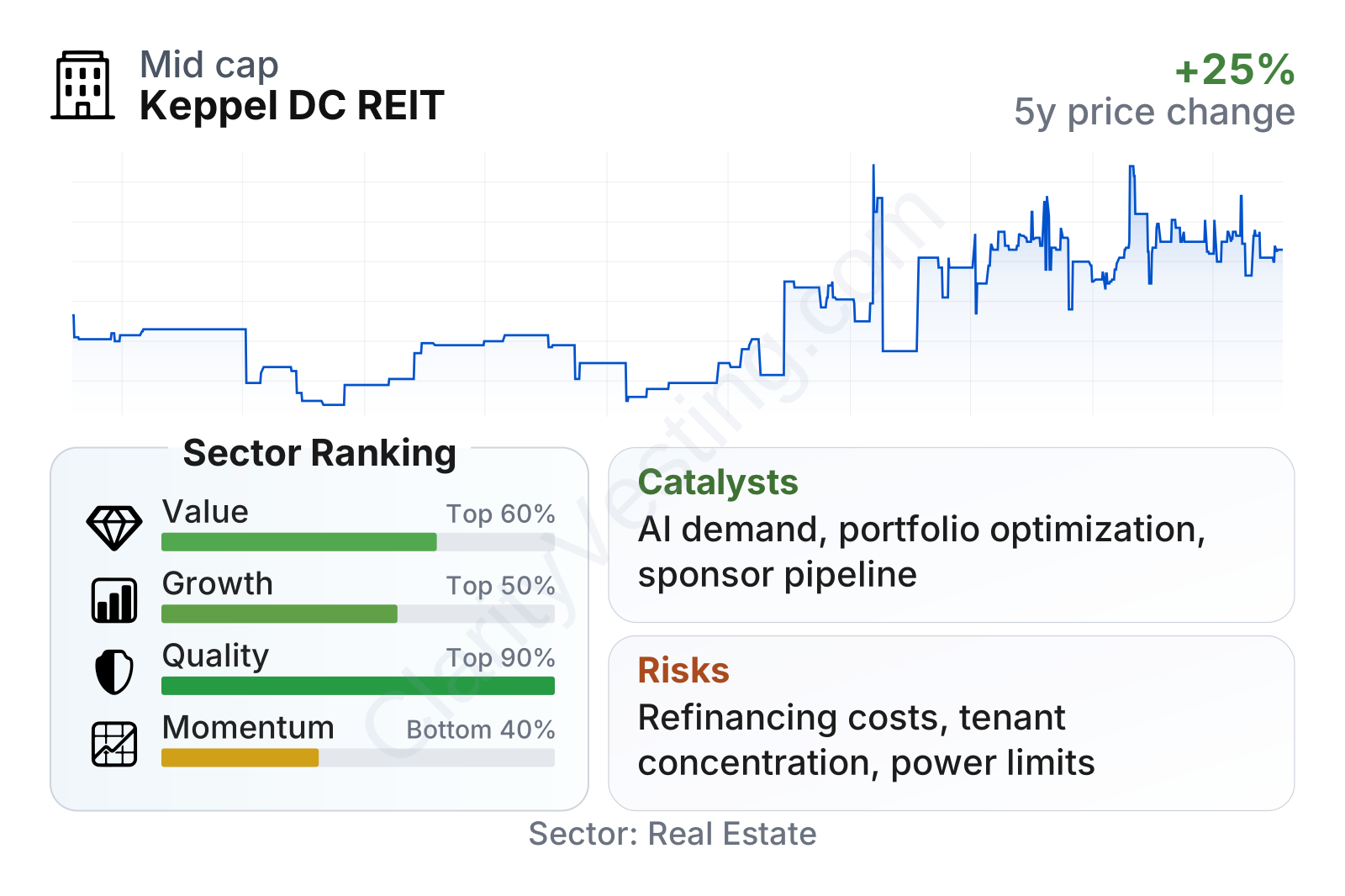
Keppel DC REIT is a mid-sized listed REIT with a market value around the mid-single-digit billions of dollars and a stock beta below 1, suggesting price swings have historically been less aggressive than the broader equity market. On valuation, the earnings multiple is below the sector median, while the price-to-book ratio sits around sector norms. The trailing dividend yield is notably above the sector median at roughly 6.8% versus about 4.7%.
The quality profile stands out more clearly than the value profile. Historical returns on capital, equity, and assets are all comfortably ahead of sector medians, and leverage against assets appears lower than many peers. Profitability also looks unusually strong for a REIT, although part of that can reflect valuation movements and accounting treatment on investment properties, so it should not be read the same way as a normal operating company’s margin.
Growth metrics are mixed but generally constructive. Recent year-over-year revenue growth has been strong relative to the sector, and five-year growth in earnings, book value per share, and free cash flow has been solid. The weaker point is dividend growth, which has been negative over five years, showing that cash distributions have not grown steadily through the cycle. Price momentum has also been softer than many real estate peers over the last year, even though the longer three-year return has held up reasonably well.
Growth
Keppel DC REIT operates in a part of real estate that benefits from long-term digitalization. Data creation, cloud migration, enterprise outsourcing, streaming, mobile traffic, and AI-related computing all require more server capacity and connectivity. That does not mean every data center owner will grow at the same pace, but it does mean the trust is positioned in a structurally stronger niche than traditional office or retail landlords.
Its strategy also makes industrial sense. Rather than owning generic commercial buildings, the trust focuses on mission-critical assets that are harder to replace and often deeply embedded in customers’ operations. Once equipment is installed in a data center, moving it can be disruptive and costly, which can support retention and pricing power when facilities are well located and technically suitable.
Revenue per share has not moved in a straight line, but the broader picture is still positive. After modest gains, there was a dip in 2024 followed by a rebound to a new high in 2025. For long-term analysis, that suggests growth has come with some capital market and portfolio reshuffling effects rather than through a perfectly smooth operating trend.
One of the clearest catalysts is continued demand for high-quality capacity in major data center hubs. Facilities linked to cloud platforms, connectivity ecosystems, and AI workloads can attract premium demand, especially where power availability is limited. In that environment, existing owners of operational assets may benefit from stronger utilization, redevelopment opportunities, and acquisitions that are difficult for new entrants to replicate quickly.
Another important support is the trust’s access to a wider sponsor ecosystem. Keppel has longstanding infrastructure and real estate capabilities, which can help with sourcing transactions, structuring developments, and managing specialized assets. For a data center REIT, this matters because technical execution, power access, and customer relationships can be barriers to entry.
Dividend per share has been more uneven than revenue. The distribution declined from 2021 to 2022, recovered in 2023, dropped again in 2024, and improved in 2025 without yet returning to the earlier peak. This pattern reflects why REIT growth needs to be judged on several layers at once: property income may grow, but financing costs, asset sales, acquisitions, and capital raising can all influence what eventually reaches unitholders.
Recent corporate updates have continued to emphasize portfolio optimization, selective acquisitions, and active capital management. Those themes point to a trust that is trying to balance growth with funding discipline rather than chasing scale at any cost. In a sector where interest rates still matter, that is a meaningful distinction.
Risks
This article is for informational purposes only and does not constitute financial advice. Some content is AI-generated. See Disclaimer


