Stock Analysis · The Coca-Cola Company (KO)
Overview
The Coca-Cola Company is one of the largest beverage companies in the world. It owns, markets, and helps distribute a very broad portfolio of brands across sparkling soft drinks, water, sports drinks, juice, dairy, plant-based beverages, tea, coffee, and energy drinks. Its business model is more focused on concentrates, syrups, brand ownership, and marketing than on directly bottling every drink itself. In practice, Coca-Cola works through a global system of company-owned and independent bottling partners that manufacture, package, and deliver finished beverages to stores, restaurants, vending machines, and other channels.
Revenue mainly comes from selling concentrates and syrups to bottling partners, as well as from finished products sold directly in some markets. Based on the company’s recent annual reporting, the brand mix remains heavily centered on sparkling soft drinks, but the portfolio is broader than many casual consumers assume.
- Sparkling soft drinks: approximately 62% of concentrate sales volume. This includes Coca-Cola, Sprite, Fanta, and other carbonated brands.
- Water, sports, coffee and tea: approximately 24%. This includes brands such as Dasani, smartwater, Powerade, Costa, Georgia, and tea-related offerings.
- Juice, value-added dairy and plant-based beverages: approximately 11%. This includes juice brands and selected dairy or plant-based products in relevant markets.
- Other beverage categories: approximately 3%. This captures smaller product lines and emerging categories.
Geographically, Coca-Cola is highly diversified, with business spread across North America, EMEA, Latin America, Asia Pacific, and its bottling investments segment. That global reach helps reduce dependence on any single country, although North America remains the largest profit contributor. One notable feature of the model is that it tends to produce high margins because concentrates and brand licensing are more profitable than heavy manufacturing.
The long-term picture is of a very large, mature consumer staples company with exceptional brand recognition, broad distribution, and a business structure designed to convert a meaningful share of revenue into operating profit and cash flow.
Over the last several years, revenue and gross profit have trended upward while costs have grown more slowly than sales. That points to a business that has been able to protect pricing and expand profitability, even as interest expense and taxes still take a visible share below operating income.
Key Figures
| Metric | Value | Sector ⓘ |
|---|---|---|
| Date | Oct 17, 2026 | |
| Context | ||
| Sector | Consumer Defensive | |
| Industry | Beverages - Non-Alcoholic | |
| Market Cap ⓘ | $386.33B | |
| Beta ⓘ | 0.32 | |
Value (Cheapness) | ||
| P/E Ratio ⓘ | 26.96 | 17.88 |
| P/B Ratio ⓘ | 11.44 | 1.29 |
| FCF Yield ⓘ | 3.70% | 12.39% |
| Dividend Yield ⓘ | 2.36% | 2.85% |
| EBIT / EV ⓘ | 4.63% | 6.43% |
| PEG ⓘ | 4.03 | |
Growth (Business expansion) | ||
| Revenue Growth ⓘ | 6.70% | 4.10% |
| RPS Growth (5Y CAGR) ⓘ | 5.69% | 6.18% |
| EPS Growth (5Y CAGR) ⓘ | -7.79% | -13.59% |
| BVPS Growth (5Y CAGR) ⓘ | 9.38% | 3.20% |
| Margin Growth (5Y Trend) ⓘ | 0.55% | -0.15% |
| FCF Growth (5Y CAGR) ⓘ | -17.18% | 4.10% |
| DPS Growth (5Y CAGR) ⓘ | 5.06% | 6.79% |
Quality (Business durability) | ||
| ROIC (Latest) ⓘ | 20.04% | 12.34% |
| ROA (Latest) ⓘ | 13.38% | 6.30% |
| ROIC (5Y Median) ⓘ | 17.46% | 10.49% |
| ROA (5Y Median) ⓘ | 10.76% | 5.44% |
| Net Debt / EBIT (Latest) ⓘ | 1.63 | 1.96 |
| Net Debt / EBIT (5Y Median) ⓘ | 2.37 | 2.35 |
| Net Debt / EBITDA (Latest) ⓘ | 1.54 | 1.38 |
| Net Debt / Assets ⓘ | 28.39% | 21.51% |
| EBITDA / Interest ⓘ | 12.66 | 9.46 |
| Operating Margin (Latest) ⓘ | 37.50% | 8.87% |
| Operating Margin (5Y Median) ⓘ | 31.65% | 9.53% |
| Debt to Equity (Latest) ⓘ | 120.45% | 72.35% |
| Profit Margin (Latest) ⓘ | 28.56% | 5.40% |
| Free Cash Flow (Latest) ⓘ | $14.30B | |
Momentum (Price trend) | ||
| 3Y Return ⓘ | +85.73% | +20.92% |
| 12M Return (excl. last month) ⓘ | +35.49% | +2.13% |
| 6M Return ⓘ | +19.40% | +1.26% |
| Price vs. 200-Day MA ⓘ | +12.94% | +1.39% |
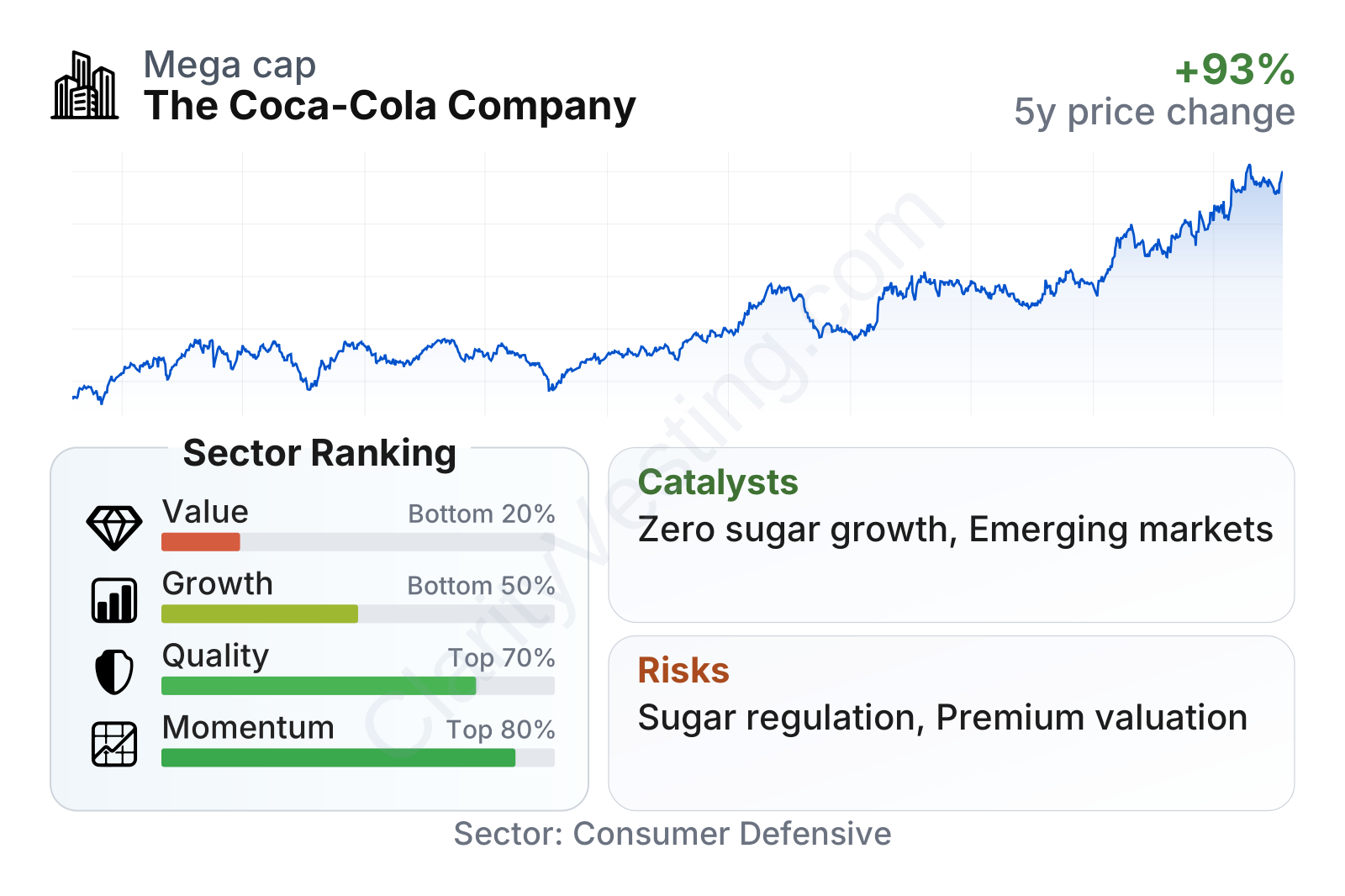
Coca-Cola stands out for size, stability, and profitability rather than cheapness. The company ranks strongly on quality and market performance, with returns on capital and margins well above typical sector levels. Growth is more mixed: recent sales growth has been solid, but longer-term free cash flow growth has been uneven. On valuation measures, the shares trade at a clear premium to the sector, which means the market is placing a high value on resilience, brand strength, and dependable earnings.
The stock’s low beta also reflects its defensive profile. In simpler terms, Coca-Cola has historically moved less than the broader market, which is common for large consumer staples businesses with recurring demand.
Growth
Coca-Cola operates in a sector that is mature in developed markets but still capable of steady long-term expansion. Global non-alcoholic beverages continue to benefit from population growth, urbanization, rising incomes in emerging markets, and premiumization. Growth no longer depends only on selling more traditional soda. It increasingly comes from pricing, package mix, expansion in away-from-home consumption, and newer categories such as sports drinks, energy, coffee, and low- or no-sugar products.
The company’s strategy is logical for this environment. Coca-Cola has spent years reshaping its portfolio toward products with broader consumption occasions and better alignment with changing consumer preferences. That includes zero-sugar variants, smaller package sizes, premium water, ready-to-drink coffee, and improved execution in food service and convenience channels. Its distribution system gives it unusual scale when launching or extending brands globally.
Recent sales momentum has improved again after a softer period. Year-over-year revenue growth moved back into a healthy mid- to high-single-digit range in the latest readings, following some temporary weaker quarters. For a company of Coca-Cola’s size, that is a respectable result and suggests pricing power and steady demand are still working.
Cash generation has been more volatile than revenue growth. Free cash flow recovered sharply after a temporary drop and is now back at a strong level in the low tens of billions of dollars. For a consumer staples company, that matters because it supports brand investment, acquisitions, debt servicing, and dividends without relying too heavily on external financing.
A meaningful catalyst is the company’s continued push into higher-growth subcategories and international markets where per-capita consumption still has room to expand. Another is the strength of its marketing system and bottling relationships, which help it scale successful products quickly. Recent company updates have also highlighted ongoing demand for zero-sugar offerings and solid performance in away-from-home channels, both of which can support mix and pricing over time.
Risks
This article is for informational purposes only and does not constitute financial advice. Some content is AI-generated. See Disclaimer


