Stock Analysis · Kiniksa Pharmaceuticals Ltd (KNSA)
Overview
Kiniksa Pharmaceuticals is a biotechnology company focused on developing and commercializing medicines for diseases driven by immune-system dysfunction, especially conditions involving inflammation. Its business is concentrated in specialty medicines for rare or underserved diseases, with the clearest commercial success coming from Arcalyst, a treatment used in recurrent pericarditis, a painful inflammatory heart condition. The company is smaller than large pharmaceutical groups, but it has already moved beyond the purely experimental stage because it now combines marketed products with a pipeline of newer programs.
Revenue is heavily concentrated in one product today. Based on the latest annual results and company disclosures, the main sources of revenue are approximately:
- Arcalyst product revenue: about 95% to 97% — this is the company’s main commercial engine and reflects net sales of the approved medicine used primarily in recurrent pericarditis.
- Collaboration, license, and other revenue: about 3% to 5% — this can include milestone-related items, partnership-related accounting, and other smaller non-product revenue streams.
This concentration matters. Kiniksa’s current business is essentially a one-product commercial platform funding a broader immunology pipeline. That can be attractive when the lead product is growing quickly, but it also means company performance is strongly tied to one medicine’s demand, reimbursement, and competitive position.
The business model has improved materially over the last several years. Revenue has expanded from a modest base to a much larger commercial level, while operating results have shifted from deep losses toward positive operating income and net income. One notable change is that selling and administrative costs have risen as commercialization scaled, but gross profit has remained strong enough to support improved cash generation.
Key Figures
| Metric | Value | Sector ⓘ |
|---|---|---|
| Date | Oct 24, 2026 | |
| Context | ||
| Sector | Healthcare | |
| Industry | Drug Manufacturers - Specialty & Generic | |
| Market Cap ⓘ | $6.22B | |
| Beta ⓘ | 0.04 | |
Value (Cheapness) | ||
| P/E Ratio ⓘ | 83.89 | 25.42 |
| P/B Ratio ⓘ | 10.30 | 3.08 |
| FCF Yield ⓘ | 2.94% | 3.12% |
| Dividend Yield ⓘ | N/A | 1.85% |
| EBIT / EV ⓘ | 2.04% | 0.56% |
| PEG ⓘ | N/A | |
Growth (Business expansion) | ||
| Revenue Growth ⓘ | 55.40% | 7.50% |
| RPS Growth (5Y CAGR) ⓘ | 97.66% | 8.60% |
| EPS Growth (5Y CAGR) ⓘ | -33.23% | -17.73% |
| BVPS Growth (5Y CAGR) ⓘ | 27.75% | 3.72% |
| Margin Growth (5Y Trend) ⓘ | N/A | -0.57% |
| FCF Growth (5Y CAGR) ⓘ | N/A | 0.96% |
| DPS Growth (5Y CAGR) ⓘ | N/A | 6.69% |
Quality (Business durability) | ||
| ROIC (Latest) ⓘ | 13.11% | 3.17% |
| ROA (Latest) ⓘ | 10.03% | 2.98% |
| ROIC (5Y Median) ⓘ | -3.11% | 4.56% |
| ROA (5Y Median) ⓘ | 2.86% | 1.87% |
| Net Debt / EBIT (Latest) ⓘ | -1.51 | 1.34 |
| Net Debt / EBIT (5Y Median) ⓘ | N/A | 1.86 |
| Net Debt / EBITDA (Latest) ⓘ | -1.49 | 1.00 |
| Net Debt / Assets ⓘ | -18.61% | 5.06% |
| EBITDA / Interest ⓘ | N/A | 9.55 |
| Operating Margin (Latest) ⓘ | 13.12% | 9.25% |
| Operating Margin (5Y Median) ⓘ | -6.16% | 7.33% |
| Debt to Equity (Latest) ⓘ | 1.36% | 26.68% |
| Profit Margin (Latest) ⓘ | 9.59% | 3.34% |
| Free Cash Flow (Latest) ⓘ | $183.10M | |
Momentum (Price trend) | ||
| 3Y Return ⓘ | +429.77% | +51.61% |
| 12M Return (excl. last month) ⓘ | +116.19% | +19.90% |
| 6M Return ⓘ | +87.71% | +10.10% |
| Price vs. 200-Day MA ⓘ | +37.36% | +6.44% |
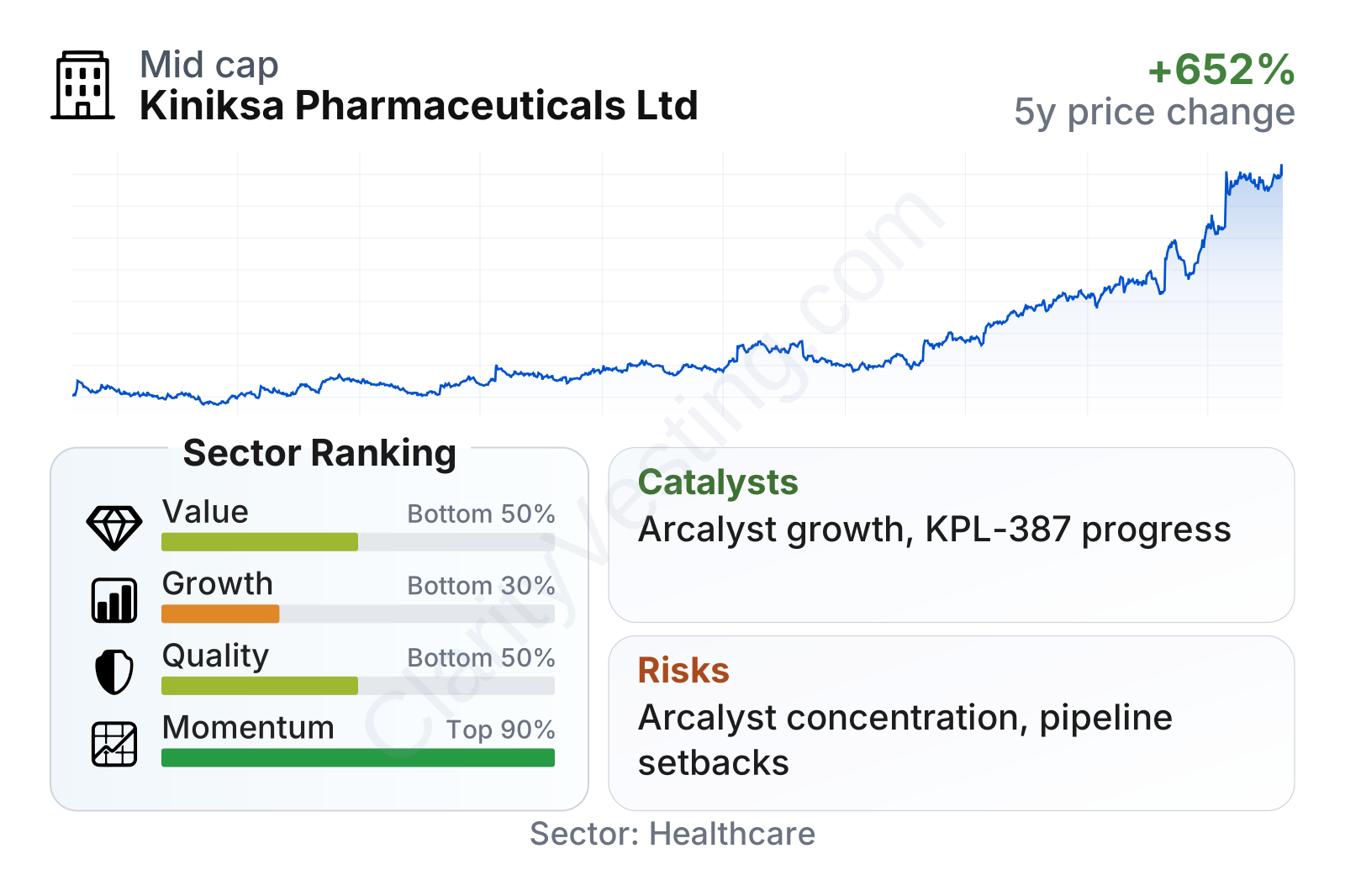
Kiniksa shows a mixed profile. Quality metrics are solid, helped by strong recent returns on capital and a very clean balance sheet. Momentum is unusually strong, reflecting a major re-rating in the stock over the last three years. Growth looks weaker in the summary ranking than the recent revenue trend might suggest, largely because earnings history has been uneven. Valuation stands out as the least comfortable area, with earnings and book-value multiples well above typical healthcare peers.
The share price history reflects a company that spent several years proving its commercial model and then saw a sharp upward move as revenue, profitability, and confidence around the lead franchise improved. That kind of move usually means the market is already recognizing much of the recent operational progress.
Growth
Kiniksa operates in an attractive part of healthcare. Immunology and rare-disease-focused specialty medicines remain active areas for long-term demand because these diseases are often chronic, difficult to treat, and can support premium pricing when clinical benefit is clear. In addition, recurrent pericarditis has historically had limited targeted treatment options, which helps explain the rapid uptake of Arcalyst.
The company’s strategy is straightforward and sensible: maximize the commercial value of Arcalyst while using the cash flow from that franchise to advance pipeline programs. That approach is more disciplined than relying only on external financing, and it gives Kiniksa more flexibility than many biotech peers that are still fully cash-burning.
Revenue growth has remained very strong, staying around the mid-50% range in the most recent periods after earlier bursts of even faster expansion. That is far above the broader sector median and suggests the lead product is still gaining scale rather than plateauing. For a company of this size, sustained growth at that level is one of the strongest arguments behind the current market interest.
Cash generation has also improved sharply. Free cash flow moved from clearly negative territory a few years ago to solidly positive levels more recently, reaching well into nine figures on a trailing basis. This is an important transition because it reduces dependence on capital markets and gives the company more room to invest in development programs, business development, or commercial support.
A key catalyst is expansion beyond the current core use of Arcalyst. Company updates in 2026 have continued to keep attention on late-stage pipeline opportunities, especially KPL-387, an antibody program targeting IL-1 receptor signaling. Management has highlighted its potential across several inflammatory diseases, and if development progresses well, it could become the company’s clearest path to reducing dependence on a single product. Continued adoption of Arcalyst itself also remains a meaningful near-term growth driver.
Another favorable element is the company’s commercial foundation. Once a specialty drug is established with physicians and payers in a niche disease, it can be difficult for later entrants to displace it quickly without clearly better data, convenience, or pricing. That does not guarantee durability, but it does support the possibility of continued growth if execution remains strong.
Risks
This article is for informational purposes only and does not constitute financial advice. Some content is AI-generated. See Disclaimer


