Stock Analysis · Knife River Corporation (KNF)
Overview
Knife River Corporation is a construction materials and contracting company focused on the infrastructure market in the United States. Its business is built around aggregates such as crushed stone, sand, and gravel, plus asphalt and ready-mix concrete production, and road and site construction services. The company operates with a vertically integrated model: it can produce raw materials, turn them into finished construction products, and then use those products in paving and civil construction projects. That structure matters because it can support margins, improve supply reliability, and help the company capture value across several steps of the project chain.
Its revenue is spread across both materials and contracting activities. Based on the company’s reporting structure in recent annual filings, the mix is approximately as follows:
- Contracting services: about 43% to 46% of revenue. This includes road construction, paving, grading, and related public and private project work.
- Aggregates: about 22% to 25%. This is the core raw material business and usually the most strategically important piece because aggregates feed the rest of the network.
- Ready-mix concrete: about 14% to 17%. This includes concrete supplied for commercial, residential, and infrastructure jobs.
- Asphalt: about 12% to 15%. This covers liquid asphalt-based products used mainly in paving.
- Other products and services: generally a small remainder, often around 3% to 6%, depending on project timing and local activity.
The business is heavily tied to state and local infrastructure spending, private construction activity, and regional population growth in the markets where it operates. That makes Knife River less of a pure commodity producer than a simple materials company, because a meaningful share of revenue comes from execution on projects, not only product sales.
From 2021 through 2025, revenue moved up from roughly $2.2 billion to $3.1 billion, while operating income also expanded over that period. The broad pattern shows a larger company with improved gross profit compared with a few years ago, although 2025 also shows pressure from higher operating and interest costs.
Key Figures
| Metric | Value | Sector ⓘ |
|---|---|---|
| Date | Oct 24, 2026 | |
| Context | ||
| Sector | Basic Materials | |
| Industry | Building Materials | |
| Market Cap ⓘ | $2.90B | |
| Beta ⓘ | 0.60 | |
Value (Cheapness) | ||
| P/E Ratio ⓘ | 20.80 | 16.92 |
| P/B Ratio ⓘ | 1.85 | 1.66 |
| FCF Yield ⓘ | 1.48% | 5.83% |
| Dividend Yield ⓘ | N/A | 2.07% |
| EBIT / EV ⓘ | 6.17% | 6.38% |
| PEG ⓘ | 1.62 | |
Growth (Business expansion) | ||
| Revenue Growth ⓘ | 12.60% | 11.25% |
| RPS Growth (5Y CAGR) ⓘ | 8.84% | 4.49% |
| EPS Growth (5Y CAGR) ⓘ | N/A | -15.24% |
| BVPS Growth (5Y CAGR) ⓘ | 14.39% | 5.49% |
| Margin Growth (5Y Trend) ⓘ | 0.75% | -1.54% |
| FCF Growth (5Y CAGR) ⓘ | N/A | 0.37% |
| DPS Growth (5Y CAGR) ⓘ | N/A | 5.91% |
Quality (Business durability) | ||
| ROIC (Latest) ⓘ | 6.81% | 9.59% |
| ROA (Latest) ⓘ | 3.55% | 4.92% |
| ROIC (5Y Median) ⓘ | 11.74% | 7.91% |
| ROA (5Y Median) ⓘ | 6.30% | 3.92% |
| Net Debt / EBIT (Latest) ⓘ | 5.81 | 1.36 |
| Net Debt / EBIT (5Y Median) ⓘ | 3.71 | 1.69 |
| Net Debt / EBITDA (Latest) ⓘ | 3.30 | 0.93 |
| Net Debt / Assets ⓘ | 38.97% | 13.69% |
| EBITDA / Interest ⓘ | 5.52 | 12.38 |
| Operating Margin (Latest) ⓘ | 8.48% | 13.24% |
| Operating Margin (5Y Median) ⓘ | 9.38% | 11.82% |
| Debt to Equity (Latest) ⓘ | 103.91% | 40.30% |
| Profit Margin (Latest) ⓘ | 4.23% | 6.38% |
| Free Cash Flow (Latest) ⓘ | $43.06M | |
Momentum (Price trend) | ||
| 3Y Return ⓘ | +5.17% | +73.47% |
| 12M Return (excl. last month) ⓘ | -26.72% | +27.59% |
| 6M Return ⓘ | -40.50% | -4.02% |
| Price vs. 200-Day MA ⓘ | -30.06% | -0.65% |
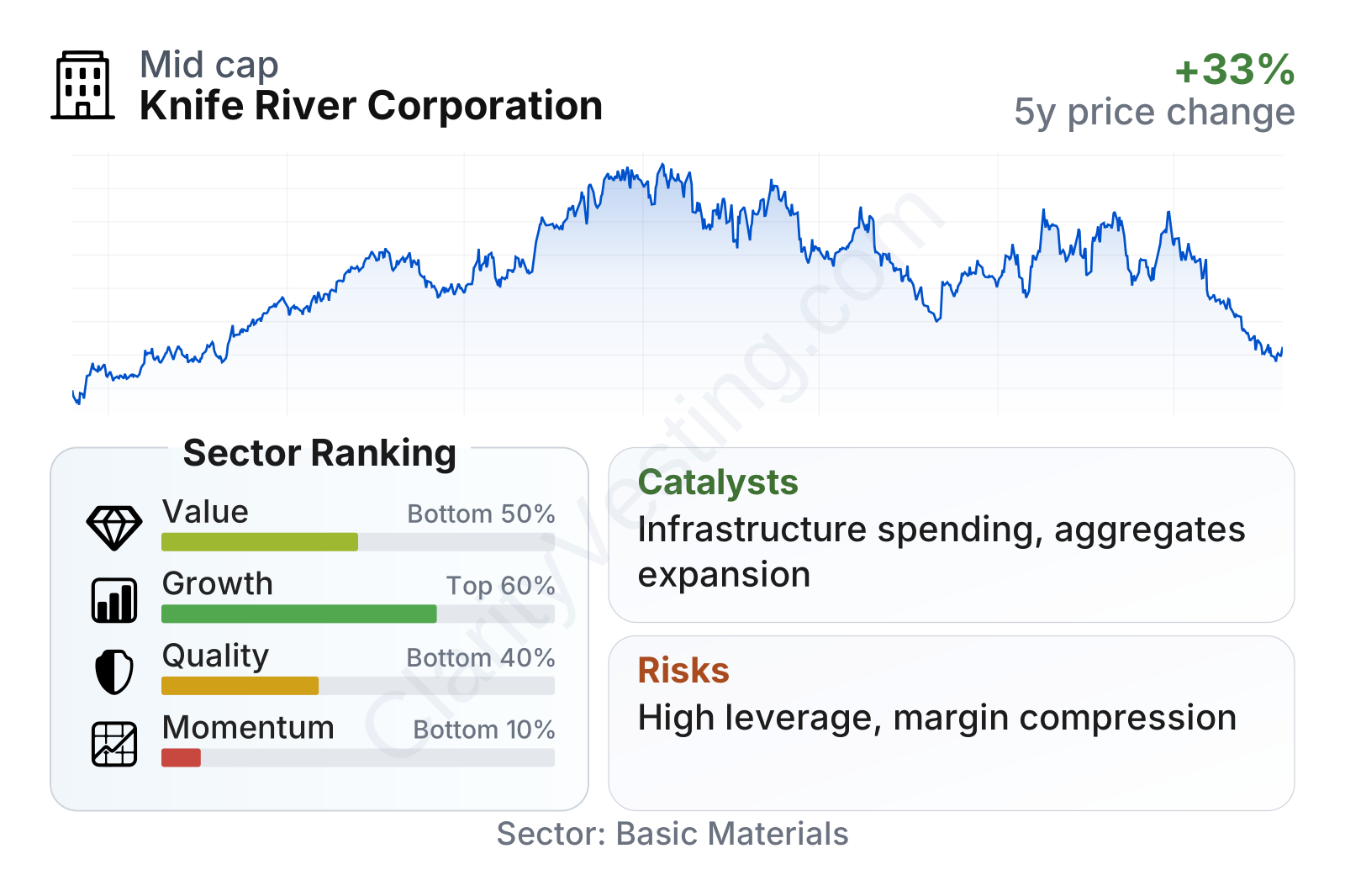
Knife River is a mid-sized building materials company with a relatively low beta of about 0.52, meaning the shares have historically moved less than the broader market. On growth measures, the company sits around the upper-middle part of its sector, helped by revenue growth above the sector median and solid multi-year expansion in revenue per share and book value per share. The weaker areas are profitability, balance-sheet strength, and share-price momentum. Current returns on capital and assets are below sector medians, leverage is materially higher than many peers, and the stock’s recent performance has lagged the broader building materials group by a wide margin.
Growth
Knife River operates in a sector with long-term support from public infrastructure needs. Roads, highways, airports, utility systems, and local civil works all require aggregates, asphalt, and concrete. In the United States, this demand is also supported by aging infrastructure and multiyear government funding programs. That gives the company exposure to a market that is cyclical in the short run but structurally necessary over longer periods.
The company’s strategy is logical for that backdrop. Aggregates are especially important because they are difficult to transport over long distances and local reserves can create durable regional positions. When a company owns aggregate sources near end markets and combines them with downstream asphalt, ready-mix, and contracting operations, it can improve pricing power and utilization. Knife River has been leaning into that model, including through acquisitions intended to deepen its local market density and raw-material base.
Recent revenue growth has accelerated, with year-over-year gains moving into the low- to mid-teens in the latest periods. That suggests the company is still benefiting from a combination of pricing, acquired growth, and project demand. Its five-year revenue-per-share growth is also well above the sector median, which points to expansion that has not been purely driven by share issuance.
The more mixed point is cash generation. Free cash flow was strong earlier, but more recent trailing figures have dropped sharply and even turned slightly negative in one period before recovering to a modest positive level on the latest metrics. For a capital-intensive business, that can happen when the company is investing heavily, building working capital, or integrating acquisitions, but it still matters because long-term value creation depends on turning accounting profit into cash over time.
A meaningful catalyst is the company’s exposure to public infrastructure funding and state transportation budgets, especially if highway lettings remain active. Another is continued integration of acquired operations, which can expand reserves, improve local scale, and strengthen the higher-value aggregates position inside the portfolio. In simple terms, Knife River appears to be positioned in a market with real long-duration demand, but the pace and quality of growth will depend on execution and cash conversion, not just top-line expansion.
Risks
This article is for informational purposes only and does not constitute financial advice. Some content is AI-generated. See Disclaimer


