Stock Analysis · Kennametal Inc (KMT)
Overview
Kennametal Inc. is an industrial manufacturing company that makes cutting tools, wear-resistant parts, and engineered materials used in metalworking and harsh operating environments. In simple terms, its products help other manufacturers cut, drill, mill, and shape metal more efficiently, while also protecting machines and equipment from heat, friction, and abrasion. Its end markets include aerospace, transportation, general engineering, earthworks, energy, and other heavy industries.
The company reports two main business segments, with revenue mainly coming from consumable tooling and engineered components that customers need to replace regularly as they wear out. Based on recent company reporting, the revenue mix is approximately as follows:
- Metal Cutting segment: about 60% to 65% of revenue. This includes indexable inserts, solid end mills, drills, tooling systems, and other products used by machine shops and industrial manufacturers to cut and shape metal parts.
- Infrastructure segment: about 35% to 40% of revenue. This includes wear components, tungsten carbide products, and engineered solutions used in mining, construction, energy, aerospace, and industrial applications where parts face extreme stress and abrasion.
Geographically, Kennametal is diversified across the Americas, Europe, and Asia-Pacific, which helps reduce dependence on a single economy, although it also exposes the company to swings in global industrial demand and currency movements.
Kennametal’s business model is not built around consumer demand or software subscriptions. It is tied much more directly to factory activity, capital spending, and replacement demand for tools and wear parts. That makes it cyclical, but it also means the company can benefit quickly when manufacturing conditions improve.
The recent financial flow shows a notable jump in revenue and operating profit in the latest period after several softer years, with profitability improving faster than costs. That kind of operating leverage is important for an industrial company because a modest sales recovery can translate into a much larger earnings recovery.
Key Figures
| Metric | Value | Sector ⓘ |
|---|---|---|
| Date | Oct 17, 2026 | |
| Context | ||
| Sector | Industrials | |
| Industry | Tools & Accessories | |
| Market Cap ⓘ | $2.39B | |
| Beta ⓘ | 1.32 | |
Value (Cheapness) | ||
| P/E Ratio ⓘ | 7.09 | 22.10 |
| P/B Ratio ⓘ | 1.58 | 1.97 |
| FCF Yield ⓘ | -3.38% | 6.38% |
| Dividend Yield ⓘ | 2.53% | 1.94% |
| EBIT / EV ⓘ | 16.29% | 4.79% |
| PEG ⓘ | 1.25 | |
Growth (Business expansion) | ||
| Revenue Growth ⓘ | 42.60% | 9.30% |
| RPS Growth (5Y CAGR) ⓘ | 6.15% | 7.81% |
| EPS Growth (5Y CAGR) ⓘ | 26.20% | -13.06% |
| BVPS Growth (5Y CAGR) ⓘ | 8.05% | 6.14% |
| Margin Growth (5Y Trend) ⓘ | 9.23% | 0.88% |
| FCF Growth (5Y CAGR) ⓘ | N/A | 11.01% |
| DPS Growth (5Y CAGR) ⓘ | -0.22% | 9.48% |
Quality (Business durability) | ||
| ROIC (Latest) ⓘ | 17.99% | 10.84% |
| ROA (Latest) ⓘ | 12.04% | 5.41% |
| ROIC (5Y Median) ⓘ | 7.78% | 9.38% |
| ROA (5Y Median) ⓘ | 4.63% | 4.95% |
| Net Debt / EBIT (Latest) ⓘ | 1.40 | 2.08 |
| Net Debt / EBIT (5Y Median) ⓘ | 2.84 | 2.27 |
| Net Debt / EBITDA (Latest) ⓘ | 1.08 | 1.39 |
| Net Debt / Assets ⓘ | 21.07% | 19.28% |
| EBITDA / Interest ⓘ | 21.61 | 9.58 |
| Operating Margin (Latest) ⓘ | 20.25% | 10.50% |
| Operating Margin (5Y Median) ⓘ | 9.05% | 10.29% |
| Debt to Equity (Latest) ⓘ | 48.65% | 65.48% |
| Profit Margin (Latest) ⓘ | 14.53% | 6.67% |
| Free Cash Flow (Latest) ⓘ | -$80.91M | |
Momentum (Price trend) | ||
| 3Y Return ⓘ | +40.54% | +61.68% |
| 12M Return (excl. last month) ⓘ | +45.21% | +12.58% |
| 6M Return ⓘ | -20.20% | 0.00% |
| Price vs. 200-Day MA ⓘ | -10.01% | +0.02% |
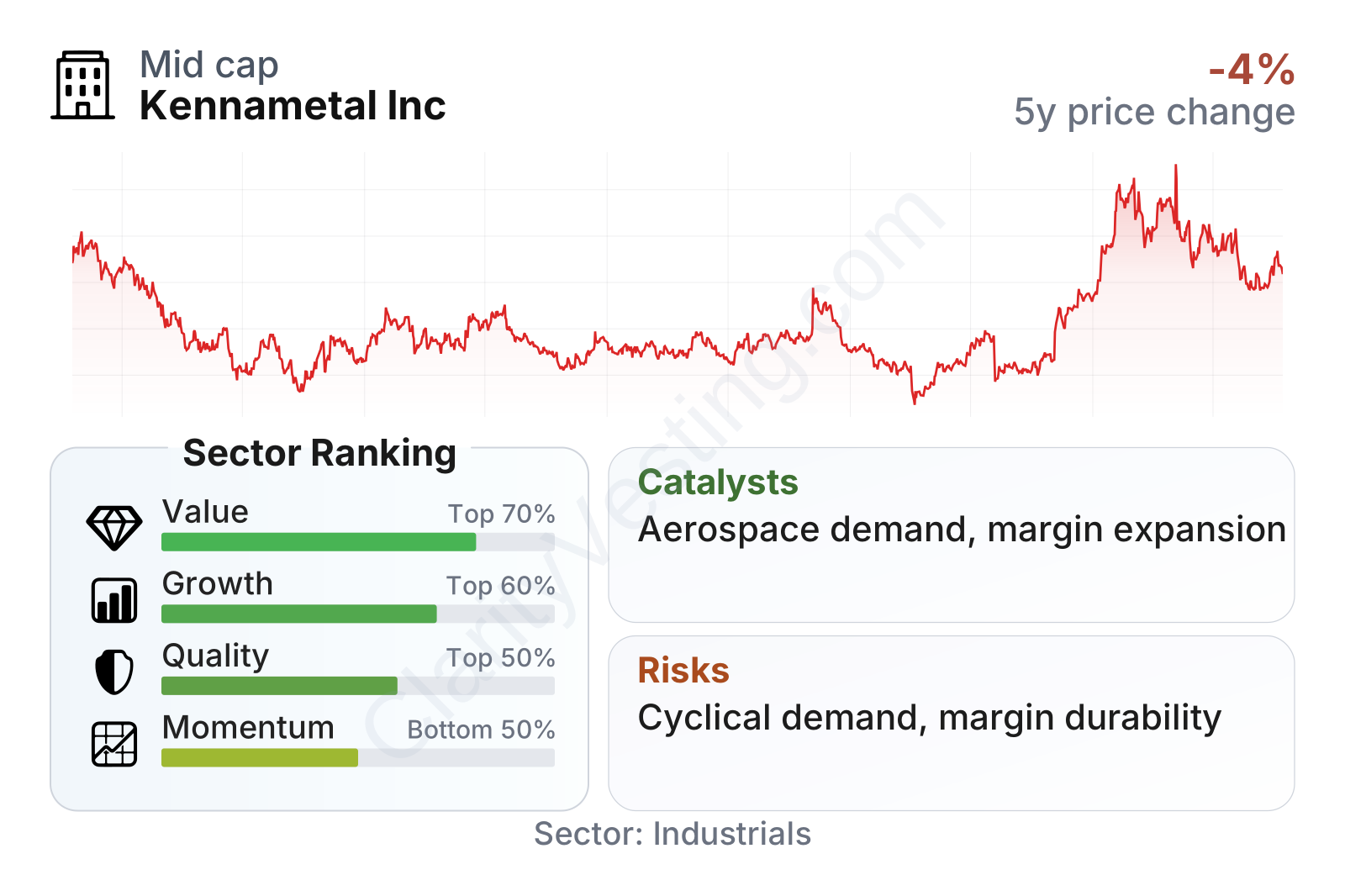
Kennametal is a mid-sized industrial company with a stock that tends to move more than the broader market, as reflected by a beta above 1. On valuation, it screens as inexpensive versus much of the industrial sector, with a low earnings multiple and a price-to-book ratio below the sector median. Quality is more mixed but currently solid: returns on capital and assets are above sector norms, operating margin is strong, and interest coverage is comfortable. Growth indicators have improved sharply in the latest period, although share-price momentum has been less consistent over longer stretches.
The stock-price history underlines that cyclicality. Shares fell hard during weaker industrial conditions, recovered, then experienced another sharp move higher as earnings improved. That pattern is common for machinery and tooling suppliers: sentiment can change quickly when demand and margins turn.
Growth
Kennametal operates in a sector with long-term relevance rather than explosive structural expansion. Precision tooling, wear materials, and engineered components remain essential to manufacturing, aerospace, defense, transportation, and infrastructure. These are durable end markets, but they usually grow in cycles instead of straight lines. The more attractive part of the case is not that the industry is rapidly expanding on its own, but that productivity, reshoring, aerospace production recovery, and demand for more efficient machining can create room for stronger performance.
The company’s strategy broadly makes sense for that environment. Management has emphasized higher-margin products, productivity improvements, pricing discipline, and capital allocation focused on operational efficiency. For a company like Kennametal, this matters because commodity-like volume growth is less valuable than profitable growth supported by better mix and disciplined manufacturing.
Recent revenue trends suggest a meaningful turnaround. After a period of declines, year-over-year growth moved back into positive territory and accelerated sharply in the latest reported periods. That pace is well above the sector median and indicates either a strong demand rebound, favorable mix, or both. Investors looking at long-term business direction should still remember that such surges are not always permanent in industrial markets, but they do show that Kennametal can still produce strong upcycles.
Cash generation has been less smooth than revenue. Free cash flow was positive and healthy over several years, then weakened materially more recently. That does not automatically mean the business model is deteriorating. In industrial companies, cash flow can swing because of working capital, inventory changes, and timing of receivables. Still, this is an area to watch closely because long-term compounding is stronger when earnings and cash flow move together.
A practical catalyst is the company’s exposure to aerospace and other precision-manufacturing markets that need high-performance tooling. If aircraft build rates continue to normalize and industrial production improves, Kennametal could benefit from better factory utilization and replacement demand. Another catalyst is internal: the latest margin improvement suggests management’s efficiency efforts may be gaining traction, which can matter as much as revenue growth in this type of business.
Risks
This article is for informational purposes only and does not constitute financial advice. Some content is AI-generated. See Disclaimer


