Stock Analysis · Kemper Corporation (KMPR)
Overview
Kemper Corporation is a U.S. insurance company focused mainly on property and casualty coverage, with a strong emphasis on auto insurance for customers who are often underserved by standard insurers. The company also has a smaller life insurance business. In simple terms, Kemper collects premiums from policyholders, invests part of that money, pays claims when covered events happen, and aims to keep enough of the premium after claims and operating costs to generate profit.
Its business is organized around a few main revenue streams. Based on recent annual reporting, the company is now primarily a specialty auto insurer, while life insurance plays a secondary role and investment income adds a smaller contribution.
- Specialty Property & Casualty insurance: approximately 85% to 90% of total revenue. This includes mainly auto insurance, especially non-standard auto coverage, along with other personal insurance lines in selected markets.
- Life insurance: approximately 8% to 12% of total revenue. This segment includes traditional life, accident, health, and supplemental insurance products.
- Net investment income and other: approximately 2% to 5% of total revenue. Like most insurers, Kemper invests its float, meaning premiums held before claims are paid.
The business has changed meaningfully over the last few years. Kemper has been simplifying its portfolio, exiting or reducing parts of the business that were not producing acceptable returns, and putting more focus on areas where it believes underwriting discipline can restore profitability. That makes the company easier to understand than it was when it had a broader mix of operations, but it also leaves results more exposed to conditions in auto insurance.
The profit flow over the last several years shows a business that went through a sharp earnings downturn and then a recovery. Revenue has drifted lower from earlier levels, but margins improved materially in 2024 and remained positive in 2025 after large losses in 2021 through 2023. That pattern fits a restructuring and repricing phase rather than a steady growth profile.
Key Figures
| Metric | Value | Sector ⓘ |
|---|---|---|
| Date | Oct 24, 2026 | |
| Context | ||
| Sector | Financial Services | |
| Industry | Insurance - Property & Casualty | |
| Market Cap ⓘ | $1.70B | |
| Beta ⓘ | 1.06 | |
Value (Cheapness) | ||
| P/E Ratio ⓘ | N/A | 12.46 |
| P/B Ratio ⓘ | 0.80 | 1.25 |
| FCF Yield ⓘ | 27.88% | 9.82% |
| Dividend Yield ⓘ | 4.30% | 2.94% |
| EBIT / EV ⓘ | -21.76% | 8.11% |
| PEG ⓘ | 0.75 | |
Growth (Business expansion) | ||
| Revenue Growth ⓘ | -9.10% | 9.10% |
| RPS Growth (5Y CAGR) ⓘ | -3.21% | 12.31% |
| EPS Growth (5Y CAGR) ⓘ | N/A | -6.97% |
| BVPS Growth (5Y CAGR) ⓘ | -32.81% | 5.02% |
| Margin Growth (5Y Trend) ⓘ | N/A | -4.00% |
| FCF Growth (5Y CAGR) ⓘ | 17.27% | 4.71% |
| DPS Growth (5Y CAGR) ⓘ | 0.34% | 8.92% |
Quality (Business durability) | ||
| ROIC (Latest) ⓘ | -11.65% | 9.18% |
| ROE (Latest) ⓘ | -20.02% | 13.93% |
| ROA (Latest) ⓘ | -4.07% | 1.57% |
| ROIC (5Y Median) ⓘ | -2.95% | 7.80% |
| ROE (5Y Median) ⓘ | -0.91% | 12.15% |
| ROA (5Y Median) ⓘ | -0.85% | 1.28% |
| Net Debt / EBIT (Latest) ⓘ | N/A | 1.02 |
| Net Debt / EBIT (5Y Median) ⓘ | N/A | 0.72 |
| Net Debt / EBITDA (Latest) ⓘ | N/A | 0.88 |
| Operating Margin (Latest) ⓘ | -11.45% | 22.30% |
| Operating Margin (5Y Median) ⓘ | -3.66% | 24.50% |
| Debt to Equity (Latest) ⓘ | 43.07% | 59.34% |
| Profit Margin (Latest) ⓘ | -10.79% | 26.42% |
| Free Cash Flow (Latest) ⓘ | $474.50M | |
Momentum (Price trend) | ||
| 3Y Return ⓘ | -20.31% | +95.73% |
| 12M Return (excl. last month) ⓘ | -47.33% | +17.30% |
| 6M Return ⓘ | -5.92% | +6.07% |
| Price vs. 200-Day MA ⓘ | +1.45% | +5.36% |
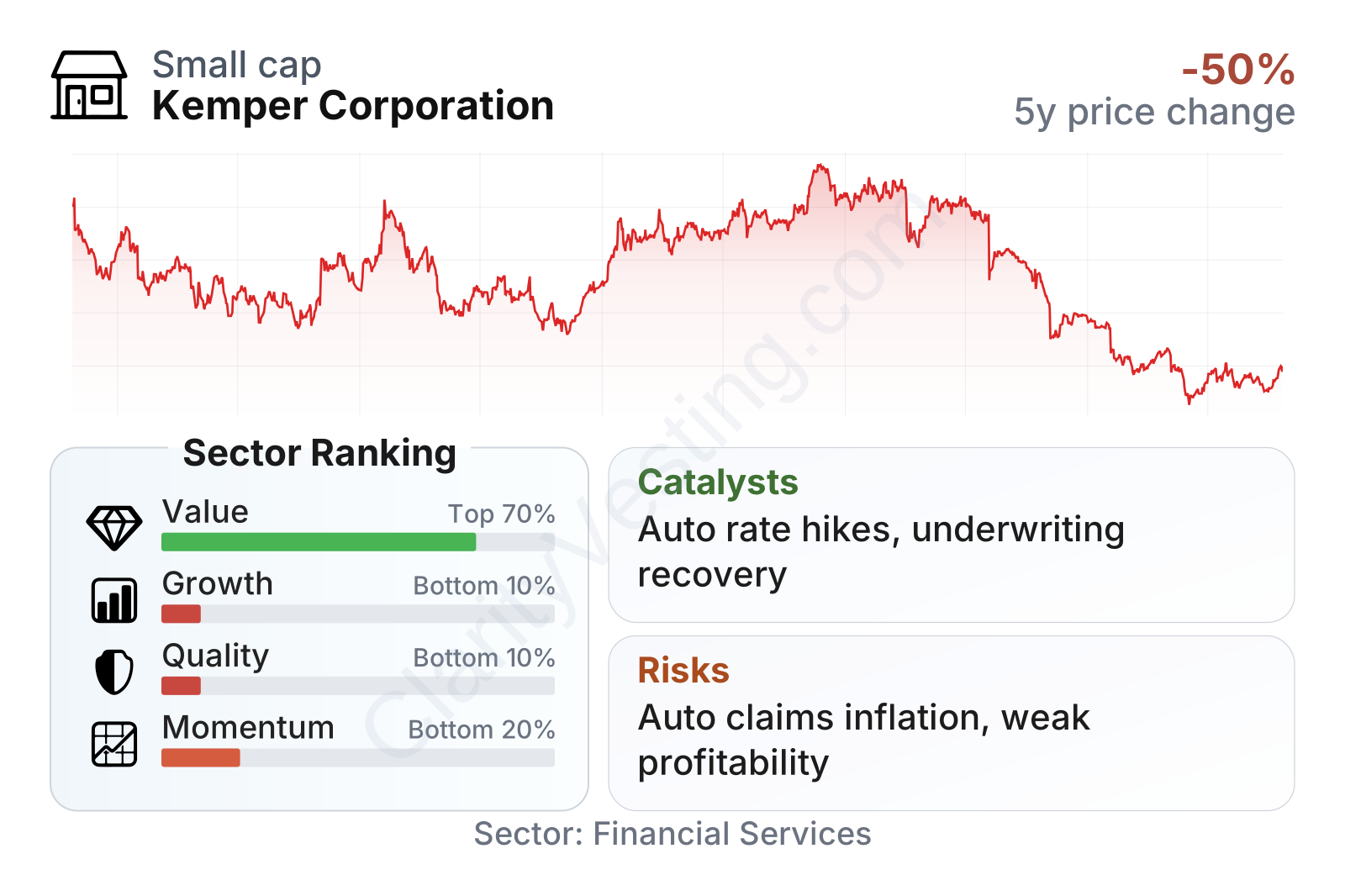
Kemper is a small-cap insurer with a stock that has been notably weak over the last year and over longer periods. In the factor summary, value metrics look better than the broader financial sector, while growth, quality, and momentum rank near the bottom. In plain language, the market is assigning a low valuation partly because recent operating performance has deteriorated again after a brief recovery. The balance sheet does not look heavily stretched by debt for the sector, and free cash flow appears strong, but profitability measures are currently the main weakness.
Growth
The insurance sector itself is not a high-growth industry in the way software or semiconductors can be, but it is a large and durable market. Auto insurance remains essential for consumers, and pricing in the sector has been rising as insurers respond to higher claims severity, repair costs, medical inflation, and weather-related losses. For Kemper, this means the opportunity is less about entering a brand-new market and more about restoring underwriting margins in a necessary product category.
Kemper’s strategy broadly makes sense for that goal. Management has been narrowing the company’s focus, adjusting rates, tightening underwriting, and reducing exposure in underperforming areas. In insurance, disciplined pricing can be a powerful catalyst because results can improve quickly once premiums catch up with claims costs. The company already showed that kind of rebound in 2024, when profitability recovered strongly compared with the prior loss years, even though revenue was lower than in earlier periods.
Earnings per share illustrate that swing clearly. Kemper moved from losses in 2021 through 2023 to a strong profit in 2024, then remained profitable in 2025, but the latest trailing picture weakened again. That makes the company look less like a steady compounder and more like a turnaround tied to underwriting execution and claims trends.
Book value per share also helps frame the growth question. After a very large reset between 2021 and 2022, book value stabilized and improved in 2023 and 2024, then was roughly flat in 2025. For an insurer, that stabilization matters because book value reflects the capital base that supports future underwriting. The key issue now is whether Kemper can turn stabilization into a sustained upward trend.
A notable catalyst is continued improvement in auto insurance pricing. If industry-wide rate increases continue to earn through the income statement while claims trends stay manageable, Kemper has room for earnings recovery. Another potential opportunity comes from the company’s narrower operating focus: a simpler portfolio can improve accountability, expense control, and capital allocation. Recent company updates have also emphasized ongoing efforts to improve underwriting profitability rather than chase premium growth at any cost, which is usually the more sensible approach in insurance.
Risks
This article is for informational purposes only and does not constitute financial advice. Some content is AI-generated. See Disclaimer


