Stock Analysis · Kimberly-Clark Corporation (KMB)
Overview
Kimberly-Clark is a large consumer staples company focused on everyday personal care and household products. Its brands are sold in more than 175 countries and include tissues, toilet paper, paper towels, diapers, training pants, feminine care, and incontinence products. Well-known names include Huggies, Pull-Ups, Kotex, Depend, Poise, Kleenex, Scott, Cottonelle, Viva, and Andrex. The business is built around products that people repurchase frequently, which usually makes demand steadier than in many other industries.
The company’s revenue mix is led by personal care, followed by consumer tissue, while a smaller share comes from professional products and other items. Based on the company’s recent annual reporting structure, the business can be summarized approximately as follows:
- Personal Care: about 47% of revenue — baby and child care, adult care, and feminine care, including Huggies, Pull-Ups, GoodNites, Depend, Poise, and Kotex.
- Consumer Tissue: about 42% of revenue — bathroom tissue, paper towels, facial tissue, and napkins, including Scott, Cottonelle, Kleenex, Viva, and Andrex.
- K-C Professional and other: about 11% of revenue — workplace and commercial hygiene products such as wipers, tissues, towels, soaps, and safety-related consumables sold to businesses and institutions.
Geographically, Kimberly-Clark is still heavily exposed to North America, but it also has meaningful operations across Europe, Asia-Pacific, and Latin America. That matters because mature developed markets provide stability, while developing markets can offer higher long-term volume opportunities, especially in diapers, adult incontinence, and hygiene categories where usage tends to rise with income and aging populations.
Another important feature of the business is pricing power. Kimberly-Clark operates in categories where brand recognition, shelf presence, retailer relationships, and product performance all influence customer choice. That does not make demand immune to pressure, but it helps the company defend margins when input costs move sharply.
The company’s recent financial profile shows a familiar pattern for a mature staples business: revenue has been fairly stable, while profitability improved more than sales. Gross profit and operating income expanded notably through 2024 as cost pressure eased and pricing actions flowed through, although the latest annual revenue trend looks softer than that peak. In short, the business has recently been more of a margin-improvement case than a high-sales-growth case.
Key Figures
| Metric | Value | Sector ⓘ |
|---|---|---|
| Date | Oct 03, 2026 | |
| Context | ||
| Sector | Consumer Defensive | |
| Industry | Household & Personal Products | |
| Market Cap ⓘ | $32.85B | |
| Beta ⓘ | 0.27 | |
Value (Cheapness) | ||
| P/E Ratio ⓘ | 19.44 | 18.16 |
| P/B Ratio ⓘ | 20.29 | 1.27 |
| FCF Yield ⓘ | 7.80% | 12.39% |
| Dividend Yield ⓘ | 5.16% | 2.83% |
| EBIT / EV ⓘ | 6.40% | 6.45% |
| PEG ⓘ | 2.02 | |
Growth (Business expansion) | ||
| Revenue Growth ⓘ | 0.60% | 3.80% |
| RPS Growth (5Y CAGR) ⓘ | -2.58% | 6.20% |
| EPS Growth (5Y CAGR) ⓘ | -10.84% | -14.64% |
| BVPS Growth (5Y CAGR) ⓘ | 17.35% | 3.26% |
| Margin Growth (5Y Trend) ⓘ | 1.71% | -0.25% |
| FCF Growth (5Y CAGR) ⓘ | -1.24% | 4.65% |
| DPS Growth (5Y CAGR) ⓘ | 2.73% | 6.86% |
Quality (Business durability) | ||
| ROIC (Latest) ⓘ | 20.15% | 12.58% |
| ROA (Latest) ⓘ | 11.03% | 6.35% |
| ROIC (5Y Median) ⓘ | 22.46% | 10.36% |
| ROA (5Y Median) ⓘ | 10.80% | 5.44% |
| Net Debt / EBIT (Latest) ⓘ | 2.26 | 1.91 |
| Net Debt / EBIT (5Y Median) ⓘ | 3.00 | 2.32 |
| Net Debt / EBITDA (Latest) ⓘ | 1.82 | 1.36 |
| Net Debt / Assets ⓘ | 29.97% | 21.25% |
| EBITDA / Interest ⓘ | 12.94 | 9.61 |
| Operating Margin (Latest) ⓘ | 14.87% | 8.96% |
| Operating Margin (5Y Median) ⓘ | 13.00% | 9.53% |
| Debt to Equity (Latest) ⓘ | 372.40% | 71.66% |
| Profit Margin (Latest) ⓘ | 11.79% | 5.40% |
| Free Cash Flow (Latest) ⓘ | $2.56B | |
Momentum (Price trend) | ||
| 3Y Return ⓘ | -7.31% | +15.25% |
| 12M Return (excl. last month) ⓘ | -11.02% | +2.63% |
| 6M Return ⓘ | +5.40% | +2.43% |
| Price vs. 200-Day MA ⓘ | -1.46% | +0.43% |
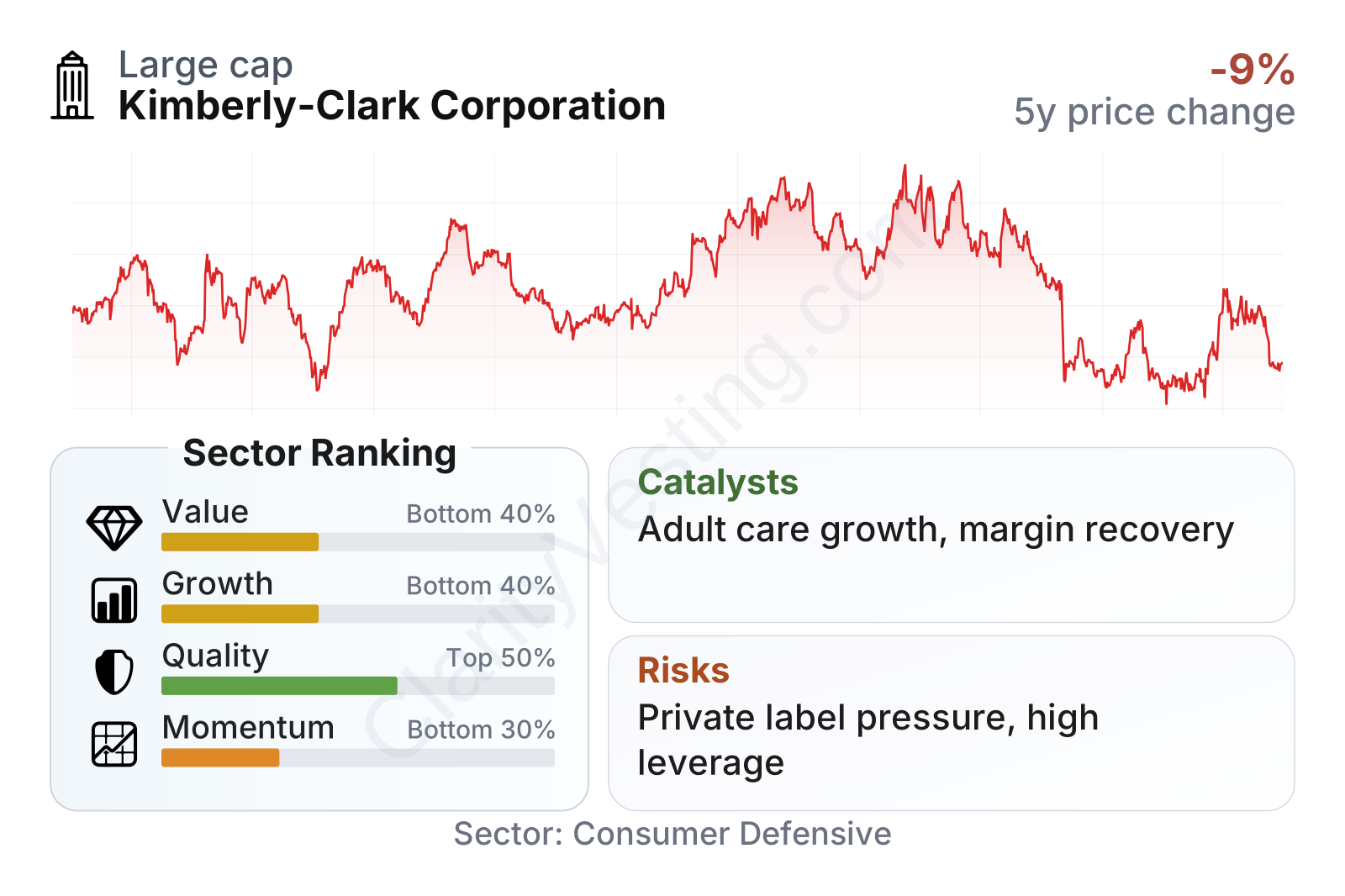
Kimberly-Clark combines strong business quality with weaker growth and muted recent share-price momentum. Profitability stands well above the sector median, with operating margin around 15%, profit margin near 12%, and returns on capital clearly stronger than many peers. The tradeoff is slower expansion: recent revenue growth has been close to flat, five-year sales per share has declined, and free cash flow growth has been modest. On valuation, the stock sits close to the sector on earnings, while the dividend yield is meaningfully higher than average. Beta is very low, which fits the stock’s defensive reputation.
The stock-price history also reflects this profile. Over the last several years, the shares have been less volatile than the market, but they have not delivered strong momentum relative to the broader consumer defensive group. That can happen when a company offers stability and income, but limited top-line acceleration.
Growth
Kimberly-Clark operates in a sector that is mature overall, but not without long-term growth pockets. Household paper categories in developed markets are generally slow growing, because usage is already widespread and population growth is limited. Personal care offers better structural support, especially in diapers in selected emerging markets and in adult incontinence, where aging populations and greater product adoption can steadily expand demand over time.
The company’s strategy for future growth makes practical sense for this kind of business. Management has emphasized a mix of brand investment, innovation, productivity savings, portfolio focus, and expansion in higher-opportunity categories and geographies. In a staples company, growth rarely depends on one breakthrough product. It tends to come from many smaller improvements: premium product upgrades, market-share gains, better manufacturing efficiency, and tighter control of product assortment.
Revenue growth has been uneven. The company posted stronger year-over-year gains in 2021 and 2022, then slowed materially and moved through a weaker stretch during 2024 and into 2025, before returning to slight positive growth more recently. That pattern suggests Kimberly-Clark is not currently in a broad-based expansion phase. Instead, it appears to be working through a reset after earlier pricing actions and portfolio changes, while trying to stabilize volumes.
Free cash flow is an important bright spot. Even with modest sales growth, Kimberly-Clark has continued to generate roughly $2.5 billion to $2.6 billion in trailing free cash flow recently. That supports dividends, debt service, and operational reinvestment. For a company in a low-growth category, durable cash generation is often more important than headline revenue growth because it gives management flexibility to keep improving the business through product development, manufacturing upgrades, and selective restructuring.
A meaningful catalyst is the company’s ongoing transformation toward higher-margin, faster-growing parts of the portfolio. Adult incontinence is particularly notable because it benefits from demographic tailwinds rather than only economic growth. Another support factor is that brand-led consumer staples companies can often recover earnings faster than sales after commodity inflation subsides, and Kimberly-Clark’s margin recovery over the last two years suggests that process has already been underway. Recent company updates have also highlighted organizational simplification and productivity programs, which can create incremental earnings support even if category growth remains modest.
Risks
This article is for informational purposes only and does not constitute financial advice. Some content is AI-generated. See Disclaimer