Stock Analysis · Keller Group plc (KLRGF)
Overview
Keller Group plc is a specialized construction and engineering company focused on geotechnical work. In simple terms, it helps make the ground strong enough and stable enough for buildings, industrial facilities, roads, rail projects, ports, tunnels, and energy infrastructure. Its services are usually required at the early stage of a project, when foundations, retaining structures, ground improvement, and other below-ground technical solutions are needed.
The company operates globally, with North America representing the largest part of the business, followed by Europe and the Asia-Pacific/Middle East region. Keller’s activities are spread across many end markets, which helps reduce dependence on any single type of project. Based on recent annual reporting, its revenue mix can be approximated as follows:
- North America: about 55% to 60% of revenue. This includes foundation engineering, ground improvement, earth retention, and related services for commercial, industrial, transportation, and infrastructure projects.
- Europe: about 25% to 30% of revenue. This covers similar geotechnical work across the U.K. and continental Europe, often tied to infrastructure, urban construction, and industrial projects.
- Asia-Pacific and Middle East: about 15% to 20% of revenue. This region includes large infrastructure and building projects, though activity can be more cyclical and project-driven.
Keller does not mainly sell a standardized product. It sells technical expertise, specialized equipment, and execution capability in difficult ground conditions. That makes the company closer to a niche engineering contractor than to a broad general construction group.
Over the last several years, revenue has moved higher overall, while operating profit and net income have improved more clearly than sales. That suggests recent progress has not come only from taking on more work, but also from better project selection, pricing discipline, and operational execution.
The long-term picture shows a business that has expanded revenue from a little above $2.2 billion in 2021 to just over $3.0 billion in 2025, while profit conversion has also improved. The most important takeaway is that earnings have grown faster than sales in recent years, which is usually a healthier sign than growth driven only by volume.
Key Figures
| Metric | Value | Sector ⓘ |
|---|---|---|
| Date | Oct 17, 2026 | |
| Context | ||
| Sector | Industrials | |
| Industry | Engineering & Construction | |
| Market Cap ⓘ | $2.80B | |
| Beta ⓘ | 0.98 | |
Value (Cheapness) | ||
| P/E Ratio ⓘ | 14.07 | 22.10 |
| P/B Ratio ⓘ | 4.50 | 1.97 |
| FCF Yield ⓘ | 8.15% | 6.38% |
| Dividend Yield ⓘ | 1.94% | 1.94% |
| EBIT / EV ⓘ | N/A | 4.79% |
| PEG ⓘ | N/A | |
Growth (Business expansion) | ||
| Revenue Growth ⓘ | 10.30% | 9.30% |
| RPS Growth (5Y CAGR) ⓘ | 9.06% | 7.81% |
| EPS Growth (5Y CAGR) ⓘ | -46.15% | -13.06% |
| BVPS Growth (5Y CAGR) ⓘ | 10.29% | 6.14% |
| Margin Growth (5Y Trend) ⓘ | 3.25% | 0.88% |
| FCF Growth (5Y CAGR) ⓘ | 24.55% | 11.01% |
| DPS Growth (5Y CAGR) ⓘ | 9.63% | 9.48% |
Quality (Business durability) | ||
| ROIC (Latest) ⓘ | N/A | 10.84% |
| ROA (Latest) ⓘ | 14.15% | 5.41% |
| ROIC (5Y Median) ⓘ | 16.67% | 9.38% |
| ROA (5Y Median) ⓘ | 5.29% | 4.95% |
| Net Debt / EBIT (Latest) ⓘ | 0.28 | 2.08 |
| Net Debt / EBIT (5Y Median) ⓘ | 1.48 | 2.27 |
| Net Debt / EBITDA (Latest) ⓘ | 0.17 | 1.39 |
| Net Debt / Assets ⓘ | 5.49% | 19.28% |
| EBITDA / Interest ⓘ | 16.25 | 9.58 |
| Operating Margin (Latest) ⓘ | 6.81% | 10.50% |
| Operating Margin (5Y Median) ⓘ | 5.24% | 10.29% |
| Debt to Equity (Latest) ⓘ | 48.00% | 65.48% |
| Profit Margin (Latest) ⓘ | 4.81% | 6.67% |
| Free Cash Flow (Latest) ⓘ | $228.39M | |
Momentum (Price trend) | ||
| 3Y Return ⓘ | +456.35% | +61.68% |
| 12M Return (excl. last month) ⓘ | +147.77% | +12.58% |
| 6M Return ⓘ | +71.50% | 0.00% |
| Price vs. 200-Day MA ⓘ | +103.75% | +0.02% |
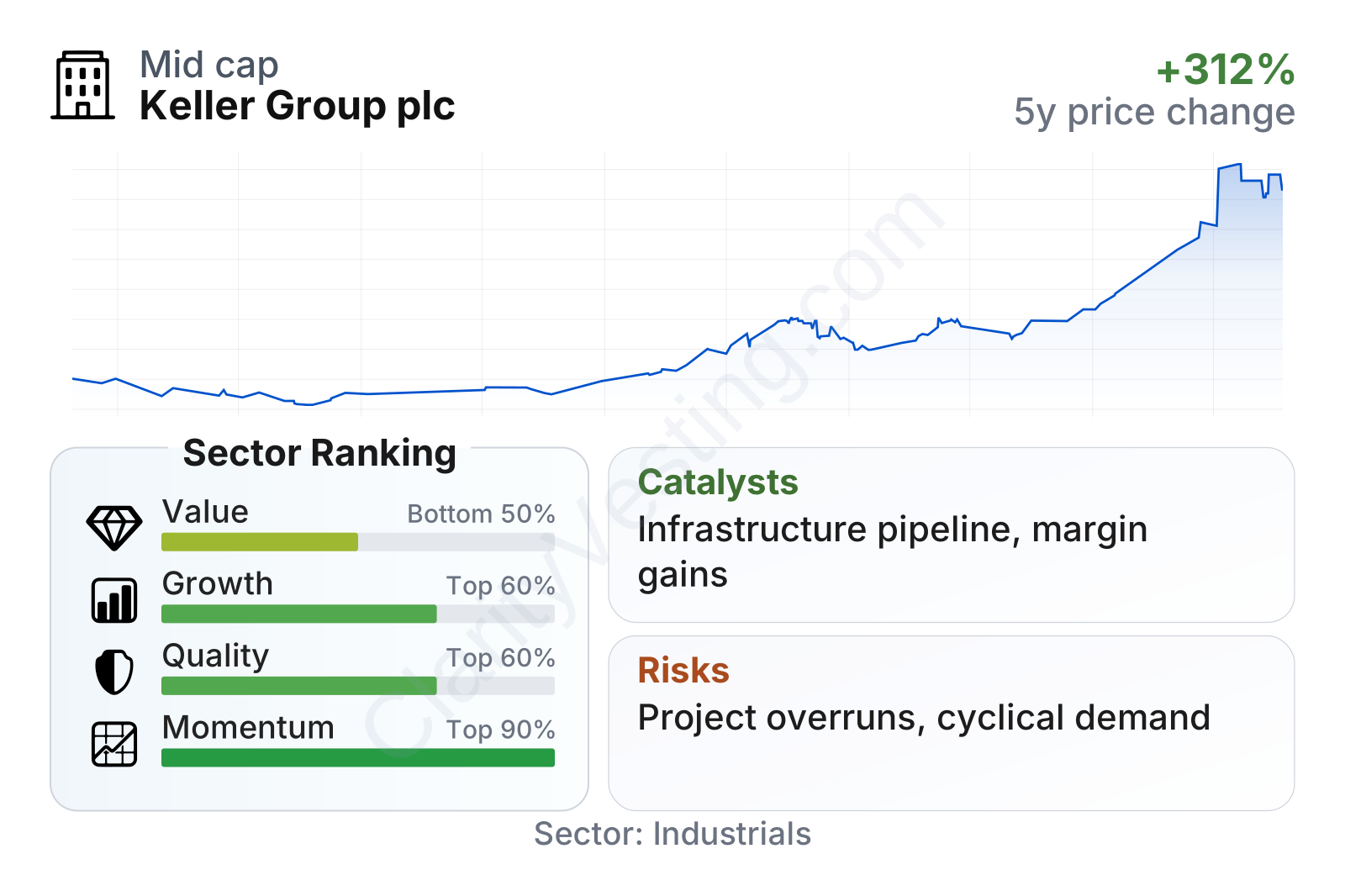
Keller stands out as a mid-sized industrial company with unusually strong recent share-price momentum and a balance sheet that looks conservative for a construction-related business. Growth and quality indicators are generally above the sector median, especially in cash generation, asset returns, and leverage. Profitability margins remain below many peers, which is common in contracting businesses, but the trend in operating margin over the last five years has improved meaningfully. The main tension in the figures is that the stock’s recent rerating has been much faster than the improvement in current earnings multiples would normally suggest.
Growth
Keller operates in a part of construction that benefits from several durable themes. Infrastructure renewal, transportation upgrades, data center construction, energy projects, industrial reshoring, flood protection, and more demanding building standards all require complex ground engineering. These are not short-lived fashion trends. In many markets, aging infrastructure and urban density are making foundation work more technically challenging, which supports demand for specialist contractors.
The company’s strategy also makes practical sense for long-term expansion. Geotechnical engineering is a niche where technical know-how, local execution capability, safety performance, and a specialized equipment fleet matter a lot. Keller has spent years building those capabilities across many countries. That can create repeat business on complex projects where reliability matters more than choosing the lowest-cost provider.
Another constructive point is that Keller’s growth does not appear to rely only on aggressive balance-sheet expansion. Net debt relative to earnings is low, interest coverage is solid, and free cash flow is healthy. That gives the group flexibility to invest in equipment, pursue bolt-on acquisitions, and absorb project volatility without stretching the balance sheet.
Recent operating trends have been encouraging. Revenue growth is running slightly above the sector median, but free cash flow growth and margin improvement look stronger than topline growth alone. That matters because engineering and construction businesses can sometimes grow sales while creating little value. Keller’s recent pattern suggests a more selective and disciplined approach.
A meaningful catalyst is the company’s exposure to public and quasi-public infrastructure programs, particularly in North America and Europe. Foundation and ground engineering often sit near the front end of large civil projects, so a fuller pipeline in transport, utilities, marine works, and resilience-related spending can support order intake. Large commercial and industrial developments, including logistics and digital infrastructure, are another potential tailwind.
There is also a less obvious catalyst: more difficult ground conditions and tighter engineering requirements can increase the value of specialist expertise. If project owners become more focused on risk reduction, technical assurance, and avoiding costly delays, companies such as Keller can gain share versus less specialized contractors.
Risks
This article is for informational purposes only and does not constitute financial advice. Some content is AI-generated. See Disclaimer


