Stock Analysis · Kailera Therapeutics Inc (KLRA)
Overview
Kailera Therapeutics Inc. is a biotechnology company focused on developing medicines for obesity and other cardiometabolic conditions. It is not a commercial-stage pharmaceutical business yet; its value currently rests on its drug pipeline, clinical progress, and its ability to fund development until potential approvals and launches.
The company does not appear to have product revenue at this stage. Based on its latest financial profile, revenue was 0 in the most recent full year available, which means the business is still in the research and development phase rather than selling approved therapies.
That makes Kailera’s economic structure very simple today:
- Product revenue: 0% — no approved product sales were recorded.
- Collaboration, licensing, or other operating revenue: 0% — no meaningful recurring operating revenue appears in the latest annual figures.
- Capital raised from investors and balance sheet cash: this is the practical funding source for operations while the pipeline advances.
The expense mix is more informative than revenue at this point. Research and development represented the largest operating use of cash in the latest year, at roughly 69% of total operating expenses, while selling, general, and administrative costs were about 31%. That pattern is typical for an early-stage drug developer: most resources are going into clinical work and pipeline building rather than commercialization.
The operating profile is consistent with a company trying to create long-term value through drug candidates rather than current earnings. The absence of revenue is not unusual in biotechnology, but it means the investment case depends heavily on whether clinical assets can show strong data and move toward approval.
Key Figures
| Metric | Value | Sector ⓘ |
|---|---|---|
| Date | Oct 17, 2026 | |
| Context | ||
| Sector | Healthcare | |
| Industry | Biotechnology | |
| Market Cap ⓘ | $1.39B | |
| Beta ⓘ | N/A | |
Value (Cheapness) | ||
| P/E Ratio ⓘ | N/A | 24.79 |
| P/B Ratio ⓘ | 1.07 | 3.08 |
| FCF Yield ⓘ | -13.67% | 3.15% |
| Dividend Yield ⓘ | N/A | 1.94% |
| EBIT / EV ⓘ | -31.05% | 0.57% |
| PEG ⓘ | N/A | |
Growth (Business expansion) | ||
| Revenue Growth ⓘ | N/A | 7.45% |
| RPS Growth (5Y CAGR) ⓘ | N/A | 8.61% |
| EPS Growth (5Y CAGR) ⓘ | N/A | -17.81% |
| BVPS Growth (5Y CAGR) ⓘ | N/A | 3.72% |
| Margin Growth (5Y Trend) ⓘ | N/A | -0.62% |
| FCF Growth (5Y CAGR) ⓘ | N/A | 1.04% |
| DPS Growth (5Y CAGR) ⓘ | N/A | 6.77% |
Quality (Business durability) | ||
| ROIC (Latest) ⓘ | N/A | 3.24% |
| ROA (Latest) ⓘ | N/A | 3.01% |
| ROIC (5Y Median) ⓘ | N/A | 4.60% |
| ROA (5Y Median) ⓘ | N/A | 1.89% |
| Net Debt / EBIT (Latest) ⓘ | N/A | 1.34 |
| Net Debt / EBIT (5Y Median) ⓘ | N/A | 1.84 |
| Net Debt / EBITDA (Latest) ⓘ | N/A | 1.00 |
| Net Debt / Assets ⓘ | -9.91% | 5.45% |
| EBITDA / Interest ⓘ | N/A | 9.64 |
| Operating Margin (Latest) ⓘ | N/A | 9.27% |
| Operating Margin (5Y Median) ⓘ | N/A | 7.38% |
| Debt to Equity (Latest) ⓘ | 0.91% | 28.58% |
| Profit Margin (Latest) ⓘ | N/A | 3.59% |
| Free Cash Flow (Latest) ⓘ | -$190.27M | |
Momentum (Price trend) | ||
| 3Y Return ⓘ | N/A | +42.80% |
| 12M Return (excl. last month) ⓘ | N/A | +18.50% |
| 6M Return ⓘ | N/A | +7.57% |
| Price vs. 200-Day MA ⓘ | N/A | +5.12% |
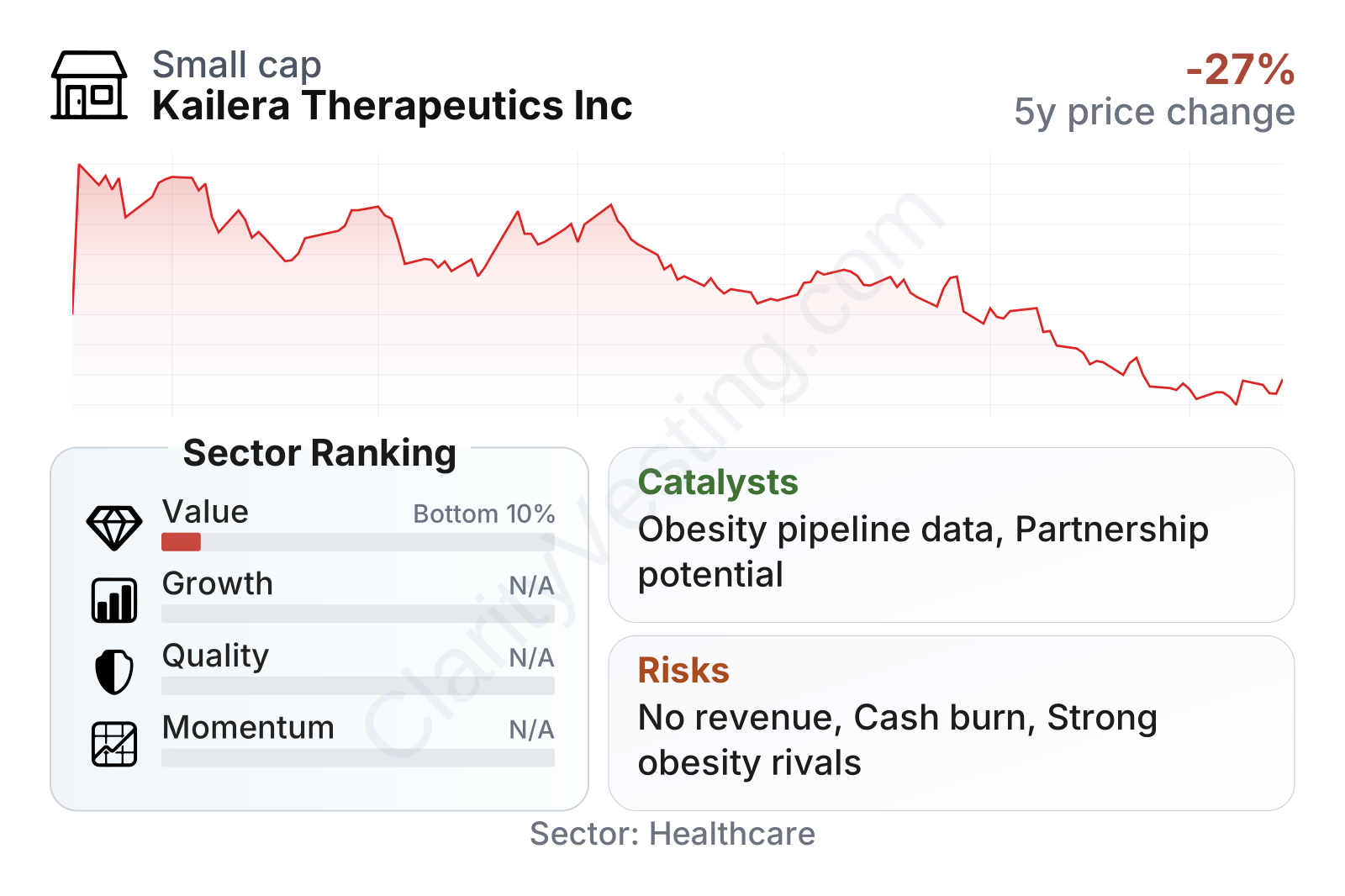
The numbers point to a pre-revenue biotech with a relatively clean balance sheet but heavy cash consumption. On valuation measures tied to earnings or cash generation, the company ranks poorly against the broader healthcare sector, which is expected for a business with no sales and negative operating income. Book value is close to the current market value, suggesting the market is not assigning an extreme premium relative to balance-sheet equity, but that does not by itself make the shares cheap because future dilution and execution risk remain central.
Financial quality is unusual in one positive way: leverage is very low, with debt-to-equity near 1%, and net debt is negative relative to assets, indicating cash exceeds debt. That lowers financial distress risk compared with many development-stage peers. The trade-off is a large free cash outflow, around $190 million over the trailing period, which means the timing of future funding will matter if development spending stays elevated.
The share price moved up from the mid-teens to the high-teens over the short period shown, indicating improving market interest after listing, but that limited history is not enough to establish a durable trading pattern. For a company at this stage, stock moves are usually driven far more by trial milestones and strategic announcements than by standard quarterly operating trends.
Growth
The company operates in one of the most active areas in healthcare: obesity and related metabolic disease. This is a large and expanding market because obesity rates remain high globally and newer treatments have changed physician and investor expectations about what these medicines can achieve. Demand is not the main question for this sector; the harder questions are clinical differentiation, safety, manufacturing scale, and speed to market.
Kailera’s strategy makes sense within that backdrop. A focused biotech can create substantial value if it develops a therapy that is either more effective, easier to tolerate, more convenient to use, or better suited for long-term maintenance than existing options. In obesity, even incremental improvements can matter commercially if they address side effects, adherence, or supply limitations that have affected current leaders.
The strongest catalysts are likely to come from pipeline updates rather than near-term financial growth, because there is no operating revenue base yet. Important milestones include clinical trial initiations, dose-escalation progress, efficacy and safety readouts, regulatory interactions, and any partnership activity that could validate the science or help finance late-stage development. For a company in this position, a single favorable trial result can change how the market values future revenue potential.
There is also a broader sector tailwind. Large pharmaceutical companies and investors continue to pay close attention to obesity assets, which has increased the strategic value of credible programs in this field. That does not guarantee success, but it does mean quality data can attract interest faster than in less visible therapeutic areas.
Risks
This article is for informational purposes only and does not constitute financial advice. Some content is AI-generated. See Disclaimer


