Stock Analysis · Klépierre SA (KLPEF)
Overview
Klépierre SA is a European retail real estate company focused on shopping centers. It owns and operates large malls and retail destinations in major urban areas across continental Europe, with a particular concentration in countries such as France, Italy, Scandinavia, the Iberian Peninsula, the Netherlands, Germany, and Central Europe. Its business model is relatively straightforward: it rents space to retailers, collects rent and service charges, and aims to increase the value of its properties through redevelopment, tenant mix optimization, and active asset management.
The company’s revenue is mainly tied to its property portfolio, so the largest source is recurring rental income from stores, restaurants, and entertainment operators located in its malls. A smaller share comes from service charges and other property-related income, while an additional contribution can come from disposals, management activities, and valuation-related items, although those are less useful for judging the recurring strength of the business.
Based on the group’s structure and reporting, the main revenue drivers can be summarized as follows:
- Net rental income from shopping centers: approximately 80% to 90% of recurring operating revenue. This includes base rents, variable rents, and leasing income from retail units.
- Service charge recoveries and other property income: approximately 10% to 20%. This generally includes tenant reimbursements, parking-related income, specialty leasing, and other mall operating revenue.
- Non-recurring items: usually a small and variable contribution. These may include gains on disposals, revaluation effects, or one-off items, which can be significant for accounting profit but are not the core engine of the business.
Klépierre’s appeal for long-term analysis comes from the quality and concentration of its assets rather than from broad diversification. This is not a generalist landlord spread across offices, logistics, and housing. It is a focused owner of European retail destinations, which makes the investment case easier to understand: results depend mainly on tenant demand, occupancy, rent collection, property values, and financing conditions.
The business has shown a solid ability to convert revenue into cash, with gross profit staying high over time and administrative costs remaining limited relative to rental income. Profit figures have been more volatile than revenue because property valuation movements, disposals, and financing costs can materially affect net income from one year to the next.
Key Figures
| Metric | Value | Sector ⓘ |
|---|---|---|
| Date | Oct 03, 2026 | |
| Context | ||
| Sector | Real Estate | |
| Industry | REIT - Retail | |
| Market Cap ⓘ | $12.21B | |
| Beta ⓘ | 0.90 | |
Value (Cheapness) | ||
| P/E Ratio ⓘ | 7.78 | 17.35 |
| P/B Ratio ⓘ | 1.91 | 0.86 |
| FCF Yield ⓘ | 13.02% | 7.47% |
| Dividend Yield ⓘ | 4.46% | 4.75% |
| EBIT / EV ⓘ | N/A | 3.81% |
| PEG ⓘ | 9.69 | |
Growth (Business expansion) | ||
| Revenue Growth ⓘ | 0.70% | 5.30% |
| RPS Growth (5Y CAGR) ⓘ | -0.29% | 5.96% |
| EPS Growth (5Y CAGR) ⓘ | -60.98% | -11.41% |
| BVPS Growth (5Y CAGR) ⓘ | -6.65% | 0.41% |
| Margin Growth (5Y Trend) ⓘ | 53.86% | 0.53% |
| FCF Growth (5Y CAGR) ⓘ | 4.42% | 5.40% |
| DPS Growth (5Y CAGR) ⓘ | -5.63% | 5.02% |
Quality (Business durability) | ||
| ROIC (Latest) ⓘ | 16.20% | 5.77% |
| ROE (Latest) ⓘ | 36.75% | 7.64% |
| ROA (Latest) ⓘ | 11.76% | 2.85% |
| ROIC (5Y Median) ⓘ | 7.87% | 4.20% |
| ROE (5Y Median) ⓘ | 6.57% | 6.03% |
| ROA (5Y Median) ⓘ | 2.44% | 2.45% |
| Net Debt / EBIT (Latest) ⓘ | 2.45 | 7.57 |
| Net Debt / EBIT (5Y Median) ⓘ | 7.29 | 8.41 |
| Net Debt / EBITDA (Latest) ⓘ | 2.42 | 5.12 |
| Net Debt / Assets ⓘ | 34.04% | 37.84% |
| EBITDA / Interest ⓘ | 5.99 | 4.11 |
| Operating Margin (Latest) ⓘ | 96.12% | 35.40% |
| Operating Margin (5Y Median) ⓘ | 65.54% | 36.59% |
| Debt to Equity (Latest) ⓘ | 83.98% | 89.06% |
| Profit Margin (Latest) ⓘ | 78.12% | 19.99% |
| Free Cash Flow (Latest) ⓘ | $1.59B | |
Momentum (Price trend) | ||
| 3Y Return ⓘ | +122.33% | +30.60% |
| 12M Return (excl. last month) ⓘ | +22.55% | +7.55% |
| 6M Return ⓘ | +22.91% | +0.69% |
| Price vs. 200-Day MA ⓘ | +17.02% | -2.30% |
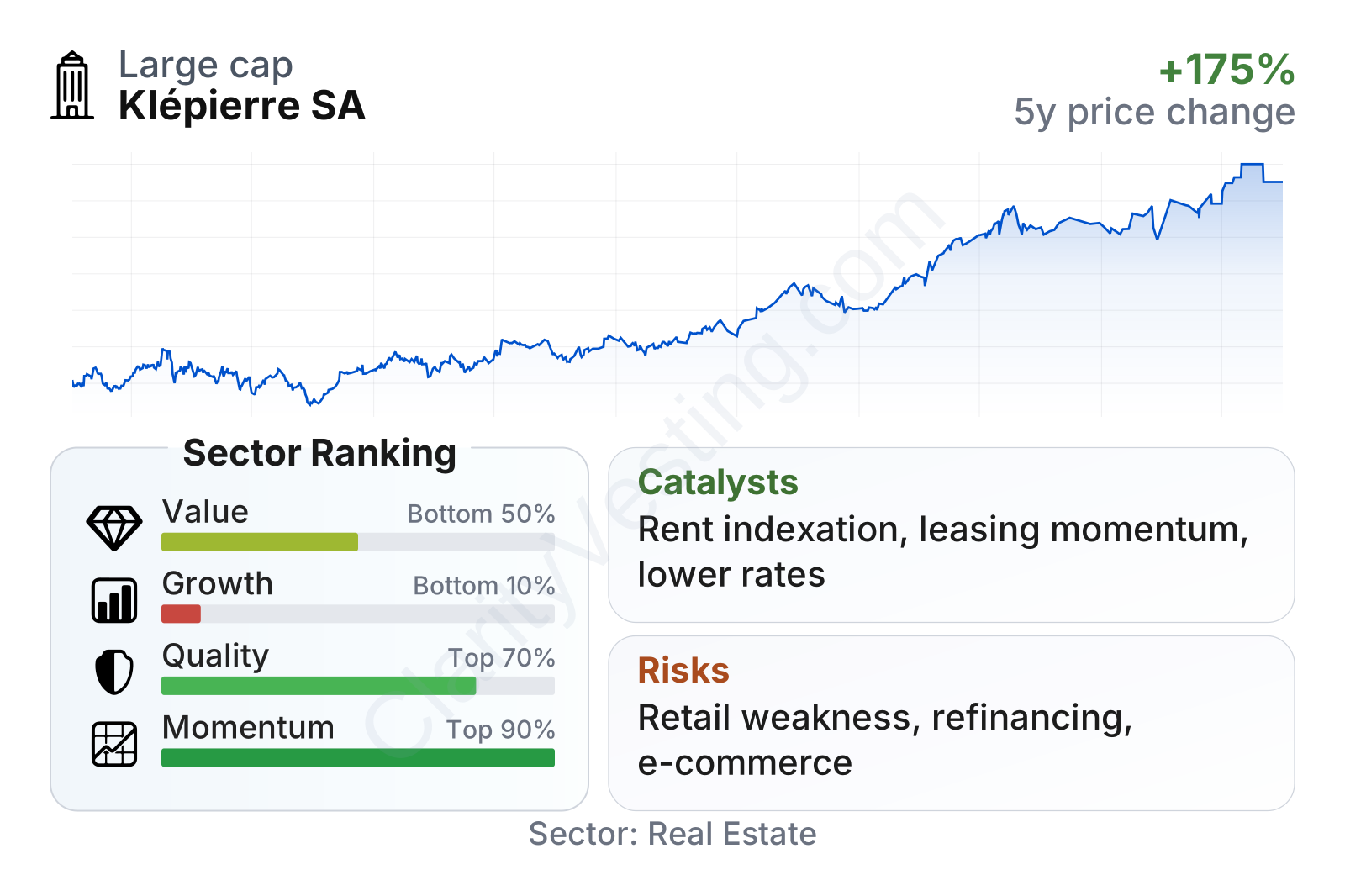
Klépierre is a large listed retail property owner with a market value in the low tens of billions of dollars and a stock volatility slightly below the broader market. The metrics present a mixed picture. On one hand, cash generation, leverage, profitability, and share price momentum compare well with many real estate peers. On the other hand, growth metrics are weak, which is typical of a mature landlord operating in a capital-intensive segment.
The valuation profile is not uniformly cheap or expensive depending on the metric used. Earnings and free cash flow measures look relatively undemanding, while the price-to-book multiple has moved above the sector median after a strong re-rating. That shift matters because property companies are often judged against the value of their underlying assets.
Growth
The company operates in a sector that is no longer treated as a high-growth area by the market, but the picture is more nuanced than that label suggests. Traditional retail real estate faces structural pressure from e-commerce, yet dominant shopping centers in large European cities can still grow through higher occupancy, rent indexation, tenant mix improvements, extensions, redevelopment projects, and stronger use of dining, services, and entertainment. In other words, the sector itself is mature, but prime assets can still compound value if they remain relevant destinations.
Klépierre’s strategy is broadly aligned with that reality. Rather than chasing rapid expansion, it focuses on dominant malls in densely populated catchment areas, portfolio rotation, operational discipline, and selective redevelopment. That approach makes sense for a business where preserving pricing power and occupancy can be more important than opening large numbers of new sites.
Revenue per share has been broadly stable over the last several years, with some fluctuation but no strong breakout trend. This supports the idea that Klépierre is currently more of a cash-generating asset manager than a fast-growing platform. For long-term analysis, that stability can still matter if rents keep compounding modestly and capital is allocated efficiently.
The dividend pattern has been uneven over the past few years, reflecting the after-effects of the pandemic period and the normalization of payouts afterward. More recently, the distribution appears to have settled into a more regular range, with a trailing yield around the mid-4% area. That is relevant because income remains a meaningful part of total return in retail real estate.
Several catalysts can support future progress. First, inflation-linked leases and rent indexation can help offset cost pressures. Second, continued retailer demand for prime physical locations can support occupancy and leasing spreads in top malls. Third, lower financing pressure in Europe, if sustained, could improve property values and refinancing conditions. Fourth, disciplined asset sales and redevelopment can unlock value without requiring aggressive balance-sheet expansion.
Recent company communication has also pointed to continued operational resilience, including healthy retailer sales trends and strong leasing activity in core assets. For a company like Klépierre, those operating indicators often matter more than headline revenue growth because they feed directly into rental strength, occupancy, and long-term asset values.
Risks
This article is for informational purposes only and does not constitute financial advice. Some content is AI-generated. See Disclaimer