Stock Analysis · Klarna Group plc (KLAR)
Overview
Klarna Group plc is a digital payments and consumer credit company best known for its buy now, pay later offering. It allows shoppers to pay immediately, split purchases into installments, or delay payment, while merchants use Klarna to improve checkout conversion, customer acquisition, and order values. Over time, Klarna has expanded beyond installment credit into a broader commerce network that includes payments, advertising and merchant marketing tools, a shopping app, and consumer banking-related products in selected markets.
The business model is built around serving two sides of the transaction. On one side are merchants that integrate Klarna at checkout and pay for payment processing and commerce-related services. On the other side are consumers who may generate interest income, late fees where permitted, interchange income from cards, and engagement within Klarna’s shopping ecosystem.
Based on the company’s recent annual reporting structure, revenue is mainly generated from transaction and service-based activity rather than from classic banking spread income alone. The mix can shift by geography and funding conditions, but the broad picture is:
- Merchant revenue: approximately 60% to 70% of revenue. This typically includes merchant fees tied to payment processing, checkout solutions, installment offerings, and commerce media or marketing services.
- Consumer and credit-related revenue: approximately 20% to 30% of revenue. This includes interest income on lending products and certain consumer fees, depending on product type and local regulation.
- Other financial and platform-related revenue: approximately 10% to 15% of revenue. This can include interchange, partner income, and other service-related streams.
Klarna’s recent financial path shows a company that grew revenue strongly from 2021 through 2025, improved operating profitability materially in 2024 and 2025, but still faced pressure from financing costs and credit-sensitive economics. That combination matters because the company sits between technology and lending: growth can be fast, but returns depend heavily on underwriting quality, funding access, and disciplined expense control.
The long-term trend is encouraging on the operating line: revenue expanded meaningfully over the past several years, gross profit also increased, and operating income moved from deep losses in 2021-2023 to positive territory in 2024 and 2025. At the same time, interest expense rose sharply, which explains why net profit recovery has been much slower than the improvement seen in operating profit.
Key Figures
| Metric | Value | Sector ⓘ |
|---|---|---|
| Date | Oct 10, 2026 | |
| Context | ||
| Sector | Financial Services | |
| Industry | Credit Services | |
| Market Cap ⓘ | $5.02B | |
| Beta ⓘ | N/A | |
Value (Cheapness) | ||
| P/E Ratio ⓘ | N/A | 12.38 |
| P/B Ratio ⓘ | 2.09 | 1.23 |
| FCF Yield ⓘ | -75.58% | 10.23% |
| Dividend Yield ⓘ | N/A | 3.01% |
| EBIT / EV ⓘ | 4.76% | 8.08% |
| PEG ⓘ | 0.08 | |
Growth (Business expansion) | ||
| Revenue Growth ⓘ | 26.60% | 9.50% |
| RPS Growth (5Y CAGR) ⓘ | 18.79% | 12.21% |
| EPS Growth (5Y CAGR) ⓘ | N/A | -9.62% |
| BVPS Growth (5Y CAGR) ⓘ | -3.18% | 4.98% |
| Margin Growth (5Y Trend) ⓘ | N/A | -4.07% |
| FCF Growth (5Y CAGR) ⓘ | 27.43% | 4.76% |
| DPS Growth (5Y CAGR) ⓘ | N/A | 8.79% |
Quality (Business durability) | ||
| ROIC (Latest) ⓘ | N/A | 9.35% |
| ROE (Latest) ⓘ | -6.06% | 13.91% |
| ROA (Latest) ⓘ | -0.74% | 1.53% |
| ROIC (5Y Median) ⓘ | N/A | 7.86% |
| ROE (5Y Median) ⓘ | -13.85% | 12.22% |
| ROA (5Y Median) ⓘ | -1.93% | 1.29% |
| Net Debt / EBIT (Latest) ⓘ | -9.12 | 0.99 |
| Net Debt / EBIT (5Y Median) ⓘ | N/A | 0.73 |
| Net Debt / EBITDA (Latest) ⓘ | -4.40 | 0.93 |
| Operating Margin (Latest) ⓘ | 2.67% | 22.19% |
| Operating Margin (5Y Median) ⓘ | -4.59% | 24.30% |
| Debt to Equity (Latest) ⓘ | 69.11% | 60.24% |
| Profit Margin (Latest) ⓘ | -3.52% | 26.49% |
| Free Cash Flow (Latest) ⓘ | -$3.80B | |
Momentum (Price trend) | ||
| 3Y Return ⓘ | N/A | +88.52% |
| 12M Return (excl. last month) ⓘ | N/A | +19.65% |
| 6M Return ⓘ | +0.75% | +6.00% |
| Price vs. 200-Day MA ⓘ | -23.96% | +3.61% |
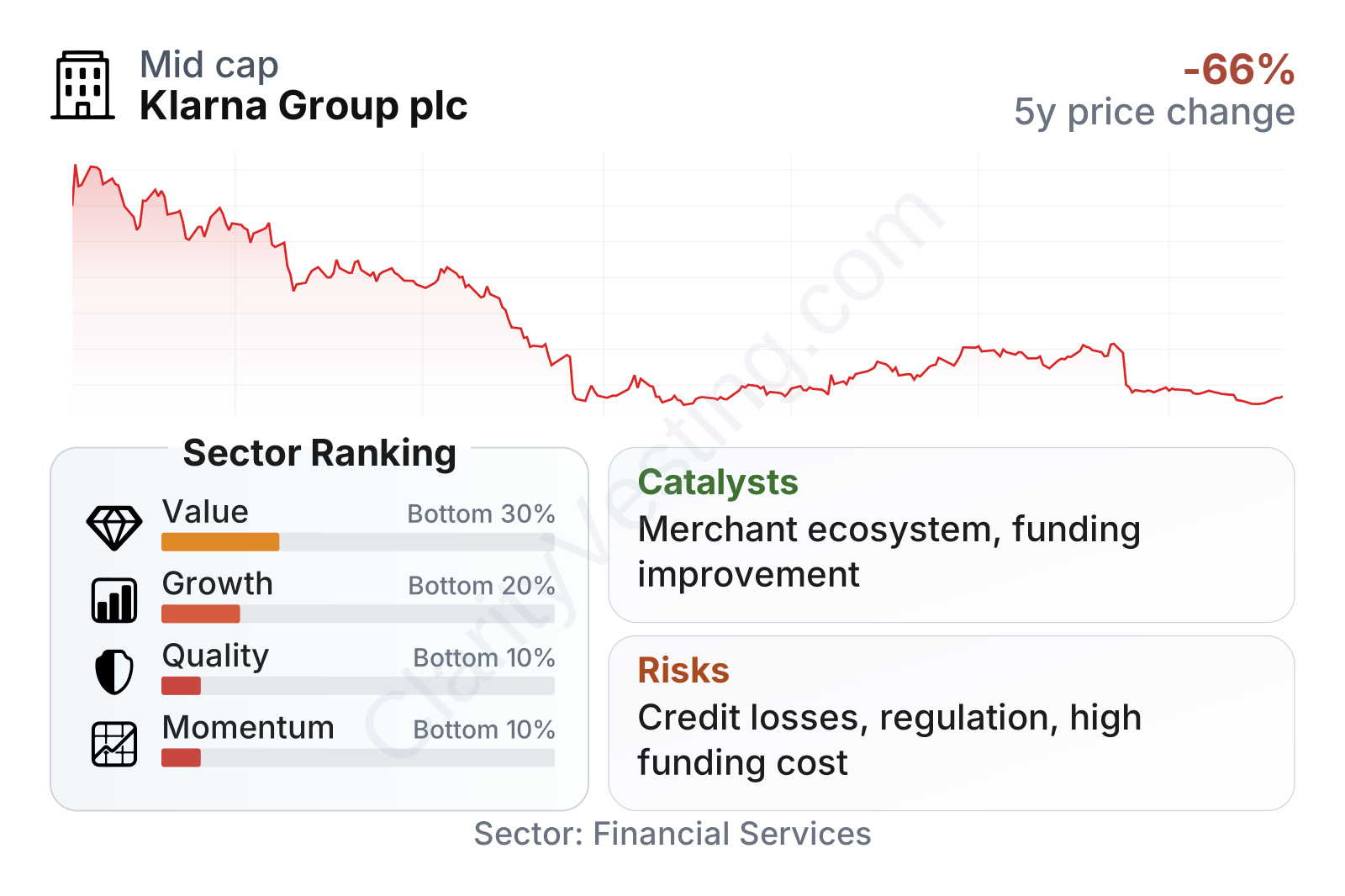
Klarna currently looks like a mid-sized listed financial services company with an unusual profile for the sector. Growth metrics are stronger than the industry median in several areas, especially revenue expansion and free cash flow progression over a multi-year period, but quality and momentum indicators remain weak. Profitability is still below normal sector standards, returns on equity and assets are negative, and the share price has fallen sharply since listing, which helps explain why value, quality, and momentum rankings remain near the lower end of the group despite fast top-line growth.
Growth
Klarna operates in a part of financial services that is still structurally growing. Digital checkout, embedded finance, and installment-based payment options continue to take share from traditional card and cash-based purchasing flows, especially in e-commerce. Even if the buy now, pay later category matures from its early hypergrowth phase, the broader market opportunity remains large because merchants increasingly want integrated payment, financing, and customer acquisition tools in one platform.
Klarna’s strategy for future expansion is logical. Instead of relying only on short-term installment lending, the company has been building a broader merchant and consumer ecosystem. That matters because pure lending can be cyclical and margin-sensitive, while platform services such as checkout, commerce media, and merchant partnerships can add recurring fee income and improve unit economics. A wider product set also gives Klarna more ways to monetize the same customer relationship.
A major positive is that revenue growth remains strong. The latest metrics indicate year-over-year revenue growth of about 27%, well above the sector median near 10%, and five-year revenue-per-share growth also appears ahead of the industry. This suggests Klarna is still gaining scale, even though its profitability profile is not yet mature.
Earnings remain a transition point rather than a finished strength. Klarna moved from heavy losses to near break-even and occasional profitability, but earnings per share are not yet consistently positive. For a long-term view, the key question is not just whether revenue grows, but whether that growth can keep turning into durable earnings after funding costs and credit losses.
Book value per share has been uneven over the past few years, declining before showing some recovery more recently. That pattern fits a company that went through a major reset, then stabilized. In financial businesses, book value matters because it reflects the capital base supporting lending and operations. A steadier upward trend would strengthen the case that Klarna’s growth is creating durable shareholder value rather than simply requiring ongoing balance-sheet support.
One of the clearest catalysts is the company’s ability to convert its large consumer and merchant network into higher-value services. If Klarna succeeds in expanding advertising, merchant software, and payment orchestration alongside lending, it can become less dependent on credit spreads alone. Another important catalyst is lower funding pressure: if interest costs normalize or Klarna secures more efficient funding, the gap between operating profit and net profit could narrow materially.
Recent corporate developments have also kept attention on scale opportunities in the U.S. and partnerships with large commerce and payments platforms. Those relationships matter because distribution is critical in payments: once integrated into major merchant ecosystems, a provider can strengthen volume growth without having to win each customer one by one.
Risks
This article is for informational purposes only and does not constitute financial advice. Some content is AI-generated. See Disclaimer