Stock Analysis · Kier Group plc (KIERF)
Overview
Kier Group plc is a U.K.-based construction, infrastructure, and property services company. Its work is centered on building and maintaining public infrastructure such as schools, hospitals, roads, rail-related assets, water facilities, and defense or justice buildings. In simple terms, Kier helps design, build, upgrade, and maintain the physical systems that governments, utilities, and large organizations rely on every day.
The business is organized around a mix of construction delivery, infrastructure services, and long-term maintenance contracts. That matters for long-term analysis because construction can be cyclical and lower-margin, while maintenance and utility-related services can add steadier demand and recurring work.
Based on the company’s latest annual reporting structure, revenue is mainly generated from the following activities:
- Construction: approximately 50% to 55% of group revenue. This includes building public and private sector facilities such as education, healthcare, custodial, defense, and commercial projects.
- Transportation: approximately 20% to 25%. This covers road, rail, and related civil infrastructure work, including upgrades, maintenance, and framework-based contracts.
- Natural Resources, Nuclear & Networks: approximately 20% to 25%. This area includes water, energy, utilities, nuclear-related infrastructure, and network services.
- Property and other activities: generally a small share of revenue, typically linked to property development gains, residential-led projects, or central activities rather than the main volume driver.
Kier’s client base is heavily exposed to public-sector and regulated markets. That can reduce dependence on purely discretionary commercial building demand, although it also ties performance to government budgets, procurement timing, and project execution discipline.
Looking at the business flow over recent years, revenue has moved upward from a little above £3.1 billion in fiscal 2022 to about £4.3 billion in fiscal 2026, while operating profit and net income have also improved. The main takeaway is that the company has expanded activity and lifted profitability, but margins remain thin, which is typical in contracting businesses.
The recent progression shows a larger business than four years ago, with higher profit than in 2022, but still a narrow earnings spread on a very large revenue base. That combination is common in construction: scale can grow faster than profit, so execution quality matters more than headline sales growth alone.
Key Figures
| Metric | Value | Sector ⓘ |
|---|---|---|
| Date | Oct 17, 2026 | |
| Context | ||
| Sector | Industrials | |
| Industry | Engineering & Construction | |
| Market Cap ⓘ | $1.74B | |
| Beta ⓘ | 0.80 | |
Value (Cheapness) | ||
| P/E Ratio ⓘ | 22.69 | 22.10 |
| P/B Ratio ⓘ | 3.67 | 1.97 |
| FCF Yield ⓘ | 23.56% | 6.38% |
| Dividend Yield ⓘ | 1.91% | 1.94% |
| EBIT / EV ⓘ | 13.88% | 4.79% |
| PEG ⓘ | N/A | |
Growth (Business expansion) | ||
| Revenue Growth ⓘ | 11.20% | 9.30% |
| RPS Growth (5Y CAGR) ⓘ | 7.89% | 7.81% |
| EPS Growth (5Y CAGR) ⓘ | N/A | -13.06% |
| BVPS Growth (5Y CAGR) ⓘ | -2.37% | 6.14% |
| Margin Growth (5Y Trend) ⓘ | 1.24% | 0.88% |
| FCF Growth (5Y CAGR) ⓘ | 33.49% | 11.01% |
| DPS Growth (5Y CAGR) ⓘ | -22.61% | 9.48% |
Quality (Business durability) | ||
| ROIC (Latest) ⓘ | N/A | 10.84% |
| ROA (Latest) ⓘ | 3.42% | 5.41% |
| ROIC (5Y Median) ⓘ | 5.57% | 9.38% |
| ROA (5Y Median) ⓘ | 1.61% | 4.95% |
| Net Debt / EBIT (Latest) ⓘ | -0.23 | 2.08 |
| Net Debt / EBIT (5Y Median) ⓘ | 0.75 | 2.27 |
| Net Debt / EBITDA (Latest) ⓘ | -0.13 | 1.39 |
| Net Debt / Assets ⓘ | -1.38% | 19.28% |
| EBITDA / Interest ⓘ | 5.17 | 9.58 |
| Operating Margin (Latest) ⓘ | 2.78% | 10.50% |
| Operating Margin (5Y Median) ⓘ | 2.67% | 10.29% |
| Debt to Equity (Latest) ⓘ | 360.81% | 65.48% |
| Profit Margin (Latest) ⓘ | 1.42% | 6.67% |
| Free Cash Flow (Latest) ⓘ | $409.34M | |
Momentum (Price trend) | ||
| 3Y Return ⓘ | +182.37% | +61.68% |
| 12M Return (excl. last month) ⓘ | +50.03% | +12.58% |
| 6M Return ⓘ | +50.44% | 0.00% |
| Price vs. 200-Day MA ⓘ | +39.44% | +0.02% |
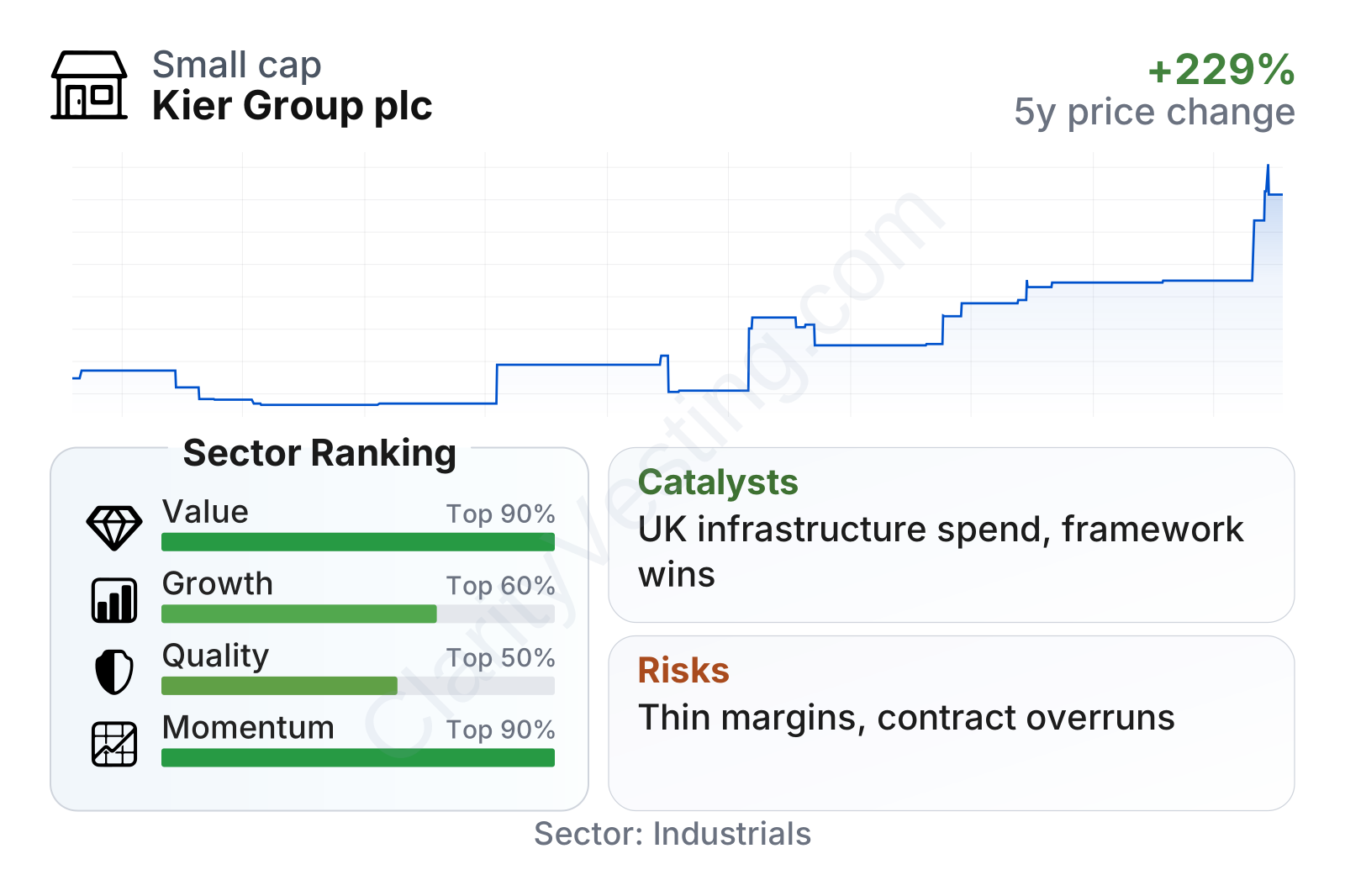
The share price has been volatile but the longer trend has been strongly upward, with a particularly sharp move over the last year. On the fundamental side, valuation looks mixed rather than uniformly cheap or expensive: earnings multiples are around sector norms, but cash-flow-based measures appear stronger than many peers. Free cash flow stands out as a relative strength, and net debt metrics are unusually favorable for the sector, with the company currently in a modest net cash position on some measures. At the same time, profitability remains below sector medians, especially on operating margin and return on assets, which reflects the low-margin nature of the business. Overall, the figures point to a company that has improved financially and generates cash well, but still operates in a sector where small margin changes can have an outsized effect on results.
Growth
Kier operates in parts of the market that have structural support. In the U.K., long-term needs remain significant in transport infrastructure, water networks, power systems, public buildings, and maintenance of aging assets. These are not short-lived themes. They are tied to national investment plans, regulated utility spending, housing-related enabling works, decarbonization efforts, and resilience upgrades. That gives the company exposure to sectors that should remain active even when private real-estate development is weaker.
The company’s strategy is broadly coherent for future growth because it has become more selective, with greater emphasis on disciplined bidding, cash generation, and framework agreements rather than chasing volume at any price. For a contractor, that is important. Construction groups often run into trouble when they expand too aggressively on low-margin fixed-price jobs. Kier’s recent financial progress suggests management has been prioritizing contract quality alongside revenue growth.
A meaningful catalyst is the company’s positioning in public infrastructure and regulated markets. Multi-year frameworks in transportation, water, utilities, defense, and public buildings can provide repeat business without needing to win each project from scratch. Another catalyst is the continuing requirement for infrastructure renewal in the U.K., especially in areas linked to road maintenance, rail-related works, water investment, and energy transition projects.
Recent operating momentum also supports the growth case. Revenue has kept rising into fiscal 2026, and free cash flow growth over a multi-year period has been much stronger than the sector median. This matters because in contracting, reported profit can look acceptable while cash performance disappoints. Kier’s recent pattern has been more encouraging than that.
There is also a market-based signal worth noticing: the stock’s three-year and six-month performance has been substantially stronger than the sector median. That does not prove future business success, but it usually indicates that the market has recognized improving fundamentals, balance sheet repair, or better confidence in earnings quality.
Risks
This article is for informational purposes only and does not constitute financial advice. Some content is AI-generated. See Disclaimer


