Stock Analysis · The Kraft Heinz Company (KHC)
Overview
The Kraft Heinz Company is one of the largest packaged food businesses in North America. It sells branded grocery products across condiments and sauces, cheese and dairy, meals, meats, coffee, and other pantry staples. Its portfolio includes globally recognized names such as Heinz, Kraft, Philadelphia, Lunchables, Oscar Mayer, Capri Sun, Jell-O, Maxwell House, and Velveeta. The business is built around products that are widely distributed through supermarkets, mass merchants, club stores, convenience stores, foodservice channels, and e-commerce.
Kraft Heinz generates revenue mainly from selling packaged foods and beverages, with North America remaining the center of the business. Based on the company’s recent annual reporting, revenue is broadly split as follows:
- United States: about 70% — the company’s largest market, covering its core grocery and household food brands sold through retail and foodservice.
- International Developed Markets: about 20% — includes markets such as Canada, Europe, Australia, and New Zealand, where Heinz and Philadelphia are especially important.
- Emerging Markets: about 10% — includes Latin America, Asia, Eastern Europe, the Middle East, and Africa, where the company is trying to expand distribution and local relevance.
By category, condiments and sauces are generally among the largest contributors, followed by cheese and dairy, easy meals, and meats, although the company reports primarily by geography rather than a detailed category profit split. The business model is straightforward: Kraft Heinz relies on brand recognition, shelf space, repeat purchases, and pricing power in everyday food products.
The longer-term financial picture shows a business that still produces large gross profit and cash flow, but with pressure from weaker sales and major non-cash charges affecting reported earnings in recent periods. Revenue has drifted down from the mid-$26 billion range toward the mid-$24 billion range over the past several years, while free cash flow has remained substantial.
The operating profile has changed notably in the last two years. Gross profit has held up better than sales, which suggests pricing and cost control still matter, but operating income and net income were distorted by unusually large charges in 2024 and especially 2025. That makes cash generation more informative than headline earnings alone when assessing the underlying business.
Key Figures
| Metric | Value | Sector ⓘ |
|---|---|---|
| Date | Oct 10, 2026 | |
| Context | ||
| Sector | Consumer Defensive | |
| Industry | Packaged Foods | |
| Market Cap ⓘ | $25.90B | |
| Beta ⓘ | 0.11 | |
Value (Cheapness) | ||
| P/E Ratio ⓘ | N/A | 17.64 |
| P/B Ratio ⓘ | 0.73 | 1.27 |
| FCF Yield ⓘ | 14.73% | 12.68% |
| Dividend Yield ⓘ | 7.21% | 2.85% |
| EBIT / EV ⓘ | -6.91% | 6.32% |
| PEG ⓘ | 0.99 | |
Growth (Business expansion) | ||
| Revenue Growth ⓘ | -1.40% | 3.85% |
| RPS Growth (5Y CAGR) ⓘ | -0.07% | 6.20% |
| EPS Growth (5Y CAGR) ⓘ | -21.17% | -14.31% |
| BVPS Growth (5Y CAGR) ⓘ | -3.14% | 3.33% |
| Margin Growth (5Y Trend) ⓘ | -32.45% | -0.17% |
| FCF Growth (5Y CAGR) ⓘ | -4.81% | 4.37% |
| DPS Growth (5Y CAGR) ⓘ | 0.22% | 6.68% |
Quality (Business durability) | ||
| ROIC (Latest) ⓘ | -4.06% | 12.58% |
| ROA (Latest) ⓘ | -4.39% | 6.32% |
| ROIC (5Y Median) ⓘ | 4.44% | 10.38% |
| ROA (5Y Median) ⓘ | 2.57% | 5.44% |
| Net Debt / EBIT (Latest) ⓘ | N/A | 1.92 |
| Net Debt / EBIT (5Y Median) ⓘ | 4.89 | 2.32 |
| Net Debt / EBITDA (Latest) ⓘ | N/A | 1.36 |
| Net Debt / Assets ⓘ | 22.69% | 21.29% |
| EBITDA / Interest ⓘ | N/A | 9.52 |
| Operating Margin (Latest) ⓘ | -12.36% | 8.88% |
| Operating Margin (5Y Median) ⓘ | 14.42% | 9.53% |
| Debt to Equity (Latest) ⓘ | 52.77% | 71.95% |
| Profit Margin (Latest) ⓘ | -13.64% | 5.37% |
| Free Cash Flow (Latest) ⓘ | $3.82B | |
Momentum (Price trend) | ||
| 3Y Return ⓘ | -18.72% | +18.12% |
| 12M Return (excl. last month) ⓘ | -2.71% | +2.64% |
| 6M Return ⓘ | -3.32% | +1.32% |
| Price vs. 200-Day MA ⓘ | -5.23% | +0.17% |
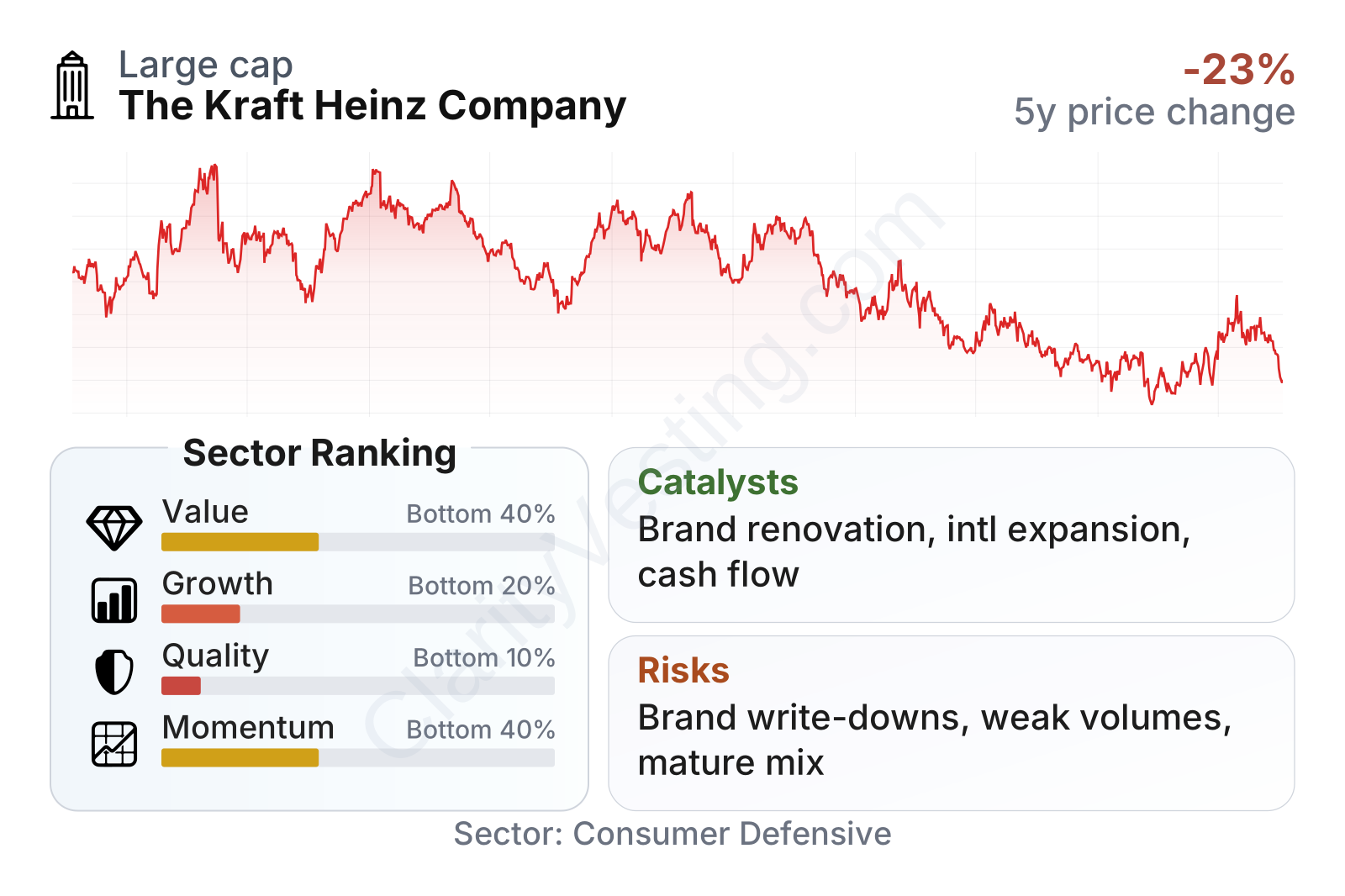
Kraft Heinz is a large-cap consumer staples company with unusually low share-price volatility, as shown by its very low beta. On valuation-related metrics, the picture is mixed rather than uniformly cheap: the dividend yield and free cash flow yield stand above the sector median, while the overall value ranking still lands in the lower half because earnings quality has been distorted by recent charges. Growth and quality metrics are the weaker areas, both ranking in the bottom 20% of the sector, reflecting declining sales, weaker long-term earnings trends, and balance-sheet pressure relative to stronger peers.
The stock’s trading history over the past several years also shows the market’s skepticism. The shares have trended lower since 2022 even though the recent six-month performance improved. In other words, the market has started to stabilize its view of the business, but it has not yet restored a premium rating.
Growth
Packaged foods is not a high-growth industry, but it is a durable one. Demand for pantry staples, sauces, prepared meals, and lunch products tends to be steady because these are recurring household purchases. That gives Kraft Heinz a degree of resilience, but it also means growth usually comes from pricing, product renovation, market share gains, premiumization, and expansion in newer channels rather than from a rapidly expanding industry.
Kraft Heinz’s current strategy is centered on modernizing brands, improving innovation, investing in marketing, and focusing resources on categories where it has stronger consumer recognition. The company has also emphasized productivity programs and supply-chain efficiencies, which matter in a business where margins can be heavily influenced by commodity and packaging costs. In principle, this strategy makes sense for a mature food company: defend core brands, keep pricing disciplined, and use cash flow to support brand investment and debt management.
The recent sales pattern remains the main challenge to the growth case. After a period of positive growth in 2022 and early 2023, year-over-year revenue turned negative for most quarters that followed. The latest reading is still slightly below the sector median, which shows Kraft Heinz is lagging much of the broader consumer defensive group on top-line momentum. A return to sustained organic volume growth would be more meaningful than further price-led gains alone.
One encouraging point is cash generation. Free cash flow has been volatile, but it recovered strongly and remains in the multi-billion-dollar range. That matters because mature branded-food companies often create value through consistent cash conversion even when revenue growth is modest. Stronger cash flow can support dividends, debt reduction, and selective reinvestment behind core brands.
Several catalysts could support better performance over time. International expansion remains one of the clearest opportunities because Kraft Heinz is still much more concentrated in the United States than some global peers. The company also continues to work on product renovation in faster-changing areas such as sauces, snacking, and convenient meals. If volume trends improve while commodity costs remain manageable, operating performance could recover faster than revenue alone suggests.
Recent company communications have also pointed to sharper portfolio focus and organizational simplification. For a business with many mature brands, execution quality matters more than headline disruption. The opportunity is less about finding a brand-new market and more about improving relevance, distribution, and profitability across an existing portfolio that already has broad household recognition.
Risks
This article is for informational purposes only and does not constitute financial advice. Some content is AI-generated. See Disclaimer