Stock Analysis · Krung Thai Bank Public Company Limited (KGTFF)
Overview
Krung Thai Bank Public Company Limited is one of Thailand’s largest commercial banks. It provides everyday banking services such as deposits, loans, payments, cards, wealth products, and corporate banking. The bank has a particularly important role in Thailand because it is closely linked to public-sector payment flows and government-related digital platforms, which gives it reach across retail customers, businesses, and state-connected activities.
Like most banks, its revenue mainly comes from the spread between what it earns on loans and investments and what it pays on deposits and funding, plus fees from financial services. Based on the bank’s business model and public reporting structure, the main revenue sources can be summarized as follows:
- Net interest income: approximately 70% to 80% of total operating income in a typical year. This includes interest from corporate loans, retail lending, SME lending, interbank assets, and investment securities, minus interest paid on deposits and other funding.
- Fee and service income: approximately 10% to 20%. This usually includes transaction fees, payment services, cards, fund transfer services, wealth-related fees, trade finance, and loan-related service charges.
- Investment and trading income: approximately 5% to 10%. This covers gains or income from securities, treasury activities, and market-related operations.
- Other operating income: generally a smaller contribution. This can include recoveries, foreign exchange-related items, and other miscellaneous banking income.
The earnings profile has improved meaningfully over the past few years. Total revenue climbed from about $4.0 billion in 2021 to about $5.8 billion in 2025, while net income more than doubled over the same period. Operating income also moved steadily higher, suggesting that growth has not come only from one-time items. The latest annual path shows a small revenue pullback in 2025 after strong 2024 growth, but profitability still increased, helped by expense control and resilient margins.
The business mix shown here points to a bank with expanding profit generation: revenue and net income are both well above 2021 levels, while operating expenses have grown much more slowly than revenue. That operating leverage is one of the more encouraging underlying trends.
Key Figures
| Metric | Value | Sector ⓘ |
|---|---|---|
| Date | Nov 21, 2026 | |
| Context | ||
| Sector | Financial Services | |
| Industry | Banks - Regional | |
| Market Cap ⓘ | $17.71B | |
| Beta ⓘ | 0.03 | |
Value (Cheapness) | ||
| P/E Ratio ⓘ | 11.45 | 12.01 |
| P/B Ratio ⓘ | N/A | 1.48 |
| FCF Yield ⓘ | 19.75% | 8.77% |
| Dividend Yield ⓘ | 5.10% | 3.01% |
| EBIT / EV ⓘ | N/A | 8.31% |
| PEG ⓘ | 3.32 | |
Growth (Business expansion) | ||
| Revenue Growth ⓘ | -11.60% | 6.70% |
| RPS Growth (5Y CAGR) ⓘ | 9.94% | 12.35% |
| EPS Growth (5Y CAGR) ⓘ | -17.03% | -0.27% |
| BVPS Growth (5Y CAGR) ⓘ | 5.31% | 4.83% |
| Margin Growth (5Y Trend) ⓘ | 10.43% | -4.16% |
| FCF Growth (5Y CAGR) ⓘ | N/A | 4.69% |
| DPS Growth (5Y CAGR) ⓘ | 63.83% | 8.82% |
Quality (Business durability) | ||
| ROIC (Latest) ⓘ | N/A | 9.49% |
| ROE (Latest) ⓘ | 10.88% | 14.02% |
| ROA (Latest) ⓘ | 1.22% | 1.53% |
| ROIC (5Y Median) ⓘ | 5.06% | 7.80% |
| ROE (5Y Median) ⓘ | 9.84% | 12.09% |
| ROA (5Y Median) ⓘ | 1.01% | 1.28% |
| Net Debt / EBIT (Latest) ⓘ | N/A | 0.88 |
| Net Debt / EBIT (5Y Median) ⓘ | -1.40 | 0.73 |
| Net Debt / EBITDA (Latest) ⓘ | 4.87 | 0.71 |
| Operating Margin (Latest) ⓘ | N/A | 23.37% |
| Operating Margin (5Y Median) ⓘ | 29.05% | 24.29% |
| Debt to Equity (Latest) ⓘ | 78.54% | 59.34% |
| Profit Margin (Latest) ⓘ | 38.56% | 26.65% |
| Free Cash Flow (Latest) ⓘ | $3.50B | |
Momentum (Price trend) | ||
| 3Y Return ⓘ | +286.62% | +73.29% |
| 12M Return (excl. last month) ⓘ | +111.86% | +18.35% |
| 6M Return ⓘ | +25.47% | +3.24% |
| Price vs. 200-Day MA ⓘ | +182.35% | +2.17% |
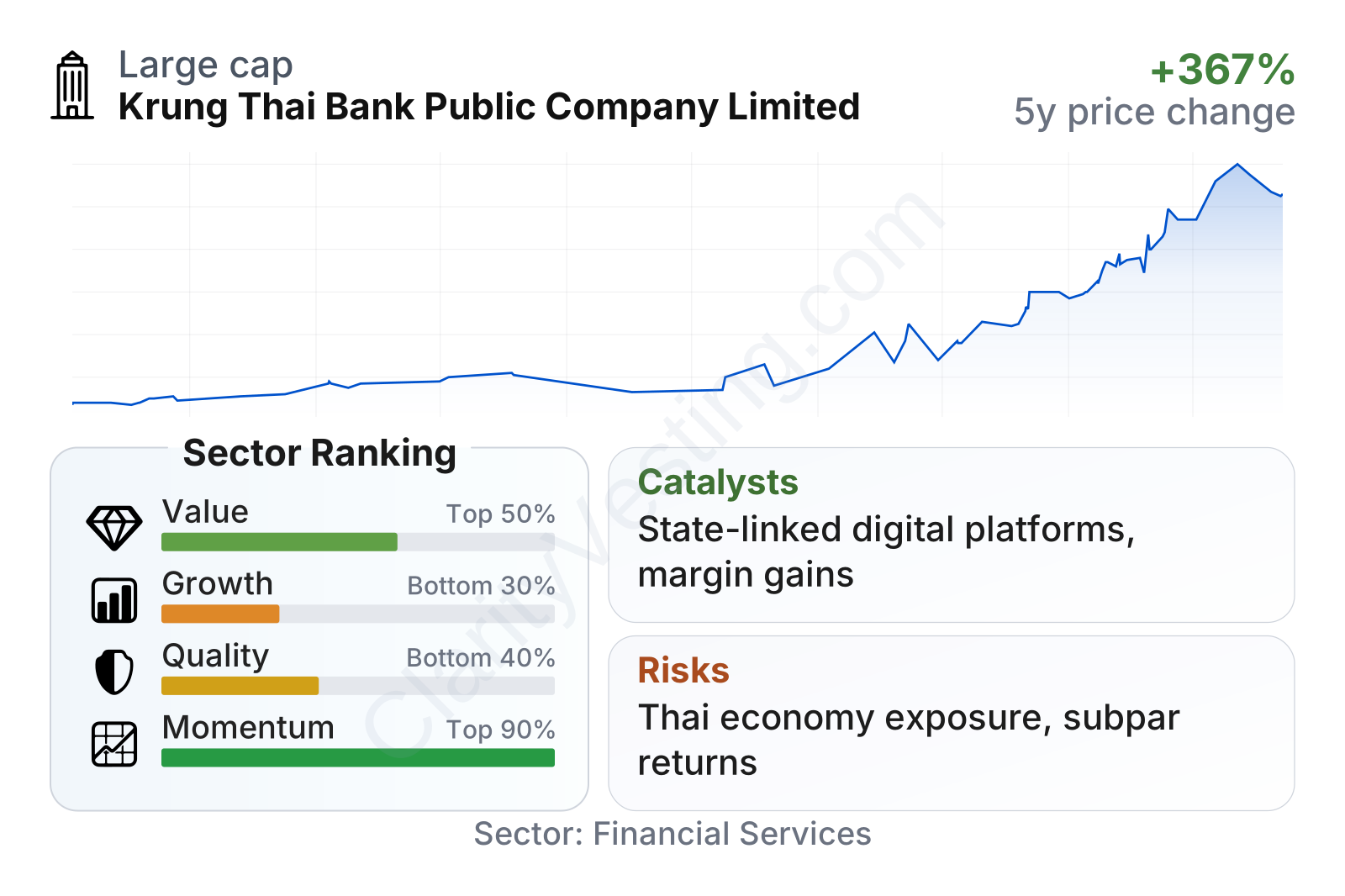
Krung Thai Bank is a large regional bank by market value, with very low observed beta in the available market data, which suggests the stock has not moved closely with broader market swings. On valuation, the shares trade around the sector median on earnings, while the dividend yield is above the sector median and free cash flow yield appears notably strong. That combination gives the bank a relatively solid value profile.
The weaker area is growth. Recent revenue growth is negative year over year, and the longer-term earnings growth record trails the sector. Quality is mixed rather than weak across the board: profitability margins are strong, but returns on equity and assets remain below sector medians. Momentum stands out as the strongest factor, with share-price performance over 6 months, 12 months, and 3 years far ahead of the sector median.
Growth
Krung Thai operates in a sector that is mature, but still capable of steady expansion through digital adoption, transaction growth, and credit demand tied to the Thai economy. In banking, growth does not usually look like rapid disruption; it tends to come from loan expansion, better pricing, wider use of digital channels, lower servicing costs, and a larger base of customers using multiple products. On that basis, Krung Thai’s strategy appears coherent.
A central part of that strategy is digital infrastructure. Krung Thai has been deeply involved in Thailand’s digital payments ecosystem and public-service platforms, which matters because these connections can lower customer acquisition costs and increase daily engagement. When a bank becomes a routine gateway for payments, transfers, public disbursements, and mobile financial services, it can create cross-selling opportunities in deposits, lending, and fee-based products.
Earnings per share have moved upward each year from 2021 through 2024, which supports the view that the bank’s recent improvement is operational rather than purely cosmetic. That said, the first-quarter annualized figure should be read carefully because banks can show seasonal variation and quarterly credit costs can move around.
Book value per share has also been trending higher, which is important for a bank because it indicates gradual capital accumulation. The five-year growth rate in book value per share is slightly ahead of the sector median, even though earnings growth has lagged. In simple terms, the bank has been steadily building its financial base, even if its profit growth has not been the strongest in the peer group.
One visible catalyst is the continued expansion of Thailand’s digital financial ecosystem, especially where Krung Thai is embedded in public payments and consumer-facing mobile services. Another is the bank’s ability to translate revenue gains into stronger profits through expense discipline; operating margin trend over five years is better than the sector median. If that continues, even moderate top-line growth could still support earnings progress.
Recent business developments have also supported a constructive backdrop for Thai banks more broadly, including normalizing credit activity, continued digital payment usage, and policy support for financial access and modernized payment rails. For Krung Thai specifically, its state-linked positioning and national platform relevance remain important structural opportunities.
Risks
This article is for informational purposes only and does not constitute financial advice. Some content is AI-generated. See Disclaimer


