Stock Analysis · Kodiak Gas Services Inc (KGS)
Overview
Kodiak Gas Services is a U.S. contract compression company serving the natural gas and oil production industry. In simple terms, it provides large compression equipment that helps move natural gas from the wellhead through gathering systems and processing infrastructure. This is a necessary step in getting gas to market, so the company sits in a critical part of the upstream and midstream energy chain.
The business model is built mainly around renting compression units under service contracts rather than selling equipment outright. That creates recurring revenue and gives Kodiak ongoing exposure to production activity in major U.S. basins, especially where associated gas volumes continue to rise alongside oil drilling.
Based on company filings, Kodiak’s revenue is heavily concentrated in service-based compression activities. The mix is generally organized as follows:
- Contract services and related compression revenue: approximately 95%+ — monthly service fees for compression horsepower deployed in the field, maintenance support, and other operating services tied to those units.
- Parts, repairs, and ancillary service work: approximately 1% to 4% — non-recurring support work, overhauls, and related items.
- Equipment and other sales: usually a very small share — occasional asset sales or miscellaneous revenue streams that are not the core of the model.
Kodiak’s financial flow shows a business that has scaled revenue meaningfully over the last several years, while gross profit has also expanded. The main drag on earnings has been interest expense, which was very heavy in earlier years and helps explain why accounting profit lagged behind operating progress for a time.
Key Figures
| Metric | Value | Sector ⓘ |
|---|---|---|
| Date | Oct 10, 2026 | |
| Context | ||
| Sector | Energy | |
| Industry | Oil & Gas Equipment & Services | |
| Market Cap ⓘ | $5.65B | |
| Beta ⓘ | 0.94 | |
Value (Cheapness) | ||
| P/E Ratio ⓘ | 64.99 | 14.91 |
| P/B Ratio ⓘ | 2.45 | 1.67 |
| FCF Yield ⓘ | 0.09% | 8.53% |
| Dividend Yield ⓘ | 3.66% | 3.63% |
| EBIT / EV ⓘ | 3.92% | 7.44% |
| PEG ⓘ | N/A | |
Growth (Business expansion) | ||
| Revenue Growth ⓘ | 21.10% | 27.10% |
| RPS Growth (5Y CAGR) ⓘ | 16.62% | 6.85% |
| EPS Growth (5Y CAGR) ⓘ | 175.25% | -15.33% |
| BVPS Growth (5Y CAGR) ⓘ | 1.80% | 6.02% |
| Margin Growth (5Y Trend) ⓘ | -10.30% | 0.64% |
| FCF Growth (5Y CAGR) ⓘ | 55.96% | 3.59% |
| DPS Growth (5Y CAGR) ⓘ | 231.55% | 16.79% |
Quality (Business durability) | ||
| ROIC (Latest) ⓘ | 5.63% | 11.33% |
| ROA (Latest) ⓘ | 1.63% | 6.03% |
| ROIC (5Y Median) ⓘ | 5.27% | 10.19% |
| ROA (5Y Median) ⓘ | 1.84% | 5.40% |
| Net Debt / EBIT (Latest) ⓘ | -0.16 | 1.60 |
| Net Debt / EBIT (5Y Median) ⓘ | 8.77 | 1.91 |
| Net Debt / EBITDA (Latest) ⓘ | -0.09 | 1.05 |
| Net Debt / Assets ⓘ | -0.95% | 17.29% |
| EBITDA / Interest ⓘ | 2.95 | 9.65 |
| Operating Margin (Latest) ⓘ | 22.73% | 16.21% |
| Operating Margin (5Y Median) ⓘ | 30.30% | 19.99% |
| Debt to Equity (Latest) ⓘ | 3.95% | 54.41% |
| Profit Margin (Latest) ⓘ | 5.77% | 8.79% |
| Free Cash Flow (Latest) ⓘ | $5.01M | |
Momentum (Price trend) | ||
| 3Y Return ⓘ | +266.31% | +70.76% |
| 12M Return (excl. last month) ⓘ | +83.96% | +46.44% |
| 6M Return ⓘ | -6.33% | +0.36% |
| Price vs. 200-Day MA ⓘ | -5.24% | +8.00% |
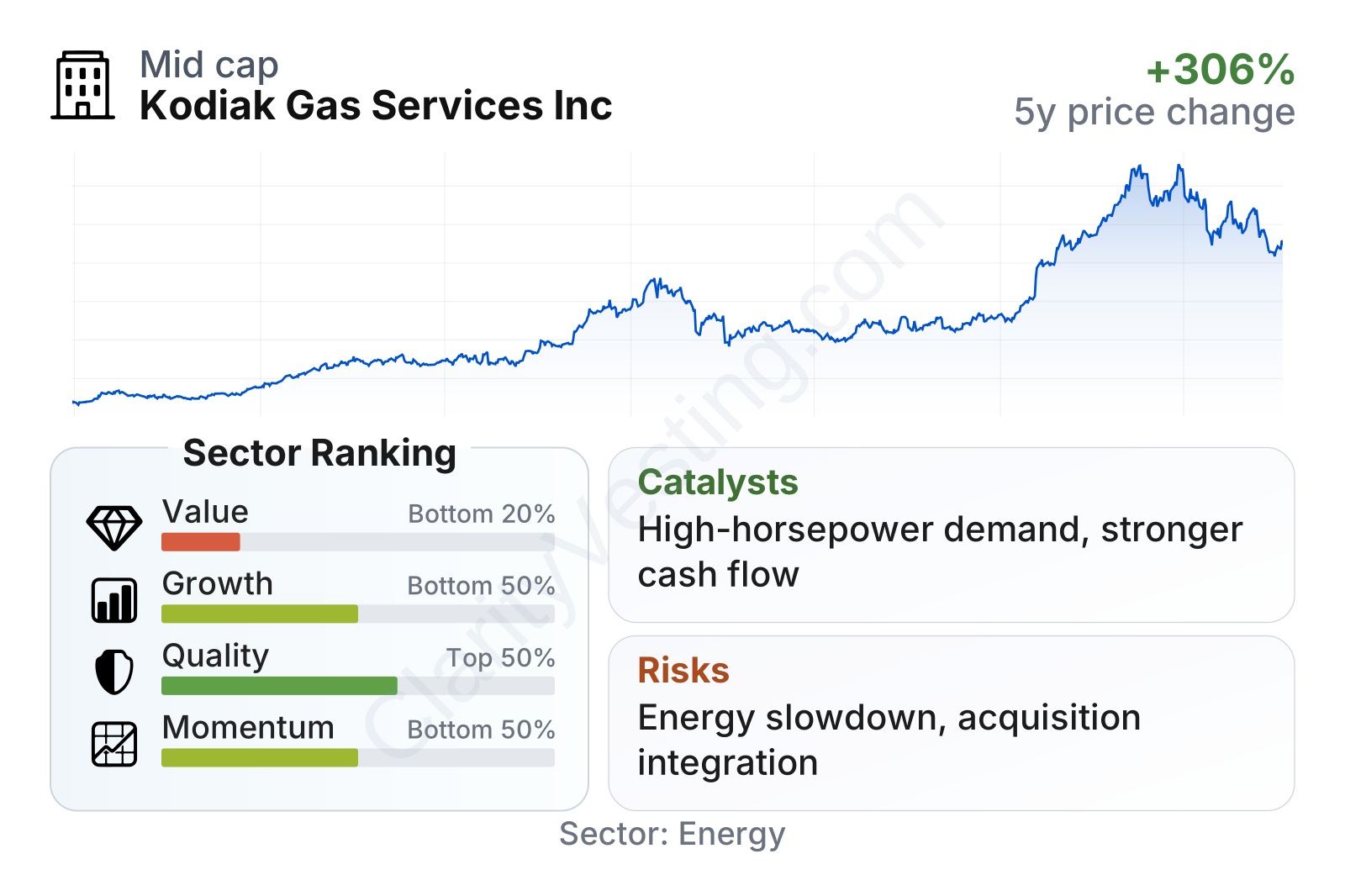
Kodiak is now a mid-sized public energy services company with a market value above $5 billion and a beta below 1, which suggests the stock has recently been somewhat less volatile than the broader market. The factor picture is mixed. Quality metrics are decent overall, helped by strong operating margins and a balance sheet that now looks much cleaner than it did in prior periods. Growth metrics are uneven in the short term but much stronger over a multiyear horizon, especially for revenue per share, earnings growth, free cash flow expansion, and dividend growth. The weaker area is valuation, where the shares screen as expensive relative to much of the energy sector, particularly on earnings and cash flow yield.
Growth
Kodiak operates in a part of the energy market that still has a clear long-term role. Natural gas remains an important fuel for power generation, industrial use, LNG exports, and petrochemical demand. Even in a transition-focused environment, gas infrastructure needs compression to function, and rising gas volumes from U.S. shale basins can support demand for the company’s equipment fleet.
The company’s strategy is straightforward and sensible for this industry: add horsepower, keep utilization high, lock in service contracts, and deepen relationships with large exploration and production customers. Scale matters here because customers want reliable fleets, maintenance support, replacement availability, and broad basin coverage. Kodiak has been building that scale both organically and through acquisitions.
Recent revenue growth has remained positive, but the pattern has not been linear. Growth was very strong through much of 2024 and early 2025, then slowed sharply before re-accelerating in 2026. That suggests the company is still expanding, but results can be affected by the timing of fleet additions, customer activity, and integration effects from acquisitions rather than moving up in a smooth straight line.
Cash generation appears to be one of the more encouraging parts of the recent profile. Free cash flow moved from modest levels into a much stronger range over the last year, which matters because this is a capital-intensive business. Better cash generation can support debt reduction, fleet investment, dividends, and acquisitions without relying as heavily on outside financing.
A notable catalyst has been Kodiak’s larger scale after recent transactions and fleet growth. The company has emphasized increased horsepower deployment, high demand for large-horsepower compression, and long-term customer relationships. If U.S. natural gas infrastructure remains busy and producers continue demanding compression in oily basins and gas-focused regions, Kodiak has room to keep compounding revenue and operating income. Public company updates have also pointed to continued contract compression demand and a sizable fleet positioned in active basins, which supports the idea that the growth backdrop remains real rather than purely cyclical optimism.
Risks
This article is for informational purposes only and does not constitute financial advice. Some content is AI-generated. See Disclaimer