Stock Analysis · Kingdee International Software Group Co Ltd (KGDEY)
Overview
Kingdee International Software Group is a Chinese enterprise software company focused on helping businesses manage finance, operations, human resources, supply chains, manufacturing, and other internal processes through cloud software. In simple terms, it sells digital tools that companies use to run their day-to-day activities. Its core market is China, where it serves large enterprises, mid-sized companies, and smaller businesses through different software platforms.
The business has been shifting for years from traditional software licenses toward subscription-based cloud services. That transition matters because cloud products usually create more recurring revenue, stronger customer retention, and a broader opportunity to sell additional modules over time. Kingdee has built product lines for different customer sizes, including enterprise-grade cloud ERP, finance cloud, human capital management, and tools for smaller businesses.
Based on the company’s annual reporting, revenue is mainly generated from cloud services and related business solutions, with the rest coming from older software activities and other services. The mix has become increasingly cloud-centered.
- Cloud services and business solutions: approximately 80%+ of revenue in recent reporting periods. This includes subscription software for enterprise resource planning, finance, supply chain, HR, and industry-specific digital management tools.
- Traditional ERP and other software-related business: approximately 10% to 20% of revenue. This includes legacy software products, implementation-related activity, and other non-cloud offerings.
- Other activities: a small residual portion when separately disclosed, generally tied to ancillary services and items outside the main cloud software business.
Operationally, the revenue profile shows a business that has kept expanding sales while investing heavily in product development. Gross profit has grown steadily over the last five years, while research and development spending has remained unusually high for the sector. That helps explain why profitability has been weak even as the top line advanced, although 2025 showed a move back to positive net income.
Key Figures
| Metric | Value | Sector ⓘ |
|---|---|---|
| Date | Oct 03, 2026 | |
| Context | ||
| Sector | Technology | |
| Industry | Software - Application | |
| Market Cap ⓘ | $3.32B | |
| Beta ⓘ | 0.91 | |
Value (Cheapness) | ||
| P/E Ratio ⓘ | 92.18 | 29.95 |
| FCF Yield ⓘ | 48.66% | 4.22% |
| Dividend Yield ⓘ | N/A | 1.30% |
| EBIT / EV ⓘ | N/A | 2.83% |
| PEG ⓘ | N/A | |
Growth (Business expansion) | ||
| Revenue Growth ⓘ | 13.60% | 15.80% |
| RPS Growth (5Y CAGR) ⓘ | 11.04% | 8.55% |
| EPS Growth (5Y CAGR) ⓘ | N/A | -11.72% |
| Margin Growth (5Y Trend) ⓘ | N/A | 0.39% |
| FCF Growth (5Y CAGR) ⓘ | N/A | 9.72% |
| DPS Growth (5Y CAGR) ⓘ | 81.39% | 7.73% |
Quality (Business durability) | ||
| ROIC (Latest) ⓘ | -1.41% | 9.36% |
| ROIC (5Y Median) ⓘ | -2.55% | 8.32% |
| Net Debt / EBIT (Latest) ⓘ | -9.81 | 0.50 |
| Net Debt / EBIT (5Y Median) ⓘ | N/A | 0.46 |
| Net Debt / EBITDA (Latest) ⓘ | -0.54 | 0.28 |
| Net Debt / Assets ⓘ | -5.35% | 3.44% |
| EBITDA / Interest ⓘ | N/A | 12.67 |
| Operating Margin (Latest) ⓘ | 0.55% | 9.81% |
| Operating Margin (5Y Median) ⓘ | -4.92% | 8.50% |
| Debt to Equity (Latest) ⓘ | 10.75% | 33.33% |
| Profit Margin (Latest) ⓘ | 3.30% | 7.15% |
| Free Cash Flow (Latest) ⓘ | $1.61B | |
Momentum (Price trend) | ||
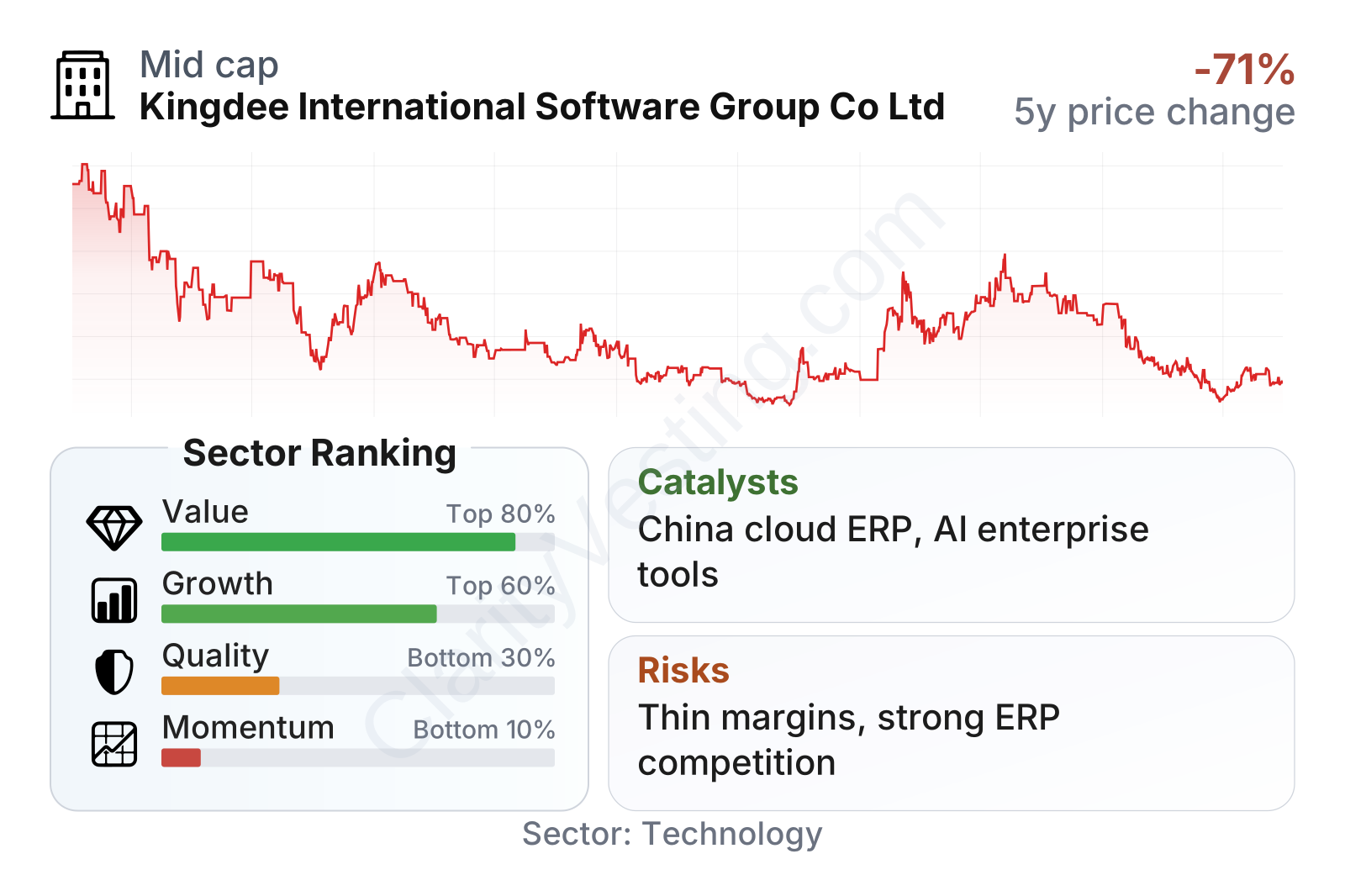
| 3Y Return ⓘ | -20.67% | +49.46% |
| 12M Return (excl. last month) ⓘ | -46.92% | +16.51% |
| 6M Return ⓘ | -16.74% | +24.29% |
| Price vs. 200-Day MA ⓘ | -20.95% | +4.74% |
Kingdee is a mid-sized software company with a stock that has been highly volatile. The share price surged in earlier years, then went through a long decline and remained weak into 2026. That weak market performance contrasts with continued revenue growth, which suggests the market has become much more demanding on profitability and execution than it was during the earlier cloud expansion phase.
The overall factor picture is mixed. Growth metrics are above average in some longer-term measures, especially five-year revenue-per-share expansion, but current profitability and returns on invested capital remain below sector norms. On the positive side, the balance sheet looks conservative, with very low leverage and net cash characteristics rather than heavy debt dependence. Free cash flow also appears strong relative to the company’s current market value, which offsets part of the concern created by a high trailing earnings multiple.
Growth
Kingdee operates in a sector with durable long-term demand. Enterprise software, especially cloud-based business management software, benefits from several structural trends: companies want to digitize accounting and operations, reduce manual work, connect departments on one platform, and increasingly use AI tools inside business workflows. In China, local software vendors may also benefit from demand for domestically developed enterprise systems, especially in large organizations and regulated industries.
The company’s strategy broadly fits that environment. It has spent years moving customers from traditional software to cloud subscriptions, and that usually improves revenue visibility over time. Its product lineup covers multiple customer segments, which gives it room to grow with clients as they scale. For large enterprises, Kingdee has been positioning its higher-end cloud ERP products as alternatives to foreign software platforms. For smaller companies, simpler cloud finance and management tools can support volume growth.
A major catalyst is the continued rise of cloud ERP adoption in China. Another is product expansion around AI-enabled enterprise applications. Recent company communications have emphasized AI integration and cloud-native offerings, which aligns with where software spending is heading. If Kingdee can deepen adoption among large enterprise customers while keeping smaller-business products sticky, the addressable market remains meaningful.
There is also a financial catalyst in the business model itself. Revenue has risen from roughly RMB 4.2 billion in 2021 to about RMB 6.8 billion in 2025, while losses narrowed materially and net income turned positive in 2025. That does not yet prove a full margin breakthrough, since operating income was still slightly negative, but it does show that scale is beginning to work through the income statement.
Risks
This article is for informational purposes only and does not constitute financial advice. Some content is AI-generated. See Disclaimer