Stock Analysis · Keurig Dr Pepper Inc (KDP)
Overview
Keurig Dr Pepper is a large North American beverage company that sells soft drinks, coffee systems, packaged coffee, juices, mixers, tea, water, and other ready-to-drink beverages. Its business combines two models under one roof: a traditional beverage portfolio sold through stores, restaurants, and distributors, and an at-home coffee platform built around Keurig brewers and K-Cup pods. That mix gives the company exposure to both cold beverages consumed on the go and hot beverages prepared at home.
The company reports its business mainly through three operating segments. Based on recent annual reporting, the largest revenue sources are approximately:
- U.S. Refreshment Beverages: about 61% of revenue. This includes carbonated soft drinks, juices, mixers, ready-to-drink tea, water, and related beverages sold under brands such as Dr Pepper, 7UP, Canada Dry, Snapple, A&W, Sunkist, Schweppes, Bai, Core Hydration, and others.
- U.S. Coffee: about 28% of revenue. This includes Keurig brewers, K-Cup pods, and owned or licensed coffee brands sold for home and office consumption.
- International: about 11% of revenue. This includes beverages sold mainly in Canada, Mexico, the Caribbean, and certain other markets.
Revenue is also diversified by product type. Concentrates and packaged beverages drive a large share of sales, while the coffee system adds a recurring consumables stream through pod purchases after the brewer is installed in households and offices. That installed-base model is important because it can create repeat demand even when new machine sales fluctuate.
The business has grown meaningfully over the past several years, with total revenue moving from roughly $12.7 billion in 2021 to about $16.6 billion in 2025. Gross profit has also expanded over that period, although earnings have been less smooth because interest expense, operating costs, and one-off pressures have had a visible effect in some years.
The long-term pattern shows a business that has been adding sales and gross profit, but not converting every year into steadily rising net income. That matters because the company’s size and brand reach are clear strengths, while the path from revenue growth to shareholder earnings has been more uneven.
Key Figures
| Metric | Value | Sector ⓘ |
|---|---|---|
| Date | Oct 03, 2026 | |
| Context | ||
| Sector | Consumer Defensive | |
| Industry | Beverages - Non-Alcoholic | |
| Market Cap ⓘ | $42.81B | |
| Beta ⓘ | 0.41 | |
Value (Cheapness) | ||
| P/E Ratio ⓘ | 31.78 | 18.16 |
| P/B Ratio ⓘ | 2.03 | 1.27 |
| FCF Yield ⓘ | 4.61% | 12.39% |
| Dividend Yield ⓘ | 2.90% | 2.83% |
| EBIT / EV ⓘ | 4.20% | 6.45% |
| PEG ⓘ | 0.98 | |
Growth (Business expansion) | ||
| Revenue Growth ⓘ | 75.60% | 3.80% |
| RPS Growth (5Y CAGR) ⓘ | 8.22% | 6.20% |
| EPS Growth (5Y CAGR) ⓘ | -14.79% | -14.64% |
| BVPS Growth (5Y CAGR) ⓘ | 1.72% | 3.26% |
| Margin Growth (5Y Trend) ⓘ | -5.28% | -0.25% |
| FCF Growth (5Y CAGR) ⓘ | -11.19% | 4.65% |
| DPS Growth (5Y CAGR) ⓘ | 8.22% | 6.86% |
Quality (Business durability) | ||
| ROIC (Latest) ⓘ | 4.81% | 12.58% |
| ROA (Latest) ⓘ | 2.01% | 6.35% |
| ROIC (5Y Median) ⓘ | 6.54% | 10.36% |
| ROA (5Y Median) ⓘ | 3.82% | 5.44% |
| Net Debt / EBIT (Latest) ⓘ | 10.91 | 1.91 |
| Net Debt / EBIT (5Y Median) ⓘ | 4.47 | 2.32 |
| Net Debt / EBITDA (Latest) ⓘ | 9.05 | 1.36 |
| Net Debt / Assets ⓘ | 37.53% | 21.25% |
| EBITDA / Interest ⓘ | 3.48 | 9.61 |
| Operating Margin (Latest) ⓘ | 15.00% | 8.96% |
| Operating Margin (5Y Median) ⓘ | 20.73% | 9.53% |
| Debt to Equity (Latest) ⓘ | 137.42% | 71.66% |
| Profit Margin (Latest) ⓘ | 7.10% | 5.40% |
| Free Cash Flow (Latest) ⓘ | $1.97B | |
Momentum (Price trend) | ||
| 3Y Return ⓘ | +7.27% | +15.25% |
| 12M Return (excl. last month) ⓘ | +14.35% | +2.63% |
| 6M Return ⓘ | +19.01% | +2.43% |
| Price vs. 200-Day MA ⓘ | +7.13% | +0.43% |
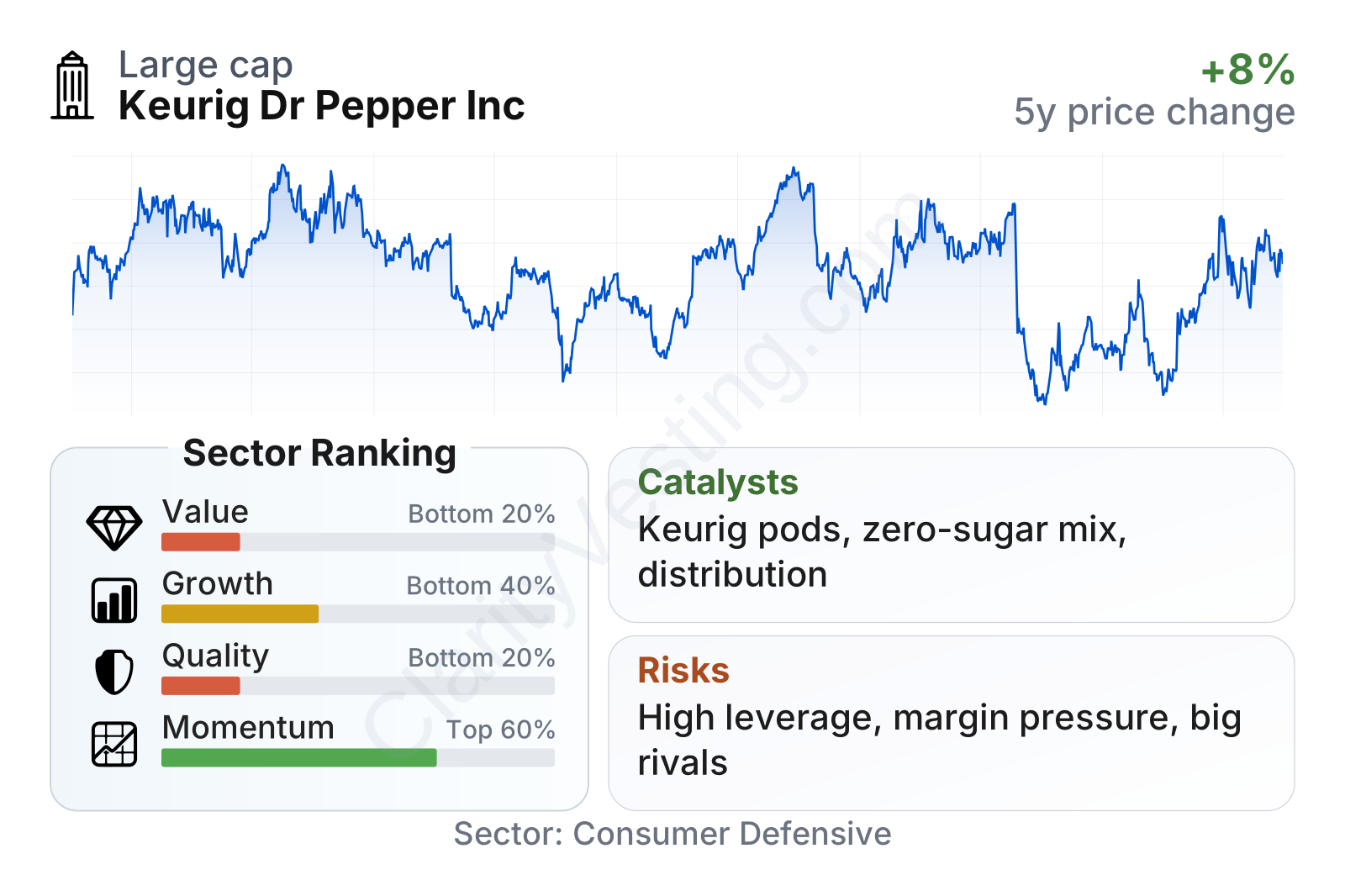
Keurig Dr Pepper is a large, relatively low-volatility consumer staples company, as reflected by a beta well below 1. The overall factor picture is mixed: momentum has recently improved, but value, quality, and growth rank in the lower half of the sector. The main reason is that the stock trades at a premium earnings multiple while leverage is elevated and cash generation has not expanded consistently over the last five years. On the positive side, profit margin remains above the sector median and the dividend yield is roughly in line with the broader beverage group.
The share price history also reflects that mixed profile. The stock has spent long periods moving sideways, with drawdowns followed by recoveries rather than a straight upward trend. That is consistent with a business viewed as stable and defensive, but not always rewarded with a higher valuation unless growth or margins improve.
Growth
Keurig Dr Pepper operates in a mature but still attractive sector. Non-alcoholic beverages are not a high-growth industry in the way software or semiconductors can be, yet they benefit from repeat consumption, wide retail distribution, and strong brand habits. Within that market, coffee pods and single-serve systems remain strategically important because they tie hardware sales to recurring purchases of consumables, while ready-to-drink beverages can still grow through pricing, innovation, and distribution gains.
The company’s strategy for future expansion is logical. It is centered on three levers: strengthening its core beverage brands, expanding the Keurig ecosystem, and using distribution scale to place more products in more channels. Product variety also helps. Keurig Dr Pepper is not relying on a single flagship brand, which reduces dependence on one consumer trend and allows it to respond to shifts in taste, such as demand for zero-sugar drinks, premium coffee, energy-adjacent refreshment, and flavored hydration.
Recent revenue growth has accelerated sharply, although the latest jump is unusually high and may not represent a normal run rate. Before that spike, growth had generally been positive but moderate, often in the low- to high-single-digit range. That suggests the company is capable of expanding, but usually through a combination of pricing, selective volume gains, and portfolio management rather than explosive organic growth.
Free cash flow remains an important support for the growth case. Even though it has been volatile and below earlier peaks, the business still produces substantial cash in absolute dollars. That provides flexibility for dividends, debt service, brand investment, and acquisitions or partnerships when management sees a good fit.
One of the clearer catalysts is the company’s coffee platform. A larger installed base of brewers can support repeat K-Cup demand for years, and licensing relationships with recognized coffee brands help keep the platform relevant. In cold beverages, the company can benefit from continued premiumization, zero-sugar reformulations, and broader distribution of existing brands. The company has also continued to use partnerships and portfolio additions to fill gaps rather than build every category from scratch, which can be an efficient approach in beverages.
Recent company communications have also pointed to ongoing brand building, innovation, and route-to-market expansion. For a consumer staples company, those are practical growth drivers: they rarely produce dramatic overnight change, but they can steadily raise shelf presence, household penetration, and mix quality over time.
Risks
This article is for informational purposes only and does not constitute financial advice. Some content is AI-generated. See Disclaimer