Stock Analysis · KBR Inc (KBR)
Overview
KBR Inc is an engineering, technology, and government services company. In simple terms, it helps customers design, build, operate, and improve complex projects tied to national security, defense, infrastructure, energy, chemicals, and large industrial facilities. Over time, KBR has shifted away from being mainly a traditional construction contractor and toward a business with more technology licensing, mission support, and long-duration service contracts.
The company reports two main business segments in its recent filings: Mission Technology Solutions and Sustainable Technology Solutions. Mission Technology Solutions serves governments and defense-related customers with engineering, logistics, operations support, digital work, and specialized mission services. Sustainable Technology Solutions focuses more on industrial and energy customers, including technology licensing, proprietary process solutions, engineering services, and consulting aimed at energy transition and more efficient industrial production.
Based on recent annual reporting, KBR’s revenue mix is roughly concentrated as follows:
- Mission Technology Solutions: about 80% of revenue. This includes defense and intelligence support, military base operations, logistics, training, space-related work, and other government service contracts.
- Sustainable Technology Solutions: about 20% of revenue. This includes technology licensing, consulting, engineering, and services related to ammonia, chemicals, refining, petrochemicals, and energy transition solutions.
That split matters because the larger government-focused unit typically brings recurring contract revenue, while the technology-focused unit can carry better margins and benefit from long-term trends such as decarbonization, energy security, and industrial modernization.
The financial profile also shows a business that has been improving its earnings power since the disruption seen in 2023. Revenue has climbed from the mid-$6 billion range to the upper-$7 billion range over the last several years, while operating income and net income recovered strongly in 2024 and 2025. At the same time, interest expense has risen, which makes balance-sheet discipline an important part of the long-term picture.
KBR’s business mix now appears more favorable than it was several years ago: revenue is supported by large service contracts, while profit recovery has been driven by a better margin profile than the legacy construction-heavy model.
Key Figures
| Metric | Value | Sector ⓘ |
|---|---|---|
| Date | Oct 03, 2026 | |
| Context | ||
| Sector | Industrials | |
| Industry | Engineering & Construction | |
| Market Cap ⓘ | $4.43B | |
| Beta ⓘ | 0.45 | |
Value (Cheapness) | ||
| P/E Ratio ⓘ | 10.59 | 22.45 |
| P/B Ratio ⓘ | 2.74 | 1.98 |
| FCF Yield ⓘ | 7.83% | 6.31% |
| Dividend Yield ⓘ | 1.88% | 1.96% |
| EBIT / EV ⓘ | 9.78% | 4.81% |
| PEG ⓘ | 0.54 | |
Growth (Business expansion) | ||
| Revenue Growth ⓘ | 1.60% | 9.10% |
| RPS Growth (5Y CAGR) ⓘ | 3.77% | 7.75% |
| EPS Growth (5Y CAGR) ⓘ | -8.50% | -13.59% |
| BVPS Growth (5Y CAGR) ⓘ | -0.33% | 6.22% |
| Margin Growth (5Y Trend) ⓘ | 6.84% | 0.72% |
| FCF Growth (5Y CAGR) ⓘ | 18.92% | 10.98% |
| DPS Growth (5Y CAGR) ⓘ | 10.76% | 9.48% |
Quality (Business durability) | ||
| ROIC (Latest) ⓘ | 12.03% | 10.92% |
| ROA (Latest) ⓘ | 6.37% | 5.41% |
| ROIC (5Y Median) ⓘ | 7.27% | 9.21% |
| ROA (5Y Median) ⓘ | 3.23% | 4.94% |
| Net Debt / EBIT (Latest) ⓘ | 3.68 | 2.07 |
| Net Debt / EBIT (5Y Median) ⓘ | 4.29 | 2.28 |
| Net Debt / EBITDA (Latest) ⓘ | 2.96 | 1.43 |
| Net Debt / Assets ⓘ | 37.29% | 19.27% |
| EBITDA / Interest ⓘ | 5.29 | 9.53 |
| Operating Margin (Latest) ⓘ | 8.75% | 10.50% |
| Operating Margin (5Y Median) ⓘ | 5.65% | 10.27% |
| Debt to Equity (Latest) ⓘ | 171.03% | 65.48% |
| Profit Margin (Latest) ⓘ | 5.49% | 6.62% |
| Free Cash Flow (Latest) ⓘ | $347.00M | |
Momentum (Price trend) | ||
| 3Y Return ⓘ | -37.95% | +58.56% |
| 12M Return (excl. last month) ⓘ | -24.47% | +15.63% |
| 6M Return ⓘ | -3.74% | +4.19% |
| Price vs. 200-Day MA ⓘ | -6.00% | +0.93% |
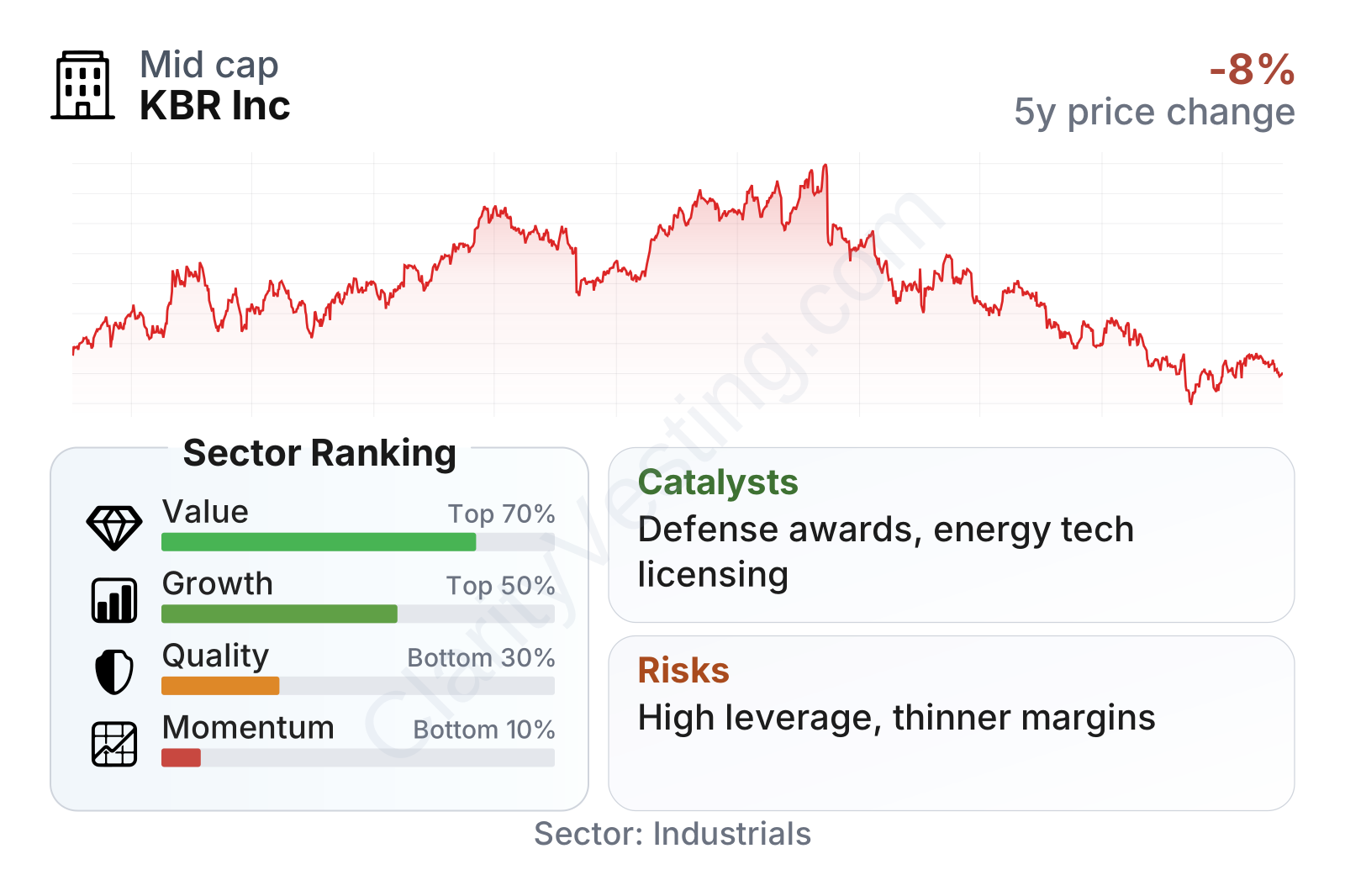
KBR is a mid-sized industrial company with a relatively low share-price volatility profile. The overall factor picture is mixed: valuation looks stronger than the sector median, growth metrics are around the middle of the pack, while quality and market momentum are weaker. In practical terms, the market is currently assigning a modest earnings multiple despite solid cash generation, but it is also discounting leverage, thinner margins than many peers, and weak recent stock performance.
The stock chart shows a clear reset after peaking in 2024. That decline has pushed the earnings multiple down meaningfully, and the current valuation stands well below the broader industrial sector median. This suggests the market is not pricing KBR like a high-confidence compounder at the moment, even though its cash flow profile remains respectable.
Growth
KBR operates in several areas that have durable long-term demand. Defense modernization, space and intelligence work, critical infrastructure, energy security, and cleaner industrial processes are all markets with multi-year spending drivers. That does not mean smooth growth every quarter, but it does support the idea that KBR is not tied to a shrinking niche.
The company’s strategy also makes sense for future expansion. Management has spent years moving the portfolio toward higher-value technical services and proprietary technologies rather than lower-quality lump-sum construction exposure. That shift can be attractive over time because it usually means more repeat business, less project volatility, and better returns on capital if execution is solid.
Revenue growth has been uneven recently. After a strong phase in 2024, growth cooled and turned negative in some 2025 and early 2026 periods before returning to a low positive rate. This pattern suggests KBR is growing, but not at a consistently fast pace. For a long-term view, the more important point is that demand appears resilient, though timing of awards and project activity can make results lumpy from quarter to quarter.
Free cash flow has been a more encouraging signal. Over the last few years, cash generation has moved upward from the high-$200 million range to close to $500 million on a trailing basis at its recent peak. That is important because cash flow gives the company flexibility to support acquisitions, reduce debt, pay dividends, and invest in technology capabilities.
Potential catalysts are tied to both segments. In government services, sustained U.S. and allied spending on defense, readiness, cybersecurity, and space programs can support contract wins and backlog. In technology solutions, demand for ammonia, low-carbon hydrogen, sustainable fuels, and process efficiency can create licensing and consulting opportunities. KBR has also highlighted strategic contract awards and program extensions in its investor communications, reinforcing that backlog and funded work remain central to the growth outlook.
A noteworthy recent opportunity is the continued policy and commercial push around energy transition and energy security. KBR’s technology portfolio is positioned in areas such as ammonia and related industrial processes, where customers are investing not only for environmental reasons but also for supply security and efficiency. That combination can create demand even when parts of the broader industrial cycle slow down.
Risks
This article is for informational purposes only and does not constitute financial advice. Some content is AI-generated. See Disclaimer