Stock Analysis · Kingboard Chemical Holdings Ltd (KBDCY)
Overview
Kingboard Chemical Holdings Ltd is a Hong Kong-based industrial group best known for making laminates, printed circuit board materials, and a range of upstream chemical products. In simple terms, it sits in the supply chain behind electronics, construction materials, and industrial manufacturing. Its products are used in items such as circuit boards for electronic devices, fiberglass and laminate materials, and chemical intermediates that feed other manufacturing processes.
The business is fairly integrated, which means Kingboard does not only sell finished or semi-finished materials, but also produces some of the chemical inputs needed for those products. That can help with cost control when conditions are favorable, but it also makes earnings more exposed to swings in industrial demand and raw material pricing.
Based on recent annual reporting, revenue is mainly split across laminate and board-related materials, chemical products, and property-related activities, with the first two categories dominating the group. The broad revenue mix can be summarized as follows:
- Laminates and PCB-related materials: approximately 45% to 55% of revenue. This includes copper clad laminates and related materials used to produce printed circuit boards for electronics.
- Chemicals: approximately 35% to 45% of revenue. This includes products such as methanol, formaldehyde, caustic soda, and other industrial chemical outputs tied to the group’s manufacturing chain.
- Properties and other activities: generally less than 10% of revenue, but this segment can still matter for profit because property income and fair value movements may affect earnings.
That mix makes Kingboard more than a pure electronics materials company. It is closer to a hybrid between a specialty materials producer and a commodity-exposed industrial manufacturer.
The long-term financial flow shows a business that went through a strong peak in 2021, then a sharp margin reset, followed by partial revenue recovery. Revenue has improved from the 2023 low, but profits have been more volatile than sales. That suggests pricing power is uneven and that changes in spreads, utilization, and financing costs still matter a lot.
Key Figures
| Metric | Value | Sector ⓘ |
|---|---|---|
| Date | Oct 17, 2026 | |
| Context | ||
| Sector | Industrials | |
| Industry | Conglomerates | |
| Market Cap ⓘ | $7.74B | |
| Beta ⓘ | 1.18 | |
Value (Cheapness) | ||
| P/E Ratio ⓘ | 13.27 | 22.10 |
| P/B Ratio ⓘ | 0.10 | 1.97 |
| FCF Yield ⓘ | 68.48% | 6.38% |
| Dividend Yield ⓘ | 3.34% | 1.94% |
| EBIT / EV ⓘ | N/A | 4.79% |
| PEG ⓘ | N/A | |
Growth (Business expansion) | ||
| Revenue Growth ⓘ | 34.80% | 9.30% |
| RPS Growth (5Y CAGR) ⓘ | -5.52% | 7.81% |
| EPS Growth (5Y CAGR) ⓘ | N/A | -13.06% |
| BVPS Growth (5Y CAGR) ⓘ | -1.47% | 6.14% |
| Margin Growth (5Y Trend) ⓘ | -18.72% | 0.88% |
| FCF Growth (5Y CAGR) ⓘ | -38.07% | 11.01% |
| DPS Growth (5Y CAGR) ⓘ | -12.03% | 9.48% |
Quality (Business durability) | ||
| ROIC (Latest) ⓘ | N/A | 10.84% |
| ROA (Latest) ⓘ | 6.29% | 5.41% |
| ROIC (5Y Median) ⓘ | 4.42% | 9.38% |
| ROA (5Y Median) ⓘ | 3.64% | 4.95% |
| Net Debt / EBIT (Latest) ⓘ | 1.58 | 2.08 |
| Net Debt / EBIT (5Y Median) ⓘ | 4.08 | 2.27 |
| Net Debt / EBITDA (Latest) ⓘ | 1.14 | 1.39 |
| Net Debt / Assets ⓘ | 14.77% | 19.28% |
| EBITDA / Interest ⓘ | 12.85 | 9.58 |
| Operating Margin (Latest) ⓘ | 12.74% | 10.50% |
| Operating Margin (5Y Median) ⓘ | 11.73% | 10.29% |
| Debt to Equity (Latest) ⓘ | 38.61% | 65.48% |
| Profit Margin (Latest) ⓘ | 8.57% | 6.67% |
| Free Cash Flow (Latest) ⓘ | $5.30B | |
Momentum (Price trend) | ||
| 3Y Return ⓘ | +197.47% | +61.68% |
| 12M Return (excl. last month) ⓘ | +94.58% | +12.58% |
| 6M Return ⓘ | +136.93% | 0.00% |
| Price vs. 200-Day MA ⓘ | +19.41% | +0.02% |
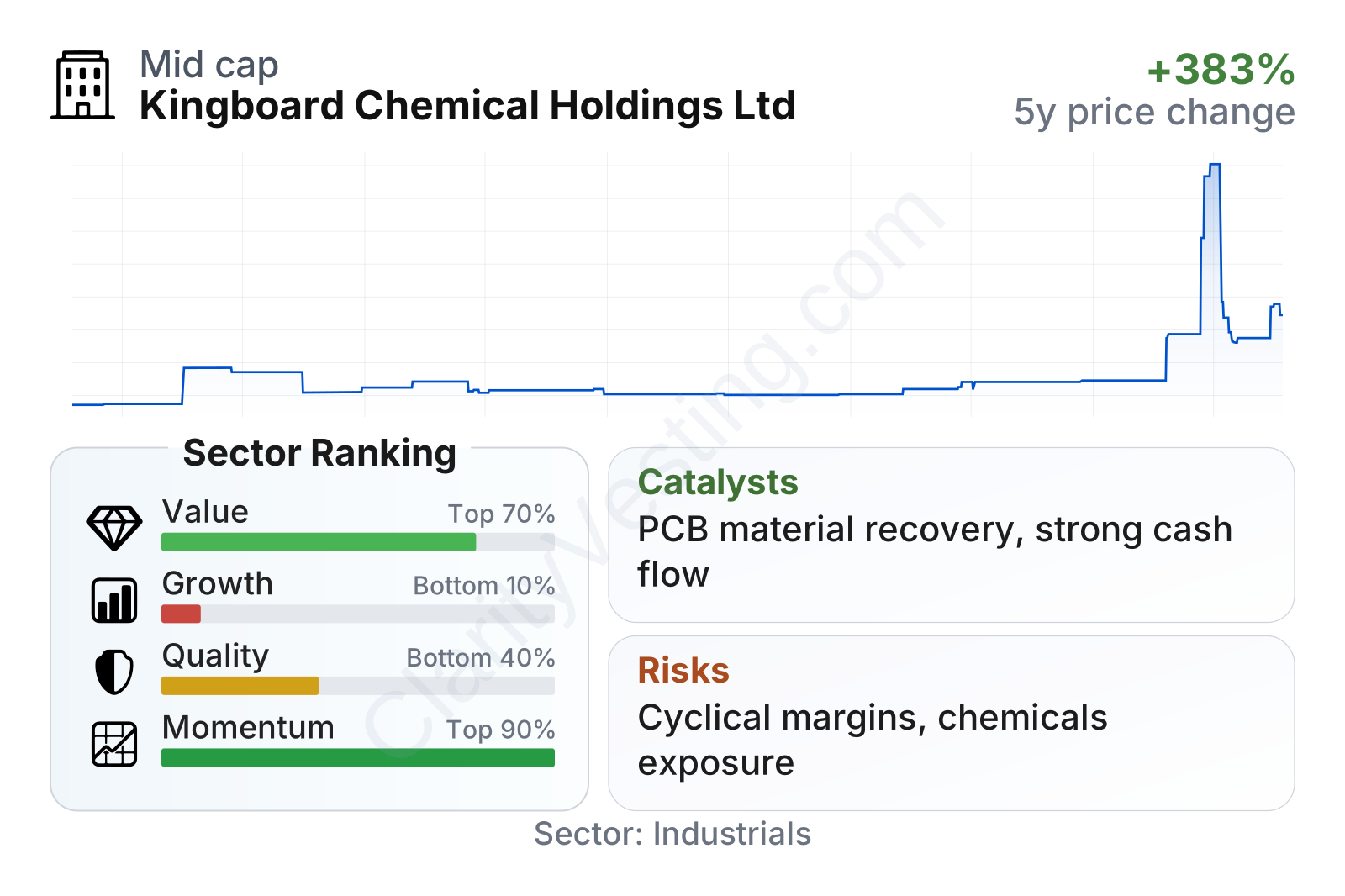
Kingboard currently screens as inexpensive on several common valuation measures compared with the broader industrial sector. Its earnings multiple is below the sector median, its price-to-book ratio is extremely low, and its free cash flow yield stands out as unusually high. Profitability is mixed: current operating and net margins are better than many sector peers, and leverage looks manageable with debt-to-equity around 39% and interest coverage comfortably above the sector median. However, the growth profile is weak over a five-year view, with declines in revenue per share, free cash flow, book value per share, and dividends, even though the latest year shows a much stronger rebound in sales. The share price trend has been exceptionally strong recently, far ahead of the sector, which means market expectations have already changed sharply.
Growth
Kingboard is exposed to markets that should remain structurally relevant over the long run. Printed circuit board materials are tied to electronics production, data infrastructure, automotive electronics, industrial automation, and increasingly more computing-intensive devices. Even if end markets move in cycles, the need for boards, laminates, and related materials does not disappear. The longer-term demand backdrop is therefore real, especially where more complex electronics require reliable base materials.
The company’s strategy also has an industrial logic. Its vertical integration across chemicals and laminate materials can support supply security, improve production economics, and protect margins when input markets are tight. This is especially important in businesses where customers care about consistency, scale, and reliable delivery as much as they care about price.
A notable positive is that recent revenue growth has accelerated strongly on a year-over-year basis, far above the sector median. That points to a recovery phase after earlier weakness. If electronics demand, utilization rates, and chemical spreads keep improving together, operational leverage could be meaningful because a large manufacturing base tends to convert better volume into profit once fixed costs are absorbed more efficiently.
There is also a potential catalyst in ongoing electronics localization and supply-chain diversification in Asia. Large-scale regional manufacturing ecosystems still need laminate and chemical inputs, and established suppliers with scale may benefit when customers prefer proven counterparties rather than smaller newcomers. Kingboard’s existing footprint and integrated production network could be useful in that setting.
Another supportive element is cash generation. Even though free cash flow has been uneven over a multi-year period, the latest trailing level is very strong relative to the company’s market value. If sustained, that could improve balance-sheet flexibility, support dividends, and give management more room for capacity upgrades or debt reduction.
Risks
This article is for informational purposes only and does not constitute financial advice. Some content is AI-generated. See Disclaimer


