Stock Analysis · Kingboard Holdings Limited (KBDCF)
Overview
Kingboard Holdings Limited is a Hong Kong-based industrial group best known for making materials used in printed circuit boards and other electronics. Its operations sit upstream in the electronics supply chain: instead of selling finished consumer devices, it produces core industrial materials such as laminates, chemicals, and copper foil that are used by manufacturers of circuit boards and electronic components. The group also has a meaningful property business, which adds a second earnings stream outside pure manufacturing.
Based on the company’s latest annual disclosures, revenue is mainly generated from materials linked to electronics manufacturing, with property contributing a smaller but still important share. The mix can shift from year to year because laminate prices, chemical demand, and property delivery timing are cyclical.
- Laminates: approximately 65% to 75% of revenue in recent years. This includes copper clad laminates, glass fabric, and related products used as key base materials in printed circuit boards.
- Chemicals: approximately 15% to 25% of revenue. This division includes chemical products used in industrial processing and electronics manufacturing.
- Properties: approximately 5% to 15% of revenue. This includes property development and investment properties, which can have an outsized effect on profit when valuations or project completions move sharply.
- Other operations: a smaller contribution from supporting industrial activities and investments.
That structure matters for long-term analysis. Kingboard is not a simple single-product manufacturer. It is a vertically integrated group with exposure to electronics materials, industrial chemicals, and real estate. This gives it diversification, but it also makes results harder to read because different businesses can move in different directions at the same time.
The multiyear profit flow shows how cyclical the business can be. Revenue peaked strongly in 2021, weakened through 2023, and then recovered in 2024 and 2025. Even with that recovery, gross profit remained below the 2021 level, while interest expense rose materially after the boom period. That means the recent rebound has been real, but it has not fully restored the very high profitability seen during the industry upcycle.
Key Figures
| Metric | Value | Sector ⓘ |
|---|---|---|
| Date | Oct 24, 2026 | |
| Context | ||
| Sector | Industrials | |
| Industry | Conglomerates | |
| Market Cap ⓘ | $7.07B | |
| Beta ⓘ | 1.18 | |
Value (Cheapness) | ||
| P/E Ratio ⓘ | 12.12 | 22.29 |
| P/B Ratio ⓘ | 0.09 | 1.98 |
| FCF Yield ⓘ | 35.67% | 6.26% |
| Dividend Yield ⓘ | 29.18% | 1.92% |
| EBIT / EV ⓘ | N/A | 4.83% |
| PEG ⓘ | N/A | |
Growth (Business expansion) | ||
| Revenue Growth ⓘ | 34.80% | 9.30% |
| RPS Growth (5Y CAGR) ⓘ | -5.49% | 7.76% |
| EPS Growth (5Y CAGR) ⓘ | -26.31% | -13.17% |
| BVPS Growth (5Y CAGR) ⓘ | -1.48% | 6.13% |
| Margin Growth (5Y Trend) ⓘ | -18.72% | 0.74% |
| FCF Growth (5Y CAGR) ⓘ | N/A | 10.79% |
| DPS Growth (5Y CAGR) ⓘ | -12.04% | 9.41% |
Quality (Business durability) | ||
| ROIC (Latest) ⓘ | N/A | 10.75% |
| ROA (Latest) ⓘ | 6.20% | 5.41% |
| ROIC (5Y Median) ⓘ | 4.33% | 9.37% |
| ROA (5Y Median) ⓘ | 3.64% | 4.95% |
| Net Debt / EBIT (Latest) ⓘ | 2.13 | 2.04 |
| Net Debt / EBIT (5Y Median) ⓘ | 4.62 | 2.27 |
| Net Debt / EBITDA (Latest) ⓘ | 1.40 | 1.39 |
| Net Debt / Assets ⓘ | 14.77% | 19.27% |
| EBITDA / Interest ⓘ | 10.35 | 9.58 |
| Operating Margin (Latest) ⓘ | 11.72% | 10.49% |
| Operating Margin (5Y Median) ⓘ | 10.29% | 10.30% |
| Debt to Equity (Latest) ⓘ | 38.61% | 64.82% |
| Profit Margin (Latest) ⓘ | 8.57% | 6.67% |
| Free Cash Flow (Latest) ⓘ | $2.52B | |
Momentum (Price trend) | ||
| 3Y Return ⓘ | +223.73% | +67.77% |
| 12M Return (excl. last month) ⓘ | +189.18% | +12.05% |
| 6M Return ⓘ | +26.48% | 0.00% |
| Price vs. 200-Day MA ⓘ | +4.26% | +0.67% |
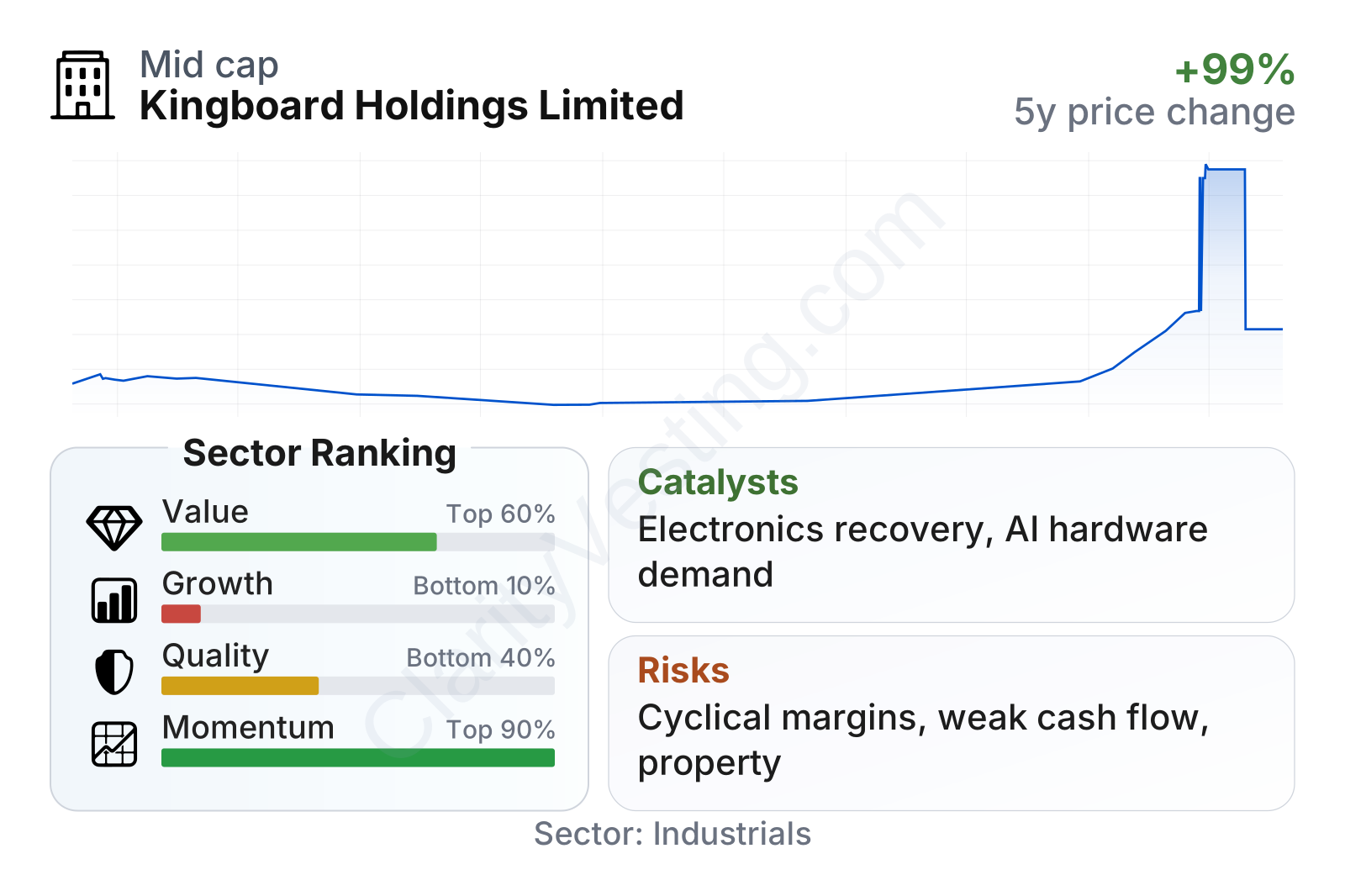
Kingboard is a large company by market value, and its recent share-price performance has been very strong, with returns over the last one, three, and six months well ahead of the sector median. At the same time, the underlying fundamental picture is more mixed. The business currently screens as inexpensive on earnings and especially on book value, while profitability margins are still decent relative to many industrial peers. However, free cash flow has recently been negative, long-term growth metrics remain weak, and leverage is not excessive but is somewhat higher than the sector on an earnings basis. In short, the market has rewarded improving conditions faster than the company’s long-term growth record would normally justify.
Growth
Kingboard operates in markets tied to electronics production, especially printed circuit boards and the broader semiconductor and digital infrastructure supply chain. Over the long run, that is an attractive place to be. Demand for servers, networking equipment, automotive electronics, industrial automation, and higher-end computing all requires more advanced circuit board materials. Even when consumer electronics are weak, enterprise infrastructure and automotive electrification can still support demand.
The company’s strategy broadly makes industrial sense. Kingboard has long focused on vertical integration, which means it controls more of its supply chain than many smaller rivals. That can help with cost control, product availability, and margins when input prices move sharply. Scale also matters in laminate manufacturing, where customer relationships, production consistency, and the ability to supply in volume are important.
A major catalyst is the recovery in electronics materials demand after the downturn that hurt much of the supply chain in 2022 and 2023. Recent revenue growth has been strong on a year-over-year basis, suggesting that end-market conditions improved meaningfully. Another helpful sign is that interest expense fell in 2025 from the prior year, which gives the company more room for earnings recovery if operating conditions remain stable.
There is also a structural angle to watch: higher computing intensity from data centers, AI-related hardware buildouts, and more electronics content in vehicles all support demand for laminates and related materials over time. Kingboard will not capture all of that growth directly, but it participates in the ecosystem that enables it.
On the property side, growth is much less predictable. Property can create value and support asset backing, but it is not the kind of steadily compounding segment that usually drives clean long-term industrial growth. For that reason, the most important growth engine remains the core electronics materials business.
Risks
This article is for informational purposes only and does not constitute financial advice. Some content is AI-generated. See Disclaimer


