Stock Analysis · Koninklijke BAM Groep nv (KBAGF)
Overview
Koninklijke BAM Groep is a Dutch construction and engineering company active mainly in Europe. It designs, builds, and maintains buildings, transport infrastructure, and specialized civil engineering projects. Its work includes roads, rail, bridges, tunnels, public buildings, commercial property, and recurring maintenance activities. BAM has spent the last few years simplifying the business, reducing exposure to activities with weak returns, and focusing more on projects where risk can be priced and controlled more carefully.
The company’s revenue comes primarily from construction and civil infrastructure contracts. Based on recent annual reporting and the company’s operating structure, the largest sources of revenue are approximately:
- Construction: about 45% to 55% of revenue. This includes residential and non-residential buildings, such as housing, offices, schools, hospitals, and public-sector facilities.
- Civil engineering: about 30% to 40% of revenue. This covers roads, rail, bridges, tunnels, marine works, water-related projects, and other large infrastructure jobs.
- Property, PPP, and other activities: about 5% to 15% of revenue. This includes real estate development, public-private partnership interests, and selected specialty activities.
- Services and maintenance: a smaller but strategically important portion, generally embedded within the divisions above, tied to long-term upkeep and asset management contracts.
BAM’s geographic exposure is concentrated in the Netherlands, the United Kingdom, and Ireland, with additional activity in Belgium and other nearby markets. That regional focus matters for long-term analysis because it keeps the company tied to developed infrastructure markets where governments and regulated clients continue to spend on transport, housing, energy transition, and resilience projects.
Recent years show a business that has become more selective. Revenue has stayed in the mid-single-digit billions of euros range, while profitability has improved from the weak levels that once characterized the group. The broad pattern is not one of explosive expansion, but of operational repair and more disciplined project selection.
The revenue and profit flow over recent years points to a company with very thin underlying margins, which is normal in construction, but also one that has improved operating profit since 2021. The main takeaway is that even moderate changes in contract execution can have an outsized effect on earnings, so discipline matters more here than raw revenue growth.
Key Figures
| Metric | Value | Sector ⓘ |
|---|---|---|
| Date | Oct 24, 2026 | |
| Context | ||
| Sector | Industrials | |
| Industry | Engineering & Construction | |
| Market Cap ⓘ | $2.96B | |
| Beta ⓘ | 0.62 | |
Value (Cheapness) | ||
| P/E Ratio ⓘ | 11.58 | 22.29 |
| P/B Ratio ⓘ | 2.71 | 1.98 |
| FCF Yield ⓘ | 5.96% | 6.26% |
| Dividend Yield ⓘ | 2.88% | 1.92% |
| EBIT / EV ⓘ | N/A | 4.83% |
| PEG ⓘ | N/A | |
Growth (Business expansion) | ||
| Revenue Growth ⓘ | 3.40% | 9.30% |
| RPS Growth (5Y CAGR) ⓘ | 0.95% | 7.76% |
| EPS Growth (5Y CAGR) ⓘ | N/A | -13.17% |
| BVPS Growth (5Y CAGR) ⓘ | 12.14% | 6.13% |
| Margin Growth (5Y Trend) ⓘ | 2.73% | 0.74% |
| FCF Growth (5Y CAGR) ⓘ | 2.89% | 10.79% |
| DPS Growth (5Y CAGR) ⓘ | 23.33% | 9.41% |
Quality (Business durability) | ||
| ROIC (Latest) ⓘ | N/A | 10.75% |
| ROA (Latest) ⓘ | N/A | 5.41% |
| ROIC (5Y Median) ⓘ | 12.43% | 9.37% |
| ROA (5Y Median) ⓘ | 4.32% | 4.95% |
| Net Debt / EBIT (Latest) ⓘ | -0.94 | 2.04 |
| Net Debt / EBIT (5Y Median) ⓘ | -3.80 | 2.27 |
| Net Debt / EBITDA (Latest) ⓘ | -0.50 | 1.39 |
| Net Debt / Assets ⓘ | -7.01% | 19.27% |
| EBITDA / Interest ⓘ | 7.43 | 9.58 |
| Operating Margin (Latest) ⓘ | 2.20% | 10.49% |
| Operating Margin (5Y Median) ⓘ | 2.47% | 10.30% |
| Debt to Equity (Latest) ⓘ | 42.39% | 64.82% |
| Profit Margin (Latest) ⓘ | 3.30% | 6.67% |
| Free Cash Flow (Latest) ⓘ | $176.29M | |
Momentum (Price trend) | ||
| 3Y Return ⓘ | +523.91% | +67.77% |
| 12M Return (excl. last month) ⓘ | +97.90% | +12.05% |
| 6M Return ⓘ | -8.99% | 0.00% |
| Price vs. 200-Day MA ⓘ | -1.19% | +0.67% |
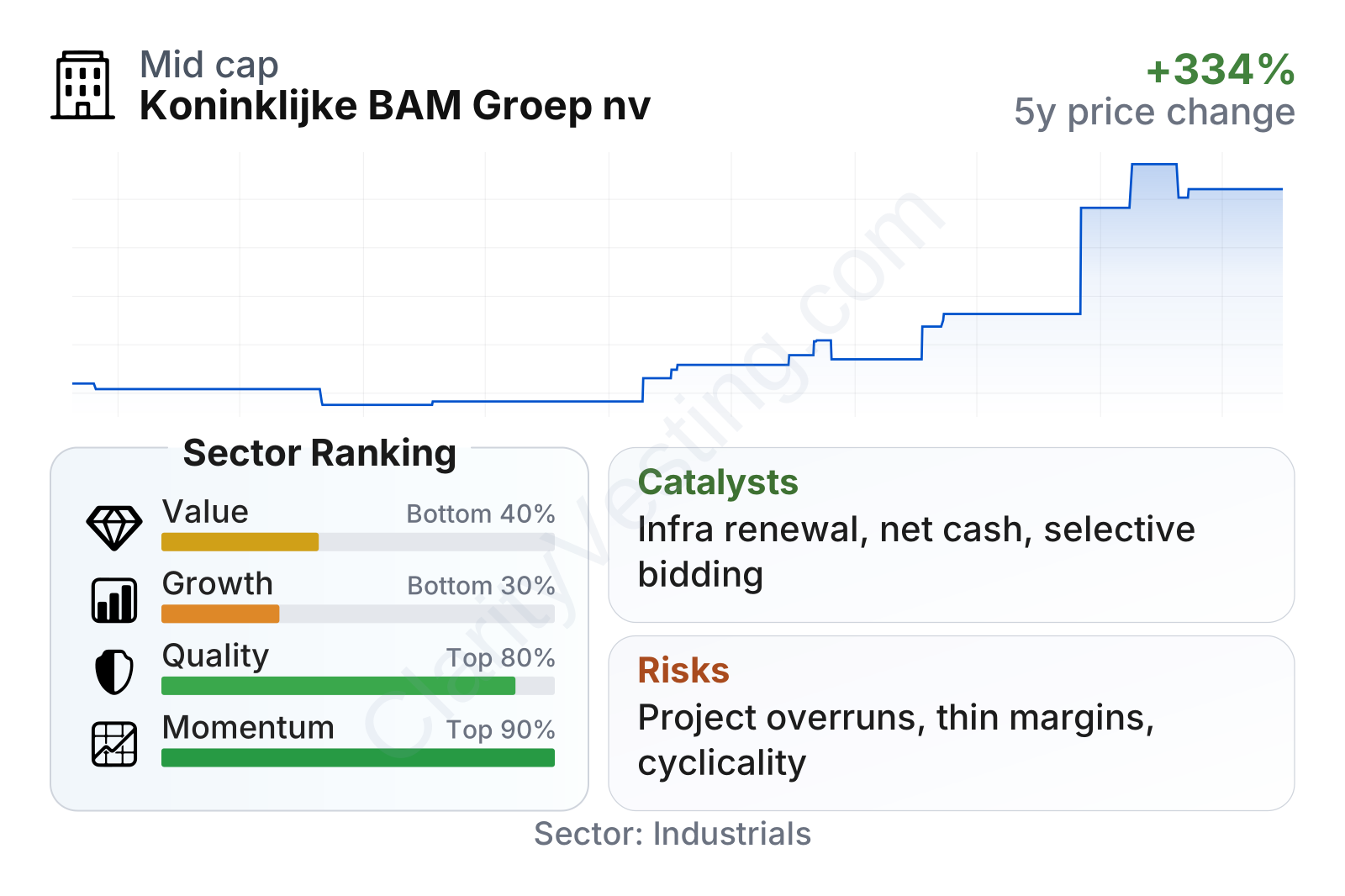
BAM stands out for balance-sheet strength rather than fast top-line growth. It carries net cash rather than net debt, debt-to-equity is below the sector median, and free cash flow remains positive. Profitability is still modest, with operating margin around 2% versus a much higher sector median, but the company’s multi-year return on invested capital has been solid relative to peers. Growth metrics are weaker than much of the sector, reflecting a mature business in a disciplined turnaround phase rather than a rapid expansion phase. Momentum has been very strong over three years, although the shares have cooled in the most recent months after a major rerating.
Growth
BAM operates in a sector with durable long-term demand, even if yearly growth is uneven. Western Europe needs continuing investment in housing, transport networks, flood protection, grid upgrades, energy-efficient buildings, and public infrastructure renewal. Those themes are not speculative: they are tied to public policy, demographic needs, and aging assets. For a contractor like BAM, this creates a large pool of potential work, especially in home markets where the company already has established customer relationships and technical credentials.
The company’s current strategy is more convincing than the older construction model that prioritized volume. Management has emphasized selective bidding, risk control, standardized execution, and stronger cash discipline. For long-term analysis, that is important because construction groups rarely create value by simply winning more contracts; they create value by choosing projects with acceptable risk-adjusted margins and then delivering them reliably.
Another support for future growth is the mix of end markets. Infrastructure spending in the Netherlands, the UK, and Ireland is being shaped by transport modernization, water and climate adaptation, and energy transition investment. Buildings activity also has structural backing from housing shortages and retrofitting needs. BAM is positioned where these spending themes overlap with public procurement and regulated development pipelines.
A meaningful catalyst is the company’s stronger financial position. Net cash gives BAM more flexibility to absorb project volatility, support working capital, and maintain shareholder distributions without relying heavily on borrowing. That matters in an industry where weaker competitors can be constrained when bidding for large or complex contracts.
Recent company updates have also pointed to a healthy order book and continued focus on projects with better risk profiles. In practical terms, this means the opportunity is less about dramatic revenue acceleration and more about sustaining improved margins, converting backlog into cash, and keeping losses on difficult projects under control. If that discipline continues, earnings quality can improve even if sales growth stays moderate.
Risks
This article is for informational purposes only and does not constitute financial advice. Some content is AI-generated. See Disclaimer


