Stock Analysis · Kernel Holding S.A (KARNF)
Overview
Kernel Holding S.A. is an agribusiness group focused on Ukraine. The company grows crops, buys grain from farmers, stores it, transports it, crushes sunflower seeds into sunflower oil and meal, and exports these products to international markets. In practice, Kernel sits across several steps of the agricultural value chain: farming, processing, logistics, and export trading.
The business is centered on products where Ukraine has long been globally important, especially sunflower oil, grains, and oilseeds. Kernel has historically presented itself as one of the largest sunflower oil producers and exporters in the region, supported by inland silos, port infrastructure, and a large farming land bank. That integrated structure matters because it can help protect margins when one part of the chain is weak but another part remains profitable.
Revenue is mainly driven by bulk agricultural commodities, which means sales can move significantly with crop volumes, export routes, and global prices. Based on recent annual reporting, the revenue mix is approximately as follows:
- Grain and other agricultural commodities trading: about 55% to 65% — mainly export sales of corn, wheat, and other grains sourced from third parties and from Kernel’s own farming operations.
- Edible oil: about 20% to 30% — mostly bottled and bulk sunflower oil sold into export and domestic channels.
- Oilseed processing products: about 10% to 20% — sunflower meal and related products generated from crushing sunflower seeds.
- Farming and other operations: usually less than 10% — crop production from its own land bank plus ancillary services such as storage and logistics.
Those percentages can shift meaningfully from year to year because commodity prices and export logistics have had an unusually large impact on the business since the war in Ukraine. Even so, the broad picture is clear: Kernel is primarily an export-oriented agricultural processor and trader rather than a branded consumer foods company.
The operating picture shows a business with very high input costs relative to sales, which is normal in commodity processing and trading. What stands out is resilience: revenue fell sharply after the 2022 disruption, then recovered over the following years, while operating income remained positive and interest expense moved lower more recently, helping net earnings recover.
Key Figures
| Metric | Value | Sector ⓘ |
|---|---|---|
| Date | Oct 17, 2026 | |
| Context | ||
| Sector | Consumer Defensive | |
| Industry | Food Distribution | |
| Market Cap ⓘ | $1.52B | |
| Beta ⓘ | 0.79 | |
Value (Cheapness) | ||
| P/E Ratio ⓘ | 6.67 | 17.88 |
| P/B Ratio ⓘ | 0.66 | 1.29 |
| FCF Yield ⓘ | -0.45% | 12.39% |
| Dividend Yield ⓘ | N/A | 2.85% |
| EBIT / EV ⓘ | 19.68% | 6.43% |
| PEG ⓘ | N/A | |
Growth (Business expansion) | ||
| Revenue Growth ⓘ | 27.10% | 4.10% |
| RPS Growth (5Y CAGR) ⓘ | -31.63% | 6.18% |
| EPS Growth (5Y CAGR) ⓘ | N/A | -13.59% |
| BVPS Growth (5Y CAGR) ⓘ | -21.65% | 3.20% |
| Margin Growth (5Y Trend) ⓘ | -0.27% | -0.15% |
| FCF Growth (5Y CAGR) ⓘ | -11.59% | 4.10% |
| DPS Growth (5Y CAGR) ⓘ | 14.51% | 6.79% |
Quality (Business durability) | ||
| ROIC (Latest) ⓘ | N/A | 12.34% |
| ROA (Latest) ⓘ | 8.69% | 6.30% |
| ROIC (5Y Median) ⓘ | 8.82% | 10.49% |
| ROA (5Y Median) ⓘ | 7.09% | 5.44% |
| Net Debt / EBIT (Latest) ⓘ | 2.46 | 1.96 |
| Net Debt / EBIT (5Y Median) ⓘ | 1.62 | 2.35 |
| Net Debt / EBITDA (Latest) ⓘ | 1.77 | 1.38 |
| Net Debt / Assets ⓘ | 18.77% | 21.51% |
| EBITDA / Interest ⓘ | 4.82 | 9.46 |
| Operating Margin (Latest) ⓘ | 6.82% | 8.87% |
| Operating Margin (5Y Median) ⓘ | 8.62% | 9.53% |
| Debt to Equity (Latest) ⓘ | 46.91% | 72.35% |
| Profit Margin (Latest) ⓘ | 7.31% | 5.40% |
| Free Cash Flow (Latest) ⓘ | -$6.88M | |
Momentum (Price trend) | ||
| 3Y Return ⓘ | +85.71% | +20.92% |
| 12M Return (excl. last month) ⓘ | +12.61% | +2.13% |
| 6M Return ⓘ | -13.33% | +1.26% |
| Price vs. 200-Day MA ⓘ | -5.53% | +1.39% |
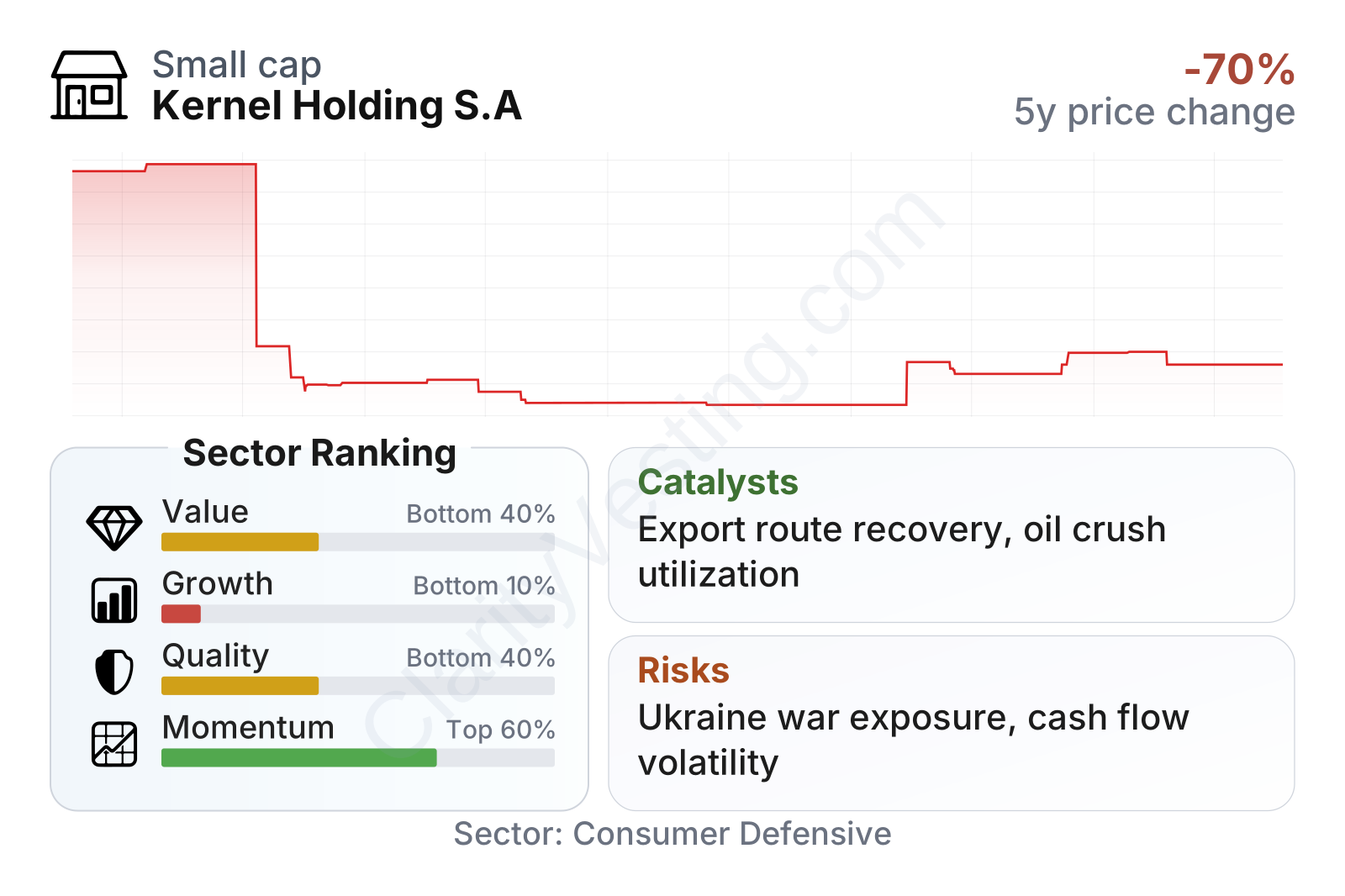
Kernel is a mid-sized company by public-market standards, with a share price history that still reflects the shock of 2022. The stock remains far below pre-war levels despite a strong rebound from its lows. In the latest factor view, valuation looks cheap against the sector on earnings and book value, quality is supported by low leverage and solid operating returns, while growth metrics remain weak because the last five years include severe wartime disruption and a reset in asset productivity.
Growth
Kernel operates in a sector with long-term structural relevance. Global demand for vegetable oils, animal feed ingredients, and grains tends to grow over time with population, urbanization, and food consumption. Sunflower oil is especially important in many importing markets, and Ukraine remains a major supplier to the world agricultural system despite the severe operational challenges of recent years.
The company’s strategy still makes industrial sense for future expansion because it combines crop origination, processing, storage, and export logistics. That integrated setup can be hard to replicate quickly. If Ukrainian agricultural exports continue normalizing, Kernel is positioned to benefit not only from higher volumes but also from better asset utilization across crushing plants, silos, rail, and port-linked infrastructure.
Recent revenue growth has clearly stabilized compared with the extreme swings seen during the initial wartime period. The latest year-over-year trend is modest rather than explosive, which suggests the business is now moving from disruption recovery into a more normalized operating phase. That is less dramatic, but usually healthier for evaluating the company’s underlying earnings power.
Cash generation tells a more cautious story. Free cash flow turned strongly positive after the crisis phase, but the trend has cooled sharply over the last few reporting periods. This does not automatically indicate deterioration in the business model, since working capital swings are common in commodity businesses, yet it does mean that headline profits should be checked against actual cash conversion.
A meaningful catalyst is any further improvement in Black Sea export logistics and agricultural infrastructure usage. Better shipping reliability can lift volumes, reduce transport inefficiencies, and improve realized pricing. Another possible tailwind is continued debt discipline: with leverage now much lower than in the stressed period, more operating profit can flow through to equity if volumes improve. Kernel has also remained active in maintaining and optimizing its asset base during wartime conditions, which increases the significance of any broader normalization in Ukrainian exports.
Risks
This article is for informational purposes only and does not constitute financial advice. Some content is AI-generated. See Disclaimer


