Stock Analysis · Kardigan Inc (KARD)
Overview
Kardigan Inc is a clinical-stage biotechnology company focused on cardiovascular disease. Rather than selling approved medicines today, it is using its capital to develop drug candidates for heart-related conditions with high unmet need. That makes Kardigan very different from a mature healthcare business: the current investment case depends far more on clinical progress, regulatory execution, and future commercialization potential than on present-day sales.
The company’s lead focus is on therapies for cardiovascular conditions, with its most visible program centered on atrial fibrillation, a common heart rhythm disorder that can raise the risk of stroke, heart failure, and repeated hospital visits. The goal is to develop treatments that improve rhythm control while avoiding some of the limitations associated with older options. As a development-stage biotech, Kardigan is still building value through research results rather than through a broad commercial footprint.
At this stage, Kardigan does not appear to generate meaningful product revenue. Based on recent financial reporting, its revenue mix is effectively:
- Product revenue: 0% — no approved products contributing recurring sales.
- Collaboration, licensing, or other operating revenue: no meaningful contribution disclosed as a recurring revenue source.
- Financing-related cash inflows: not revenue, but an important source of funding for operations while the pipeline advances.
This revenue profile is typical for a young biotech: spending is concentrated on drug development, especially research and development, while commercial income has not yet started. Over the last full year, operating expenses increased sharply, and research and development remained the largest cost item by a wide margin, showing that most resources are being directed toward advancing the pipeline.
The operating flow is still dominated by research spending rather than revenue generation. From 2024 to 2025, total operating expenses roughly doubled, with research and development still representing the majority of the cost base. That pattern is consistent with a company pushing programs deeper into clinical development.
Key Figures
| Metric | Value | Sector ⓘ |
|---|---|---|
| Date | Oct 03, 2026 | |
| Context | ||
| Sector | Healthcare | |
| Industry | Biotechnology | |
| Market Cap ⓘ | $1.38B | |
| Beta ⓘ | N/A | |
Value (Cheapness) | ||
| P/E Ratio ⓘ | N/A | 24.06 |
| P/B Ratio ⓘ | 2.16 | 3.08 |
| FCF Yield ⓘ | -12.06% | 3.07% |
| Dividend Yield ⓘ | N/A | 2.05% |
| EBIT / EV ⓘ | -28.08% | 0.63% |
| PEG ⓘ | N/A | |
Growth (Business expansion) | ||
| Revenue Growth ⓘ | N/A | 7.50% |
| RPS Growth (5Y CAGR) ⓘ | N/A | 8.70% |
| EPS Growth (5Y CAGR) ⓘ | N/A | -18.20% |
| BVPS Growth (5Y CAGR) ⓘ | N/A | 3.95% |
| Margin Growth (5Y Trend) ⓘ | N/A | -0.58% |
| FCF Growth (5Y CAGR) ⓘ | N/A | 0.88% |
| DPS Growth (5Y CAGR) ⓘ | N/A | 6.80% |
Quality (Business durability) | ||
| ROIC (Latest) ⓘ | N/A | 3.29% |
| ROA (Latest) ⓘ | N/A | 3.02% |
| ROIC (5Y Median) ⓘ | N/A | 4.75% |
| ROA (5Y Median) ⓘ | N/A | 1.93% |
| Net Debt / EBIT (Latest) ⓘ | N/A | 1.33 |
| Net Debt / EBIT (5Y Median) ⓘ | N/A | 1.83 |
| Net Debt / EBITDA (Latest) ⓘ | N/A | 0.99 |
| Net Debt / Assets ⓘ | -51.35% | 5.33% |
| EBITDA / Interest ⓘ | N/A | 9.63 |
| Operating Margin (Latest) ⓘ | N/A | 9.25% |
| Operating Margin (5Y Median) ⓘ | N/A | 7.80% |
| Debt to Equity (Latest) ⓘ | 2.17% | 28.99% |
| Profit Margin (Latest) ⓘ | N/A | 3.60% |
| Free Cash Flow (Latest) ⓘ | -$166.26M | |
Momentum (Price trend) | ||
| 3Y Return ⓘ | N/A | +37.48% |
| 12M Return (excl. last month) ⓘ | N/A | +20.85% |
| 6M Return ⓘ | N/A | +9.73% |
| Price vs. 200-Day MA ⓘ | N/A | +4.69% |
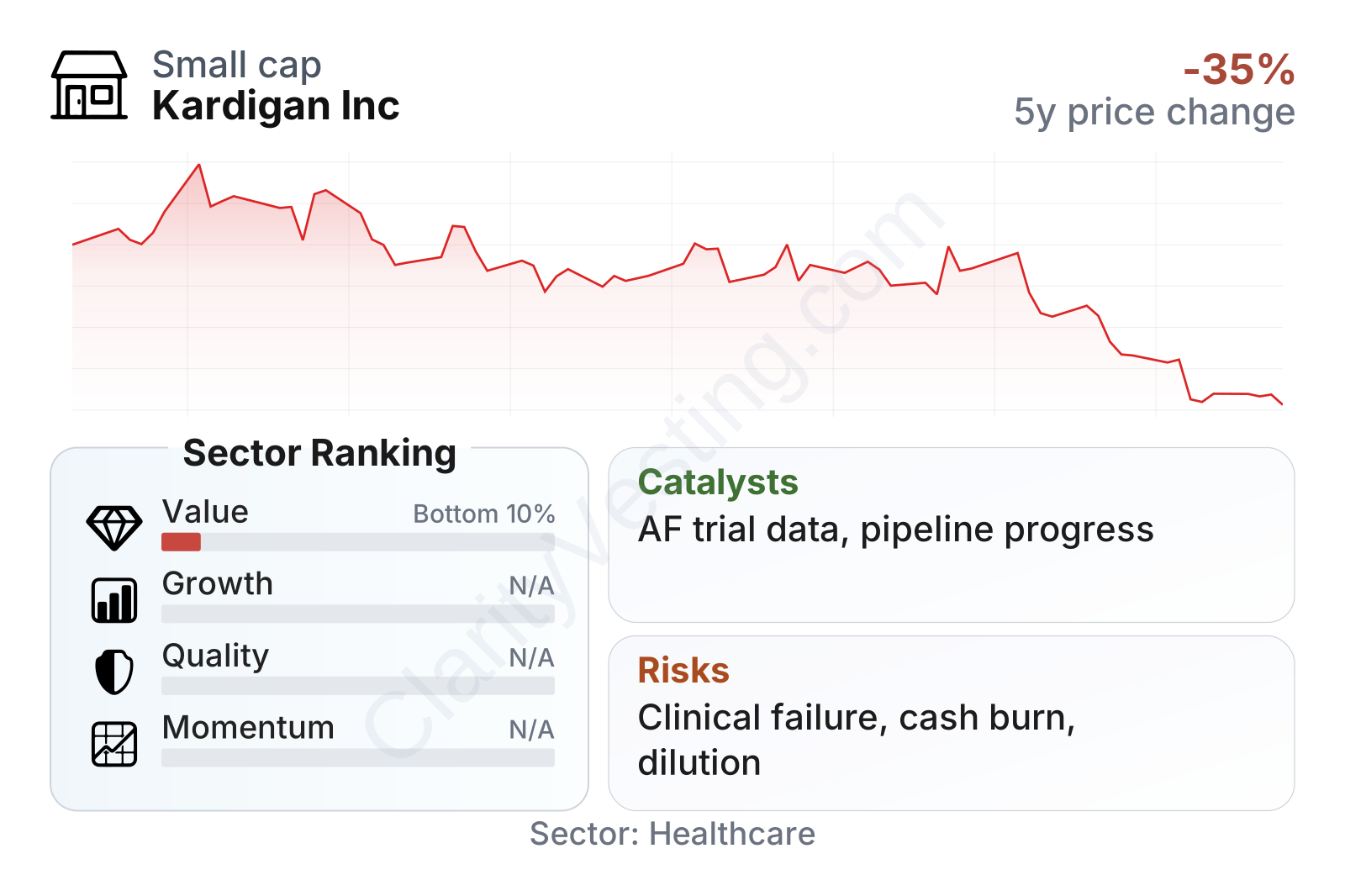
Kardigan is a small-cap biotech with no current earnings and negative free cash flow, so traditional valuation measures look weak compared with the broader healthcare sector. The balance sheet is a brighter point: debt is very low, and net debt is effectively negative because cash exceeds borrowings by a wide margin. That gives the company flexibility to fund trials, although the cash burn remains substantial and will stay central to the long-term outlook.
The share price has also pulled back meaningfully from mid-2026 levels, which suggests the market is weighing execution risk, development timelines, or financing concerns more heavily than before. For a pre-revenue biotech, moves like this often reflect shifting expectations around clinical milestones rather than changes in current business performance.
Growth
Kardigan operates in a large and important healthcare segment. Cardiovascular disease remains one of the biggest areas of unmet medical need globally, and atrial fibrillation in particular is a growing burden because of aging populations, increasing diagnosis rates, and the limits of existing treatment approaches. That means the company is active in a sector with durable long-term demand if its drug candidates can prove both safety and effectiveness.
The company’s strategy is coherent for this stage of development. It is concentrating capital on a focused set of cardiovascular programs rather than trying to cover many unrelated disease areas at once. In biotechnology, that kind of focus can be valuable because it helps management direct cash, scientific talent, and trial execution around a narrower clinical objective. If clinical data are positive, a focused pipeline can also make the future commercial message clearer.
A major catalyst for Kardigan is the normal sequence of biotech value creation: clinical trial enrollment, top-line study results, dose selection, regulatory interactions, and possible expansion into larger studies. Positive data in atrial fibrillation or related cardiovascular indications could meaningfully improve the company’s strategic position, especially because large pharmaceutical companies continue to watch cardiovascular innovation closely. For a business with no product revenue yet, these milestones matter far more than near-term income statement trends.
Recent company communications and filings indicate ongoing advancement of the pipeline and continued investment in development activities. The sharp rise in research spending is important because it usually signals that clinical work is moving forward rather than remaining in a purely early discovery phase. That does not guarantee success, but it does show that the company is actively trying to convert scientific potential into clinical proof.
Risks
This article is for informational purposes only and does not constitute financial advice. Some content is AI-generated. See Disclaimer