Stock Analysis · Kaiser Aluminum Corporation (KALU)
Overview
Kaiser Aluminum Corporation is a U.S. manufacturer of specialty aluminum products. Rather than focusing on primary aluminum mining or smelting, the company mainly converts aluminum into rolled, extruded, and drawn products engineered for demanding applications. Its end markets include aerospace, packaging, general engineering, and automotive uses, with a business mix that is more industrial and value-added than commodity-oriented.
The company’s revenue comes from a relatively concentrated set of end markets. Based on recent annual disclosures, the largest sources of sales are approximately:
- Packaging: about 35% to 40% of revenue. This primarily includes aluminum sheet used for beverage and food can stock.
- Aerospace and high-strength products: about 25% to 30% of revenue. This includes plate, sheet, extrusions, rod, bar, and tube for commercial aerospace and defense-related applications.
- General engineering: about 20% to 25% of revenue. This category covers a broad mix of industrial, machinery, and other engineered applications.
- Automotive extrusions: about 10% to 15% of revenue. These products are used in crash management systems, structural components, and other transportation applications.
Kaiser’s model is built around processing know-how, manufacturing quality, and customer-specific product requirements. That matters because specialized aluminum products usually carry better pricing and stickier customer relationships than undifferentiated metal sales. Over the last few years, the company’s revenue base has remained fairly stable in the low-single-digit billions of dollars, while profitability has improved meaningfully from the weaker levels seen in 2021 and 2022.
The business mix shows a company with very high input costs relative to sales, which is normal in metals processing, but the more important trend is the recovery in operating income and net income since 2022. Revenue has moved around with aluminum pricing and end-market demand, while earnings have improved more sharply, suggesting better plant utilization and a healthier product mix.
Key Figures
| Metric | Value | Sector ⓘ |
|---|---|---|
| Date | Oct 24, 2026 | |
| Context | ||
| Sector | Basic Materials | |
| Industry | Aluminum | |
| Market Cap ⓘ | $2.49B | |
| Beta ⓘ | 1.58 | |
Value (Cheapness) | ||
| P/E Ratio ⓘ | 11.32 | 16.92 |
| P/B Ratio ⓘ | 2.75 | 1.66 |
| FCF Yield ⓘ | 3.49% | 5.83% |
| Dividend Yield ⓘ | 2.05% | 2.07% |
| EBIT / EV ⓘ | 9.79% | 6.38% |
| PEG ⓘ | 1.17 | |
Growth (Business expansion) | ||
| Revenue Growth ⓘ | 52.70% | 11.25% |
| RPS Growth (5Y CAGR) ⓘ | 5.22% | 4.49% |
| EPS Growth (5Y CAGR) ⓘ | 93.56% | -15.24% |
| BVPS Growth (5Y CAGR) ⓘ | 3.25% | 5.49% |
| Margin Growth (5Y Trend) ⓘ | 4.96% | -1.54% |
| FCF Growth (5Y CAGR) ⓘ | N/A | 0.37% |
| DPS Growth (5Y CAGR) ⓘ | 1.14% | 5.91% |
Quality (Business durability) | ||
| ROIC (Latest) ⓘ | 13.82% | 9.59% |
| ROA (Latest) ⓘ | 8.25% | 4.92% |
| ROIC (5Y Median) ⓘ | 4.65% | 7.91% |
| ROA (5Y Median) ⓘ | 2.04% | 3.92% |
| Net Debt / EBIT (Latest) ⓘ | 2.89 | 1.36 |
| Net Debt / EBIT (5Y Median) ⓘ | 9.98 | 1.69 |
| Net Debt / EBITDA (Latest) ⓘ | 2.14 | 0.93 |
| Net Debt / Assets ⓘ | 34.73% | 13.69% |
| EBITDA / Interest ⓘ | 8.54 | 12.38 |
| Operating Margin (Latest) ⓘ | 8.44% | 13.24% |
| Operating Margin (5Y Median) ⓘ | 3.34% | 11.82% |
| Debt to Equity (Latest) ⓘ | 113.25% | 40.30% |
| Profit Margin (Latest) ⓘ | 5.49% | 6.38% |
| Free Cash Flow (Latest) ⓘ | $87.00M | |
Momentum (Price trend) | ||
| 3Y Return ⓘ | +166.81% | +73.47% |
| 12M Return (excl. last month) ⓘ | +100.10% | +27.59% |
| 6M Return ⓘ | +1.38% | -4.02% |
| Price vs. 200-Day MA ⓘ | +0.64% | -0.65% |
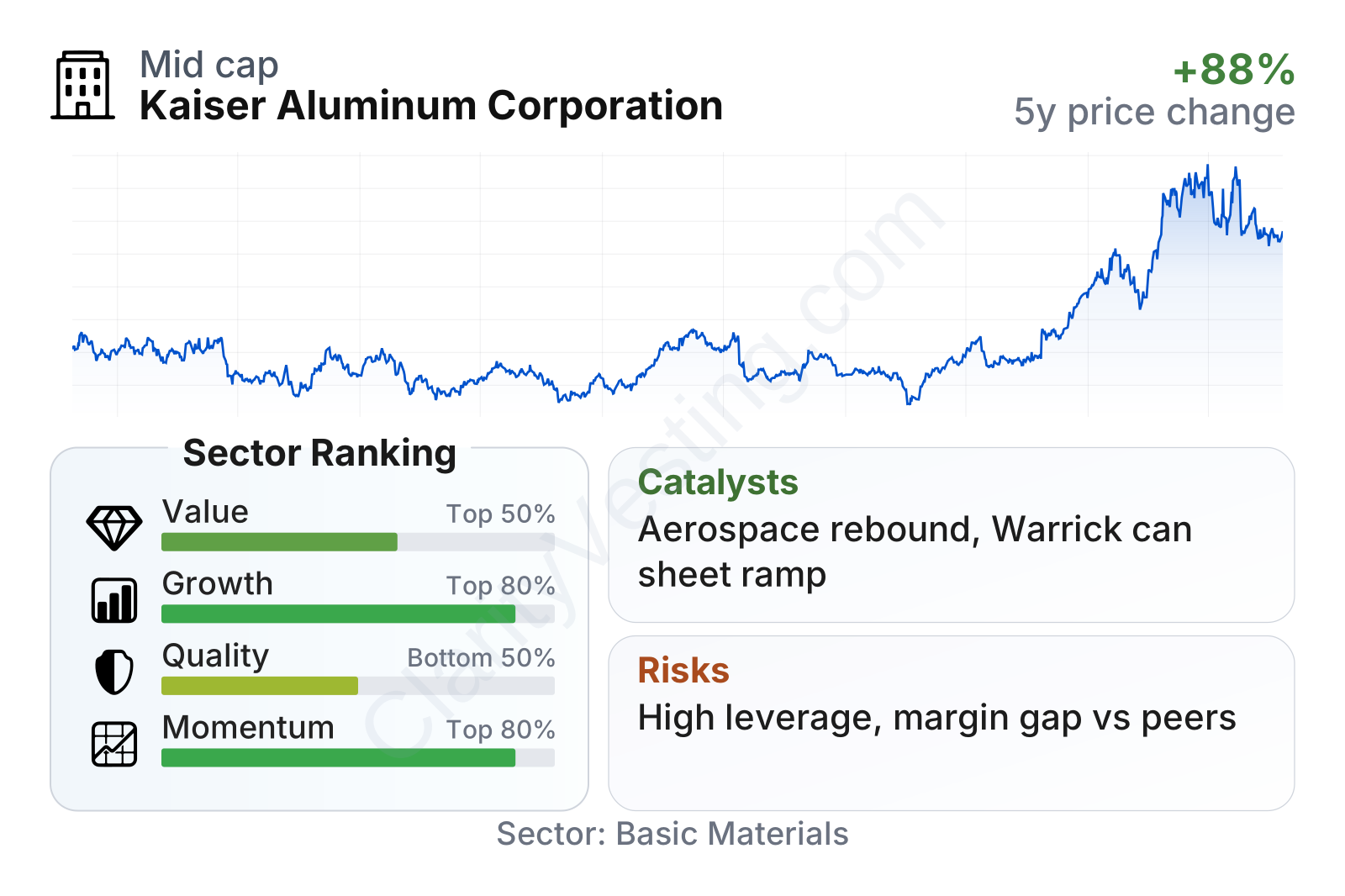
Kaiser Aluminum sits in the mid-cap range and shows a mixed profile. Growth and share-price momentum rank well versus much of the sector, while quality is less convincing because leverage is elevated and margins remain below many peers. On valuation, earnings-based measures look moderate, and operating earnings relative to enterprise value stand above the sector median, which points to a market that is recognizing the recovery but not pricing the company like a top-tier compounder.
The stock’s recent multi-year performance has been strong, with a particularly sharp move higher through 2026. At the same time, the beta of about 1.6 indicates that the shares can be more volatile than the broader market, which fits the cyclical nature of industrial metals exposure.
Growth
Kaiser operates in a sector with clear long-term demand drivers, even if short-term results can swing with the industrial cycle. Aluminum remains important in aerospace, beverage packaging, and vehicle lightweighting because it combines strength, low weight, and recyclability. Those themes support long-range demand, especially in markets where customers care about fuel efficiency, emissions, durability, and circular-material supply chains.
The company’s strategy is logical for future growth because it is centered on value-added applications instead of pure commodity volume. Aerospace has been a particularly important opportunity: large aircraft production is still in a multi-year recovery phase, and that tends to support demand for plate, sheet, and extrusion products. Packaging is a steadier business that can help absorb some of the swings from more cyclical industrial end markets.
Recent top-line momentum has clearly improved. After a period of declines and uneven demand, year-over-year revenue growth turned positive and then accelerated strongly into 2026, reaching a pace far above the sector median. That does not automatically mean a straight-line expansion ahead, but it does show that Kaiser is participating in a meaningful rebound.
Cash generation has been more volatile than revenue, which is common in manufacturing businesses with working-capital swings and periodic investment needs. Free cash flow moved between positive and negative territory in recent years before returning to a modest positive level. That pattern suggests the business can generate cash, but not yet with the consistency of the strongest industrial peers.
A notable catalyst in recent years has been the ramp-up of the company’s new packaging capacity project in Warrick. This investment was designed to increase can sheet capability and strengthen Kaiser’s position in a market tied to long-duration beverage packaging demand. In addition, the company has continued to highlight aerospace demand recovery and operational improvement efforts, both of which can support volume growth and better absorption of fixed costs.
Risks
This article is for informational purposes only and does not constitute financial advice. Some content is AI-generated. See Disclaimer


