Stock Analysis · Kadant Inc (KAI)
Overview
Kadant Inc. is a specialized industrial equipment company that sells engineered systems used in process industries. Its products help manufacturers handle fluids, clean and prepare materials, connect and move rolls, and improve efficiency in production lines. The company is especially tied to paper and packaging, but it also serves tissue, wood processing, recycling, and other industrial end markets.
Kadant’s business model is attractive because it is not built only on large one-time machine sales. A meaningful part of revenue comes from replacement parts, consumables, and aftermarket service, which tends to be more recurring and often steadier than capital equipment demand. This helps cushion the business when customers slow big project spending.
Based on the company’s reporting structure, revenue is primarily generated from three operating segments:
- Flow Control: approximately 49% of revenue in 2025. This segment includes rotary joints, steam systems, condensate systems, doctors, cleaning systems, and industrial valves used mainly in paper, packaging, and related process industries.
- Industrial Processing: approximately 34% of revenue in 2025. This business includes equipment for wood processing, stranders, chippers, debarkers, screening, and material handling systems used in forest products and other industrial applications.
- Material Handling: approximately 17% of revenue in 2025. This segment includes conveying, baling, fiber processing, and related systems that support recycling, packaging, and bulk material operations.
Geographically, Kadant is a global company with a meaningful international footprint, which broadens its customer base but also exposes results to currency moves and regional manufacturing cycles.
The long-term picture is of a mid-sized industrial company focused on niche markets where downtime is expensive and customers value reliability, efficiency, and service support. Revenue has expanded significantly over the past several years, while profitability has remained solid even as the business mix and cost base evolved.
Over the last five years, sales moved from roughly $787 million to just above $1.05 billion, while gross profit also climbed. The more notable shift is below the gross profit line: selling and administrative costs rose faster in recent years, which helps explain why operating income and net income have not grown as smoothly as revenue.
Key Figures
| Metric | Value | Sector ⓘ |
|---|---|---|
| Date | Oct 17, 2026 | |
| Context | ||
| Sector | Industrials | |
| Industry | Specialty Industrial Machinery | |
| Market Cap ⓘ | $3.09B | |
| Beta ⓘ | 1.20 | |
Value (Cheapness) | ||
| P/E Ratio ⓘ | 28.12 | 22.10 |
| P/B Ratio ⓘ | 3.03 | 1.97 |
| FCF Yield ⓘ | 5.18% | 6.38% |
| Dividend Yield ⓘ | 0.54% | 1.94% |
| EBIT / EV ⓘ | 4.96% | 4.79% |
| PEG ⓘ | 3.23 | |
Growth (Business expansion) | ||
| Revenue Growth ⓘ | 22.60% | 9.30% |
| RPS Growth (5Y CAGR) ⓘ | 7.23% | 7.81% |
| EPS Growth (5Y CAGR) ⓘ | -9.84% | -13.06% |
| BVPS Growth (5Y CAGR) ⓘ | 14.05% | 6.14% |
| Margin Growth (5Y Trend) ⓘ | 0.27% | 0.88% |
| FCF Growth (5Y CAGR) ⓘ | 0.76% | 11.01% |
| DPS Growth (5Y CAGR) ⓘ | 8.00% | 9.48% |
Quality (Business durability) | ||
| ROIC (Latest) ⓘ | 9.09% | 10.84% |
| ROA (Latest) ⓘ | 6.41% | 5.41% |
| ROIC (5Y Median) ⓘ | 19.30% | 9.38% |
| ROA (5Y Median) ⓘ | 8.56% | 4.95% |
| Net Debt / EBIT (Latest) ⓘ | -0.77 | 2.08 |
| Net Debt / EBIT (5Y Median) ⓘ | 1.32 | 2.27 |
| Net Debt / EBITDA (Latest) ⓘ | -0.58 | 1.39 |
| Net Debt / Assets ⓘ | -7.12% | 19.28% |
| EBITDA / Interest ⓘ | 6.41 | 9.58 |
| Operating Margin (Latest) ⓘ | 15.16% | 10.50% |
| Operating Margin (5Y Median) ⓘ | 16.43% | 10.29% |
| Debt to Equity (Latest) ⓘ | 49.92% | 65.48% |
| Profit Margin (Latest) ⓘ | 9.52% | 6.67% |
| Free Cash Flow (Latest) ⓘ | $159.99M | |
Momentum (Price trend) | ||
| 3Y Return ⓘ | +15.56% | +61.68% |
| 12M Return (excl. last month) ⓘ | -14.35% | +12.58% |
| 6M Return ⓘ | -21.82% | 0.00% |
| Price vs. 200-Day MA ⓘ | -15.92% | +0.02% |
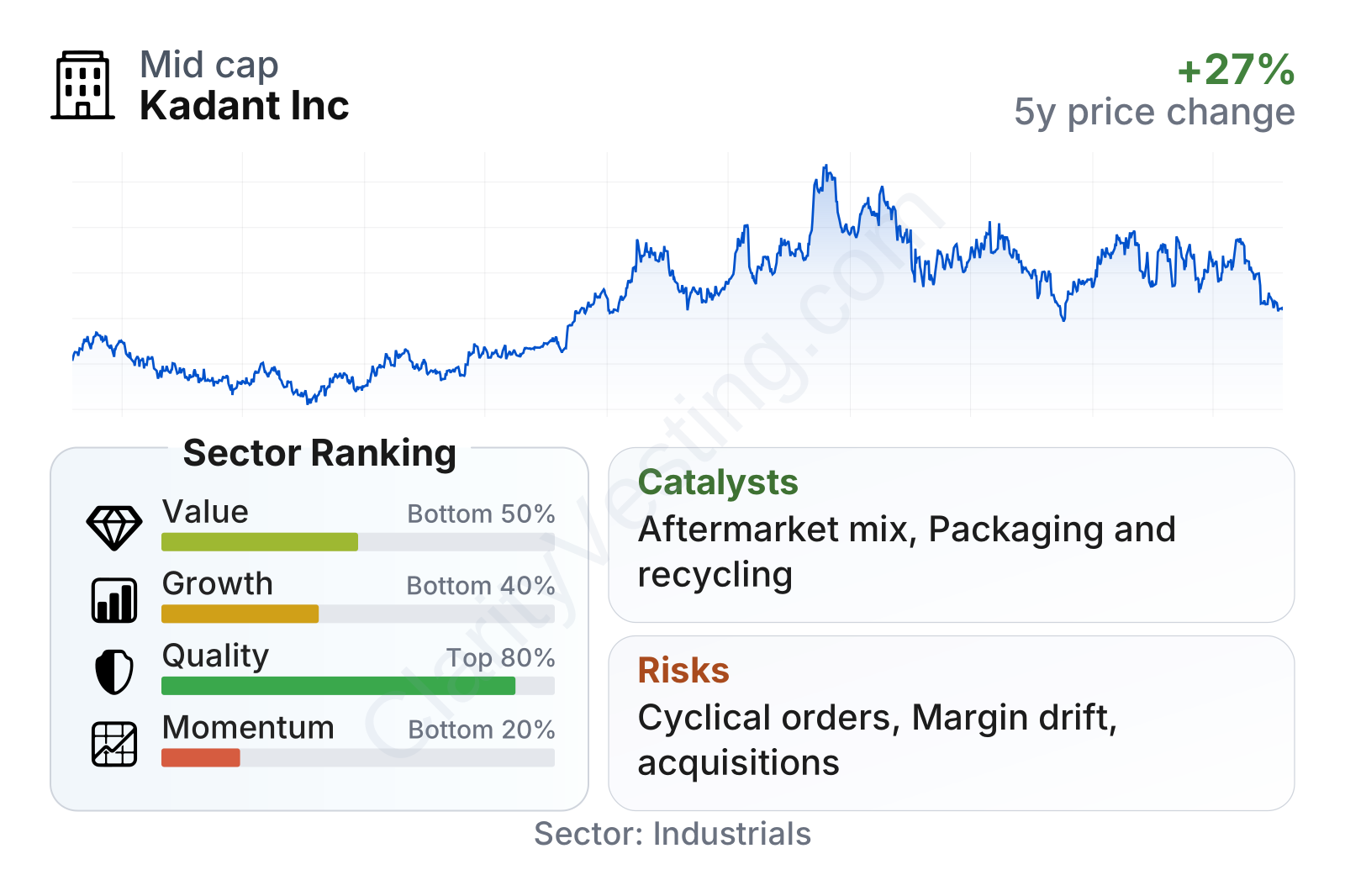
Kadant combines strong business quality with a less compelling value profile. Profitability remains better than much of the industrial machinery group, and the balance sheet looks healthier than the sector median. On the other hand, the shares trade above typical sector valuation multiples, while recent stock performance has lagged many peers.
The company’s market value places it in the mid-cap range, large enough to operate globally but still small enough for acquisitions and niche expansion to matter. Share price volatility is moderately above the broader market, which is common for cyclical industrial names.
Growth
Kadant operates in areas that benefit from several durable trends: automation, efficiency upgrades, packaging demand, recycling infrastructure, and the need for industrial customers to reduce waste, water use, and energy consumption. These are not fast-moving consumer trends, but they can support steady demand for specialized equipment and upgrades over long periods.
The company’s strategy is fairly coherent. It focuses on narrow industrial niches where product performance matters, where installed equipment can lead to aftermarket sales, and where acquisitions can broaden technology or geographic reach. That approach has worked reasonably well in expanding the revenue base beyond its historical paper exposure.
Recent growth has been uneven, which is typical for industrial companies tied to customer capital spending. After slower or negative periods during 2025, year-over-year growth reaccelerated strongly in the latest periods of 2026, reaching levels clearly above the sector median. That suggests order activity and end-market demand improved after a softer patch.
Cash generation has also remained respectable. Free cash flow has recovered from earlier dips and is back in the range of roughly $150 million to $160 million on a trailing basis. That matters because it gives Kadant flexibility to invest in product development, fund acquisitions, support dividends, and manage downturns without relying heavily on external capital.
A meaningful catalyst is the company’s exposure to consumables and replacement parts tied to installed equipment. Even when customers delay major expansion projects, they often still need maintenance items and efficiency upgrades. Another catalyst is acquisition-led expansion: Kadant has a long history of adding niche businesses that fit its process-industry focus. If integration remains disciplined, this can support both product breadth and geographic reach.
Recent company updates have also pointed to continued demand in markets tied to packaging, recycling, and industrial processing. These are not guaranteed growth engines every quarter, but they do provide a practical runway for steady expansion if manufacturing conditions remain stable.
Risks
This article is for informational purposes only and does not constitute financial advice. Some content is AI-generated. See Disclaimer


