Stock Analysis · Jyske Bank A/S (JYSKY)
Overview
Jyske Bank A/S is a Danish regional bank that provides everyday banking, mortgage lending, asset management, trading, and financial advisory services. Its customer base includes households, small and medium-sized businesses, larger corporates, and institutional clients, with activities centered mainly in Denmark. In practical terms, the bank earns money by taking deposits, making loans, arranging mortgages, charging fees for investment and banking services, and generating income from capital markets activities.
Its revenue mix can move meaningfully from year to year because interest rates, trading income, loan activity, and mortgage refinancing volumes all affect results. Based on the bank’s recent annual reporting structure, the main sources of revenue can be described as follows:
- Net interest income: roughly the largest component in most periods, often around 50% to 65% of core income. This includes income from loans, deposits placed with the bank, securities holdings, and funding costs.
- Fees, commissions, and mortgage-related income: often around 20% to 30%. This covers advisory fees, asset management, payments, refinancing activity, and mortgage administration.
- Trading and investment income: often around 10% to 20%, though it can be volatile. This includes market-making, securities valuation effects, and client-driven capital markets activity.
- Other income: usually a smaller share, generally below 10%, including assorted banking and service items.
Over the last few years, earnings expanded sharply when higher interest rates lifted banking spreads, but reported revenue has also shown some volatility as market-related items and funding effects moved around. The broad picture is that Jyske is a diversified domestic bank rather than a narrow niche lender, with mortgage banking and traditional commercial banking both important to the overall business model.
The multi-year profit flow shows a clear jump in revenue and earnings after 2022, followed by a more mixed pattern. Operating expenses have been fairly controlled relative to the increase in income, which helped profitability, but the path is not perfectly smooth, reflecting how sensitive banks are to rates, funding, and market conditions.
Key Figures
| Metric | Value | Sector ⓘ |
|---|---|---|
| Date | Nov 21, 2026 | |
| Context | ||
| Sector | Financial Services | |
| Industry | Banks - Regional | |
| Market Cap ⓘ | $7.45B | |
| Beta ⓘ | 0.37 | |
Value (Cheapness) | ||
| P/E Ratio ⓘ | 10.35 | 12.01 |
| P/B Ratio ⓘ | N/A | 1.48 |
| FCF Yield ⓘ | 40.17% | 8.77% |
| Dividend Yield ⓘ | 2.89% | 3.01% |
| EBIT / EV ⓘ | N/A | 8.31% |
| PEG ⓘ | 5.23 | |
Growth (Business expansion) | ||
| Revenue Growth ⓘ | -3.90% | 6.70% |
| RPS Growth (5Y CAGR) ⓘ | 35.83% | 12.35% |
| EPS Growth (5Y CAGR) ⓘ | 5.23% | -0.27% |
| BVPS Growth (5Y CAGR) ⓘ | 12.56% | 4.83% |
| Margin Growth (5Y Trend) ⓘ | -17.60% | -4.16% |
| FCF Growth (5Y CAGR) ⓘ | N/A | 4.69% |
| DPS Growth (5Y CAGR) ⓘ | 77.38% | 8.82% |
Quality (Business durability) | ||
| ROIC (Latest) ⓘ | N/A | 9.49% |
| ROE (Latest) ⓘ | 9.82% | 14.02% |
| ROA (Latest) ⓘ | 0.67% | 1.53% |
| ROIC (5Y Median) ⓘ | 1.05% | 7.80% |
| ROE (5Y Median) ⓘ | 10.52% | 12.09% |
| ROA (5Y Median) ⓘ | 0.69% | 1.28% |
| Net Debt / EBIT (Latest) ⓘ | N/A | 0.88 |
| Net Debt / EBIT (5Y Median) ⓘ | 56.59 | 0.73 |
| Net Debt / EBITDA (Latest) ⓘ | 62.64 | 0.71 |
| Operating Margin (Latest) ⓘ | N/A | 23.37% |
| Operating Margin (5Y Median) ⓘ | 47.50% | 24.29% |
| Debt to Equity (Latest) ⓘ | 921.10% | 59.34% |
| Profit Margin (Latest) ⓘ | 36.25% | 26.65% |
| Free Cash Flow (Latest) ⓘ | $2.99B | |
Momentum (Price trend) | ||
| 3Y Return ⓘ | +99.92% | +73.29% |
| 12M Return (excl. last month) ⓘ | +43.28% | +18.35% |
| 6M Return ⓘ | 0.00% | +3.24% |
| Price vs. 200-Day MA ⓘ | +4.12% | +2.17% |
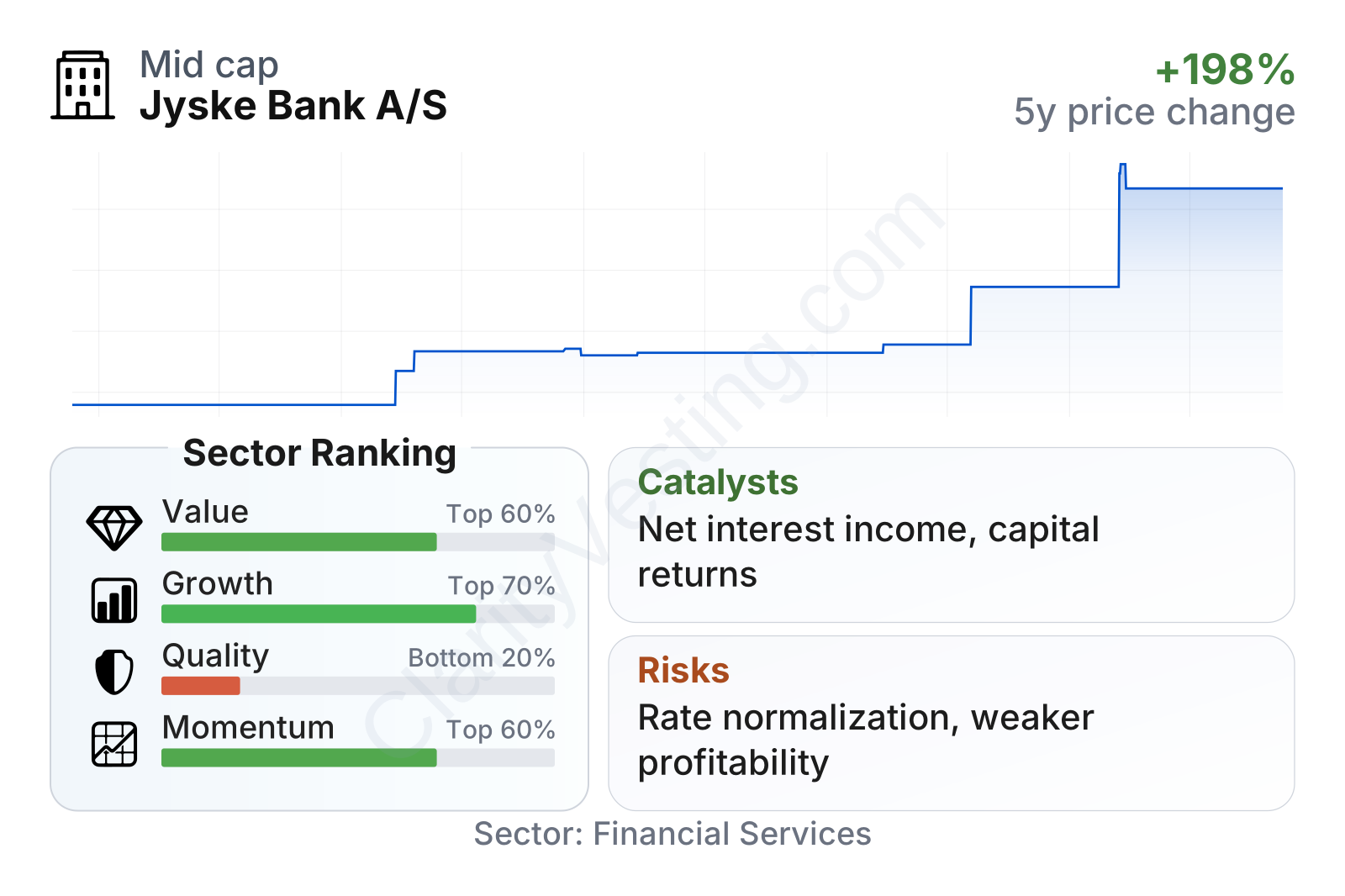
Jyske Bank is a mid-sized listed bank with a relatively low share-price volatility profile, as shown by its beta well below 1. On valuation, the stock trades on a price-to-earnings ratio around the lower end of the regional bank range, while the dividend yield is close to the sector median. The value profile looks supported by a low earnings multiple and unusually strong free cash flow yield, although cash flow metrics can be less straightforward for banks than for industrial companies.
The main weak point in the current snapshot is quality. Profitability ratios such as return on equity and return on assets sit below the sector median, even though profit margin itself is healthy. Growth metrics are more favorable over a five-year view: revenue per share, earnings per share, book value per share, and dividend growth all show solid expansion versus many peers. Momentum is also constructive over the last one- and three-year periods, indicating that the market has recognized the improvement in earnings and capital strength.
Growth
Jyske Bank operates in a mature sector, so the long-term growth case is not about a rapidly expanding industry. Banking in Denmark tends to be steady rather than explosive, with growth tied to household credit demand, business activity, wealth management flows, digital efficiency, and the interest-rate environment. That makes this a business where disciplined execution matters more than headline sector growth.
Its strategy for future expansion appears practical. Management has emphasized core banking, mortgage lending, efficiency, capital discipline, and shareholder distributions while continuing to invest in digital capabilities. For a regional bank, that approach makes sense: stronger customer retention, better cross-selling, and lower cost per customer can improve returns even if the broader market grows slowly.
Earnings per share have been uneven from year to year, which is common in banking, but the broader trend over the last five years is still positive. The large spike visible in one period should be treated carefully rather than extrapolated as a normal run-rate, yet it does illustrate how quickly bank earnings can change when margins, provisions, or one-off items move in the bank’s favor.
Book value per share has increased steadily, which is important for a bank because book value is a rough indicator of the capital base supporting future lending and earnings. Jyske’s five-year compound growth in book value per share is well ahead of the sector median, suggesting the bank has been adding underlying balance-sheet strength over time rather than relying only on short-term profit swings.
A meaningful catalyst is the bank’s sensitivity to net interest income. If rates remain at levels that still support healthy deposit and lending spreads, earnings can stay resilient. Another possible tailwind is continued capital distribution through dividends and share repurchases when capital ratios remain comfortably above regulatory requirements. In addition, operational simplification and digital improvements can gradually lift efficiency in a business where small cost gains matter.
Recent company communications have also pointed to ongoing capital management and stable business activity in core markets, which matters because Danish banking remains highly regulated and trust-based. In that environment, consistency itself can be an advantage when paired with solid capital generation.
Risks
This article is for informational purposes only and does not constitute financial advice. Some content is AI-generated. See Disclaimer


