Stock Analysis · Jumbo S.A (JUMSF)
Overview
Jumbo S.A. is a Greek specialty retailer best known for toys, baby products, seasonal goods, home items, and low-priced everyday merchandise. The company operates a large store network in Greece, Cyprus, Bulgaria, and Romania, and it also supports online sales in several of its markets. Its model is built around broad product variety, value pricing, high store traffic, and disciplined purchasing.
The business is still mainly a physical retail operation, with revenue coming primarily from merchandise sold through its store network. Based on recent company reporting, the geographic revenue mix is led by Greece, followed by Romania, Bulgaria, and Cyprus, with a smaller contribution from other channels such as franchise-related activity and e-commerce where disclosed. A practical breakdown is:
- Greece: approximately 60% of revenue. This is the company’s largest market and includes its core store base and the broadest customer reach.
- Romania: approximately 20% to 25% of revenue. This has been one of the most important expansion markets for new stores and scale.
- Bulgaria: approximately 10% of revenue. This market adds regional diversification and a meaningful contribution to sales.
- Cyprus: approximately 5% of revenue. A smaller but established market for the group.
- Other activity: a low-single-share portion of revenue, including franchise-related streams and online sales where reported.
From a product perspective, Jumbo does not rely on one narrow category. Its assortment usually combines toys, stationery, baby goods, home decoration, household items, gifts, and seasonal merchandise. That wide mix helps the company capture demand across different times of the year rather than depending on only one shopping season.
Over the last several years, the business has shown a clear ability to turn sales into profit and cash. Revenue has moved steadily higher, while gross profit and net income have also expanded materially. The flow from sales to earnings suggests a retailer with strong purchasing power and tight cost control, especially compared with many lower-margin peers in discretionary retail.
The long-term pattern is encouraging: sales have risen consistently since 2021, and profitability has remained unusually strong for a retailer. The most notable point is that profit growth broadly kept pace with revenue growth, which indicates that expansion has not come at the expense of margins.
Key Figures
| Metric | Value | Sector ⓘ |
|---|---|---|
| Date | Oct 17, 2026 | |
| Context | ||
| Sector | Consumer Cyclical | |
| Industry | Specialty Retail | |
| Market Cap ⓘ | $3.70B | |
| Beta ⓘ | 0.35 | |
Value (Cheapness) | ||
| P/E Ratio ⓘ | 9.79 | 16.89 |
| P/B Ratio ⓘ | 2.24 | 1.61 |
| FCF Yield ⓘ | 9.18% | 8.99% |
| Dividend Yield ⓘ | 2.55% | 2.73% |
| EBIT / EV ⓘ | N/A | 6.69% |
| PEG ⓘ | N/A | |
Growth (Business expansion) | ||
| Revenue Growth ⓘ | 4.40% | 5.60% |
| RPS Growth (5Y CAGR) ⓘ | 10.67% | 8.91% |
| EPS Growth (5Y CAGR) ⓘ | -15.89% | -17.41% |
| BVPS Growth (5Y CAGR) ⓘ | 4.69% | 5.62% |
| Margin Growth (5Y Trend) ⓘ | -2.72% | -0.17% |
| FCF Growth (5Y CAGR) ⓘ | -1.96% | 4.91% |
| DPS Growth (5Y CAGR) ⓘ | 6.17% | 9.86% |
Quality (Business durability) | ||
| ROIC (Latest) ⓘ | N/A | 12.38% |
| ROA (Latest) ⓘ | 24.39% | 5.49% |
| ROIC (5Y Median) ⓘ | 19.90% | 10.75% |
| ROA (5Y Median) ⓘ | 17.23% | 5.44% |
| Net Debt / EBIT (Latest) ⓘ | -0.97 | 2.17 |
| Net Debt / EBIT (5Y Median) ⓘ | -1.09 | 2.30 |
| Net Debt / EBITDA (Latest) ⓘ | -0.84 | 1.50 |
| Net Debt / Assets ⓘ | -25.67% | 21.57% |
| EBITDA / Interest ⓘ | N/A | 9.13 |
| Operating Margin (Latest) ⓘ | 24.11% | 9.10% |
| Operating Margin (5Y Median) ⓘ | 32.86% | 9.56% |
| Debt to Equity (Latest) ⓘ | 3.84% | 75.99% |
| Profit Margin (Latest) ⓘ | 25.80% | 5.31% |
| Free Cash Flow (Latest) ⓘ | $339.28M | |
Momentum (Price trend) | ||
| 3Y Return ⓘ | +86.38% | +15.94% |
| 12M Return (excl. last month) ⓘ | +5.20% | -2.82% |
| 6M Return ⓘ | +1.30% | -1.58% |
| Price vs. 200-Day MA ⓘ | +1.11% | -3.31% |
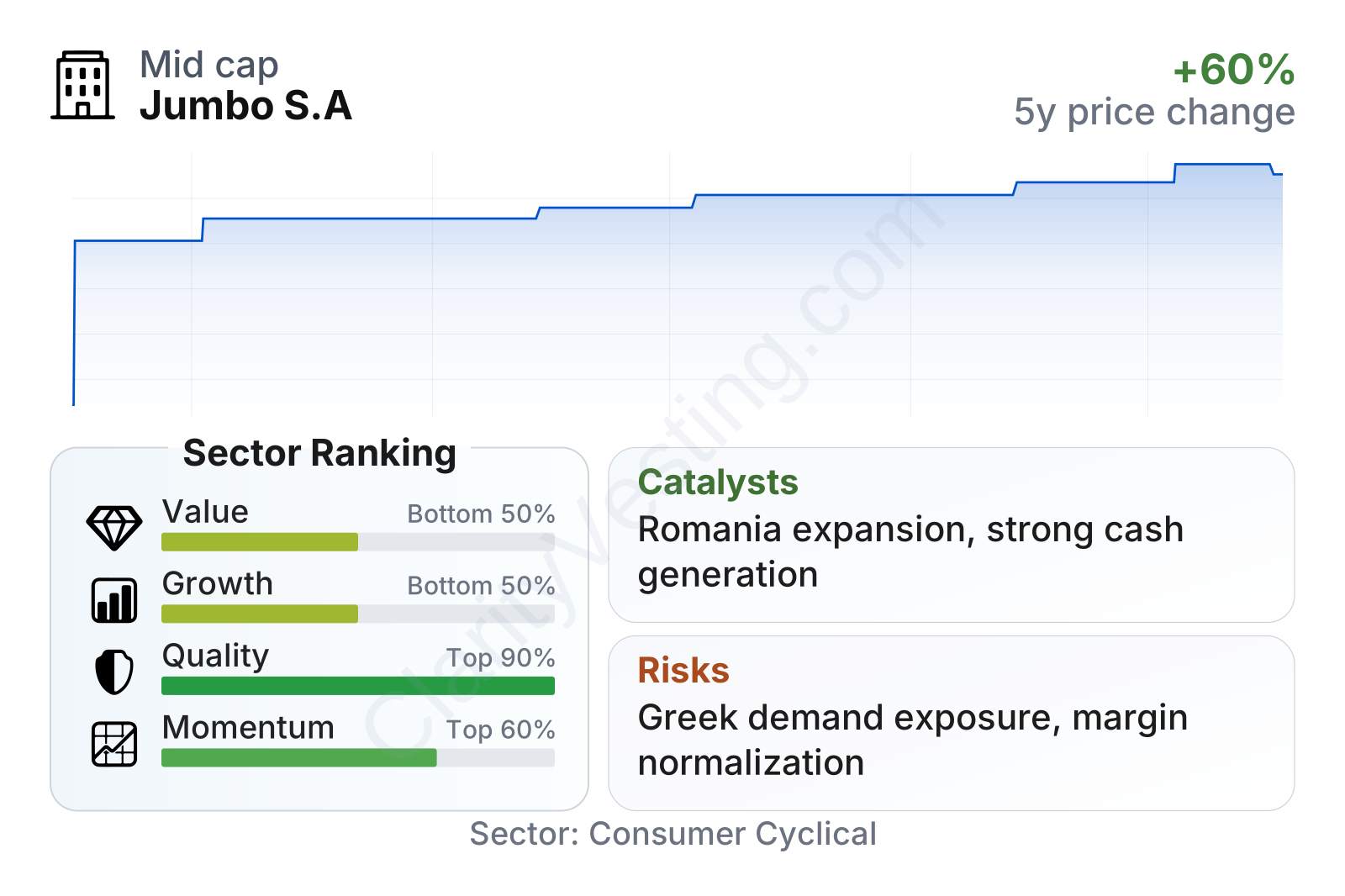
Jumbo stands out more for business quality than for rapid growth. Profitability metrics are well above typical specialty retail levels, with operating and net margins that are unusually high for the sector. Asset returns are also very strong, pointing to efficient use of stores, inventory, and capital. The balance sheet is another clear strength: debt is very low, and net cash remains an important cushion. Free cash flow generation is solid as well, supporting dividends and expansion without heavy financial strain.
Growth indicators are more mixed. Recent annual revenue growth is positive but somewhat below the sector median, while longer-term revenue per share growth has been stronger. Earnings and cash flow trends over five years look less impressive than the company’s current profitability, which suggests that recent strength should be weighed against a more uneven longer-run pattern. On market behavior, the shares have outperformed much of the sector over one year and especially over three years, while also showing relatively low volatility.
Growth
Jumbo operates in a retail segment that is mature rather than structurally fast-growing. Demand for toys, household goods, baby products, and seasonal merchandise tends to track consumer spending, household formation, and traffic in shopping areas more than breakthrough innovation. That said, the company has positioned itself in a resilient part of discretionary retail by focusing on value-priced items and broad assortment, which can work well when consumers are budget-conscious.
Its growth strategy is straightforward and easy to understand: open stores selectively in markets where modern large-format value retail still has room to expand, keep prices competitive, and use scale in sourcing to protect margins. Romania appears especially important in this plan because it offers a larger population base and has been a key driver of network growth. Continued regional expansion matters because Greece, while still the profit anchor, is already a more mature market.
Another useful catalyst is the company’s financial structure. With low leverage and strong cash generation, Jumbo has more flexibility than many retailers to fund new stores, improve logistics, absorb cost swings, and continue shareholder distributions. This does not automatically create growth, but it lowers execution risk when management chooses to expand.
Recent operating updates and annual reporting have also pointed to continued sales progress, with revenue advancing into 2025. That matters because it suggests demand has remained healthy even after several years of strong performance. If store additions in Romania and the wider Balkan region continue to contribute without damaging margins, the company could keep compounding at a respectable pace even in a non-high-growth industry.
Risks
This article is for informational purposes only and does not constitute financial advice. Some content is AI-generated. See Disclaimer


