Stock Analysis · Japan Metropolitan Fund Investment Corporation (JRFIF)
Overview
Japan Metropolitan Fund Investment Corporation is a Japanese real estate investment trust, or REIT, focused mainly on income-producing commercial properties in major urban areas of Japan. Its portfolio is centered on retail assets, but it also owns other urban real estate tied to consumer activity and daily living. In simple terms, the company collects rent from tenants occupying shopping centers, urban retail buildings, and related properties, then distributes a large share of its cash earnings to unitholders.
The business model is relatively straightforward: acquire properties in densely populated metropolitan areas, keep occupancy high, manage leases and tenants, and finance the portfolio with a mix of equity and debt. Because it operates as a REIT, recurring rental income matters much more than product sales, manufacturing, or technology development.
Based on its portfolio disclosures, revenue is primarily generated from property leasing and related real estate income. A simplified breakdown is:
- Rental revenue from retail properties: approximately 80% to 90%. This includes rent from shopping centers, neighborhood retail facilities, and urban commercial buildings.
- Rental revenue from other commercial and mixed-use assets: approximately 10% to 20%. This can include assets connected to broader urban consumption and service activity.
- Other property-related income: a small share. This typically includes common area charges, parking, utility recoveries, and other lease-related fees.
The earnings profile has been fairly stable over the past few years, but the latest fiscal year stands out: revenue, operating income, and net income all moved noticeably higher, showing that the trust benefited from stronger property income and improved profitability even as interest expense also rose.
Over the last five fiscal years, total revenue moved from roughly ¥71 billion to about ¥96 billion, while net income climbed from about ¥25 billion to around ¥41 billion. That is a meaningful improvement for a mature REIT and suggests that asset quality, leasing conditions, and portfolio management have recently been working in its favor.
Key Figures
| Metric | Value | Sector ⓘ |
|---|---|---|
| Date | Oct 03, 2026 | |
| Context | ||
| Sector | Real Estate | |
| Industry | REIT - Retail | |
| Market Cap ⓘ | $4.49B | |
| Beta ⓘ | 0.21 | |
Value (Cheapness) | ||
| P/E Ratio ⓘ | 17.99 | 17.35 |
| P/B Ratio ⓘ | 0.01 | 0.86 |
| FCF Yield ⓘ | N/A | 7.47% |
| Dividend Yield ⓘ | 6.26% | 4.75% |
| EBIT / EV ⓘ | 415.25% | 3.81% |
| PEG ⓘ | N/A | |
Growth (Business expansion) | ||
| Revenue Growth ⓘ | 12.40% | 5.30% |
| RPS Growth (5Y CAGR) ⓘ | 6.95% | 5.96% |
| EPS Growth (5Y CAGR) ⓘ | -28.09% | -11.41% |
| BVPS Growth (5Y CAGR) ⓘ | 0.24% | 0.41% |
| Margin Growth (5Y Trend) ⓘ | -1.25% | 0.53% |
| FCF Growth (5Y CAGR) ⓘ | N/A | 5.40% |
| DPS Growth (5Y CAGR) ⓘ | 10.71% | 5.02% |
Quality (Business durability) | ||
| ROIC (Latest) ⓘ | N/A | 5.77% |
| ROE (Latest) ⓘ | N/A | 7.64% |
| ROA (Latest) ⓘ | N/A | 2.85% |
| ROIC (5Y Median) ⓘ | 2.81% | 4.20% |
| ROE (5Y Median) ⓘ | 5.13% | 6.03% |
| ROA (5Y Median) ⓘ | 2.56% | 2.45% |
| Net Debt / EBIT (Latest) ⓘ | N/A | 7.57 |
| Net Debt / EBIT (5Y Median) ⓘ | 13.67 | 8.41 |
| Net Debt / EBITDA (Latest) ⓘ | N/A | 5.12 |
| Net Debt / Assets ⓘ | 44.87% | 37.84% |
| EBITDA / Interest ⓘ | N/A | 4.11 |
| Operating Margin (Latest) ⓘ | N/A | 35.40% |
| Operating Margin (5Y Median) ⓘ | 43.84% | 36.59% |
| Debt to Equity (Latest) ⓘ | N/A | 89.06% |
| Profit Margin (Latest) ⓘ | 44.77% | 19.99% |
| Free Cash Flow (Latest) ⓘ | N/A | |
Momentum (Price trend) | ||
| 3Y Return ⓘ | +13.61% | +30.60% |
| 12M Return (excl. last month) ⓘ | +6.43% | +7.55% |
| 6M Return ⓘ | +3.08% | +0.69% |
| Price vs. 200-Day MA ⓘ | +3.54% | -2.30% |
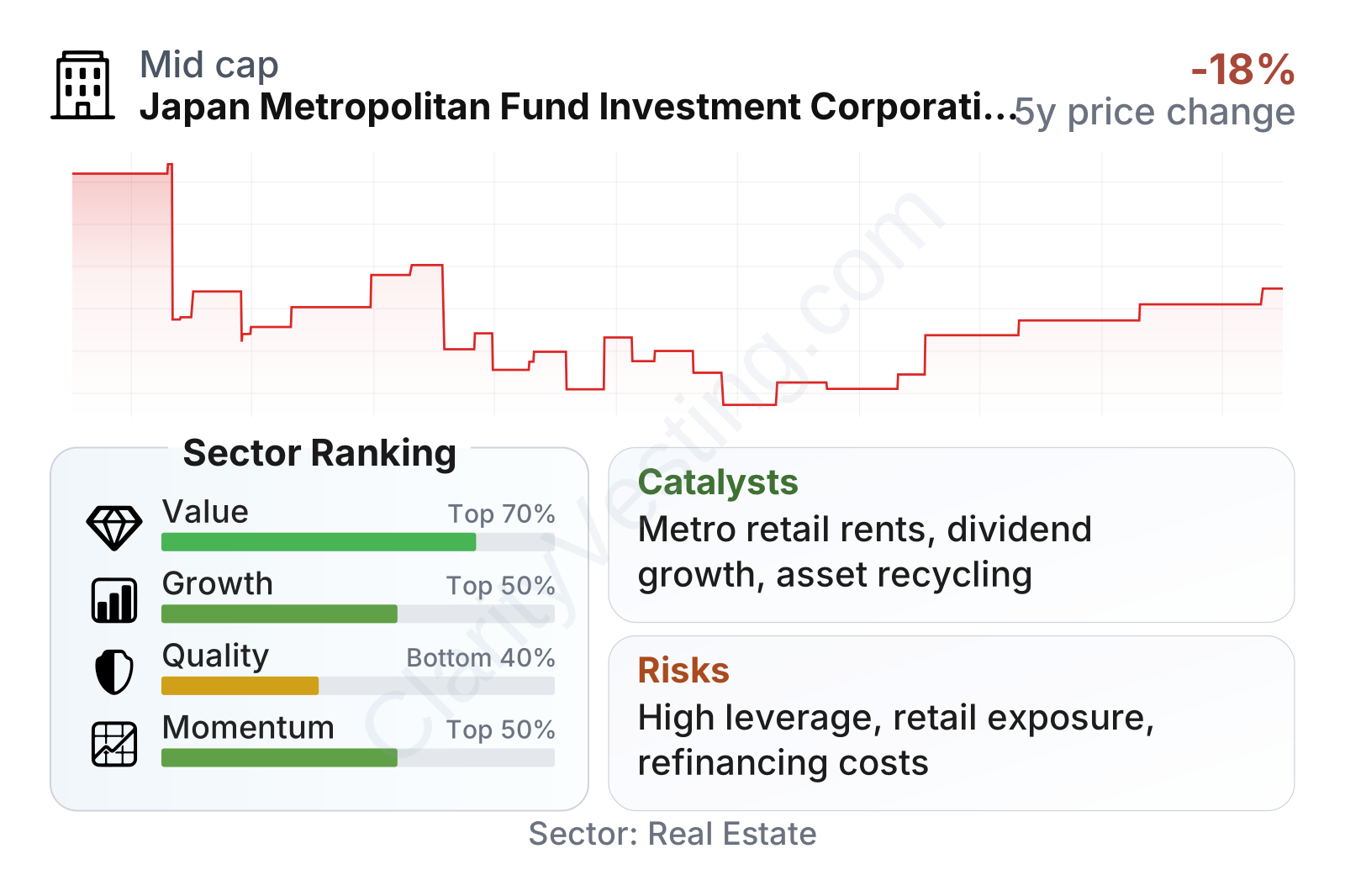
Japan Metropolitan Fund is a large listed REIT with a market value in the mid-single-digit billions of U.S. dollars. Its share price has been volatile over the last several years, dropping sharply in 2022 and 2023 before recovering part of that decline through 2025 and 2026. The stock’s beta is very low, which means it has historically moved less than the broader equity market.
The latest metrics show a mixed but understandable profile for a property trust. On valuation, the dividend yield is above the sector median at roughly 6%, which is often one of the first things income-oriented market participants notice with REITs. Revenue growth and dividend growth have also been stronger than many peers. On the other hand, quality metrics are weaker overall because leverage is relatively high and returns on capital are not especially strong compared with the broader real estate group.
The numbers also point to a business with strong accounting profitability. Profit margin is well above the sector median, and long-term operating margins have been solid. However, debt load remains an important part of the picture, which is normal for REITs but still worth monitoring closely when interest costs are rising.
Growth
Japan Metropolitan Fund operates in a sector that is mature rather than fast-growing, but that does not mean growth is absent. Urban retail real estate in Japan can still expand through rent revisions, occupancy gains, redevelopment, better tenant mix, acquisitions, and asset recycling. The trust’s focus on metropolitan locations gives it exposure to dense population centers where foot traffic, convenience spending, and transportation-linked commerce tend to be more resilient than in weaker regional markets.
Its strategy makes sense for long-term expansion because it is built around established assets in major cities rather than speculative development. That usually supports steadier cash generation. For a REIT, durable leasing income and disciplined capital allocation often matter more than rapid expansion.
Revenue per share has shown a generally upward trend over the past five fiscal years, with a particularly strong step-up in the latest year. That matters because it suggests growth has not come only from issuing more equity; on a per-share basis, the trust has still been creating more revenue.
Dividend per share has also moved up meaningfully since 2022, with only a small pause along the way. The five-year dividend growth rate is comfortably ahead of the sector median, which indicates that the recent improvement in earnings has been translating into distributions.
A practical catalyst for future growth is any continuation of stronger leasing conditions in Japanese metropolitan retail, especially if tenant sales and occupancy remain healthy enough to support rent increases or better lease renewals. Another potential driver is portfolio optimization: selling lower-growth assets and reinvesting into stronger properties can lift portfolio quality without requiring a major strategic change.
The latest fiscal-year jump in revenue and net income is itself an important recent development. It does not guarantee a lasting trend, but it does show the company entered 2026 with positive operating momentum rather than stagnation.
Risks
This article is for informational purposes only and does not constitute financial advice. Some content is AI-generated. See Disclaimer