Stock Analysis · JPMorgan Chase & Co (JPM)
Overview
JPMorgan Chase & Co is one of the largest financial institutions in the world. It operates as a diversified bank, serving consumers, small businesses, large corporations, governments, and institutional investors. Its activities range from everyday checking accounts and credit cards to investment banking, trading, asset management, commercial lending, and treasury services. That breadth matters because it gives the company multiple ways to earn money across different economic environments.
Based on the company’s latest annual reporting structure, revenue comes from four main business lines. Using 2025 managed revenue as a practical reference point, the mix is approximately:
- Commercial & Investment Bank: about 42% — investment banking fees, markets and trading, securities services, payments, and lending for corporations, governments, and institutions.
- Consumer & Community Banking: about 37% — consumer banking, home lending, auto lending, credit cards, small business banking, and branch-based deposit services.
- Asset & Wealth Management: about 12% — investment management, custody, private banking, and wealth advisory services for institutions and affluent clients.
- Corporate: about 9% — treasury-related items, capital management, and other corporate-level activities that do not sit neatly inside the operating segments.
This structure shows why JPMorgan is often seen less as a single bank and more as a financial platform. It earns substantial net interest income from loans and deposits, but it also benefits from fee-based businesses such as advisory, payments, card services, and asset management. Over the last several years, total revenue has expanded strongly, while expenses have risen more slowly than revenue overall, allowing the company to preserve solid profitability even as interest costs moved higher.
The long-term pattern is favorable: revenue has climbed materially since 2021, and net income has remained very large even after a modest pullback from the peak reached in 2024. That suggests a business with strong earning power, though one that is still tied to credit conditions, rates, and capital markets activity.
Key Figures
| Metric | Value | Sector ⓘ |
|---|---|---|
| Date | Oct 03, 2026 | |
| Context | ||
| Sector | Financial Services | |
| Industry | Banks - Diversified | |
| Market Cap ⓘ | $879.41B | |
| Beta ⓘ | 0.97 | |
Value (Cheapness) | ||
| P/E Ratio ⓘ | 14.17 | 12.60 |
| P/B Ratio ⓘ | 2.48 | 1.23 |
| FCF Yield ⓘ | -18.48% | 10.16% |
| Dividend Yield ⓘ | 1.79% | 2.96% |
| EBIT / EV ⓘ | 11.70% | 7.77% |
| PEG ⓘ | 1.57 | |
Growth (Business expansion) | ||
| Revenue Growth ⓘ | 30.40% | 9.50% |
| RPS Growth (5Y CAGR) ⓘ | 24.23% | 12.10% |
| EPS Growth (5Y CAGR) ⓘ | N/A | -9.45% |
| BVPS Growth (5Y CAGR) ⓘ | 9.37% | 5.01% |
| Margin Growth (5Y Trend) ⓘ | -20.86% | -4.07% |
| FCF Growth (5Y CAGR) ⓘ | N/A | 4.96% |
| DPS Growth (5Y CAGR) ⓘ | 8.79% | 8.79% |
Quality (Business durability) | ||
| ROIC (Latest) ⓘ | 7.60% | 9.60% |
| ROE (Latest) ⓘ | 17.52% | 13.84% |
| ROA (Latest) ⓘ | 1.36% | 1.53% |
| ROIC (5Y Median) ⓘ | 6.88% | 7.86% |
| ROE (5Y Median) ⓘ | 16.89% | 12.20% |
| ROA (5Y Median) ⓘ | 1.35% | 1.29% |
| Net Debt / EBIT (Latest) ⓘ | 11.06 | 0.91 |
| Net Debt / EBIT (5Y Median) ⓘ | 0.47 | 0.74 |
| Net Debt / EBITDA (Latest) ⓘ | 9.96 | 0.97 |
| Operating Margin (Latest) ⓘ | 28.19% | 22.12% |
| Operating Margin (5Y Median) ⓘ | 27.73% | 24.39% |
| Debt to Equity (Latest) ⓘ | 330.45% | 60.37% |
| Profit Margin (Latest) ⓘ | 34.92% | 26.62% |
| Free Cash Flow (Latest) ⓘ | -$162.53B | |
Momentum (Price trend) | ||
| 3Y Return ⓘ | +147.55% | +89.23% |
| 12M Return (excl. last month) ⓘ | +20.01% | +17.35% |
| 6M Return ⓘ | +13.88% | +10.00% |
| Price vs. 200-Day MA ⓘ | +4.09% | +3.73% |
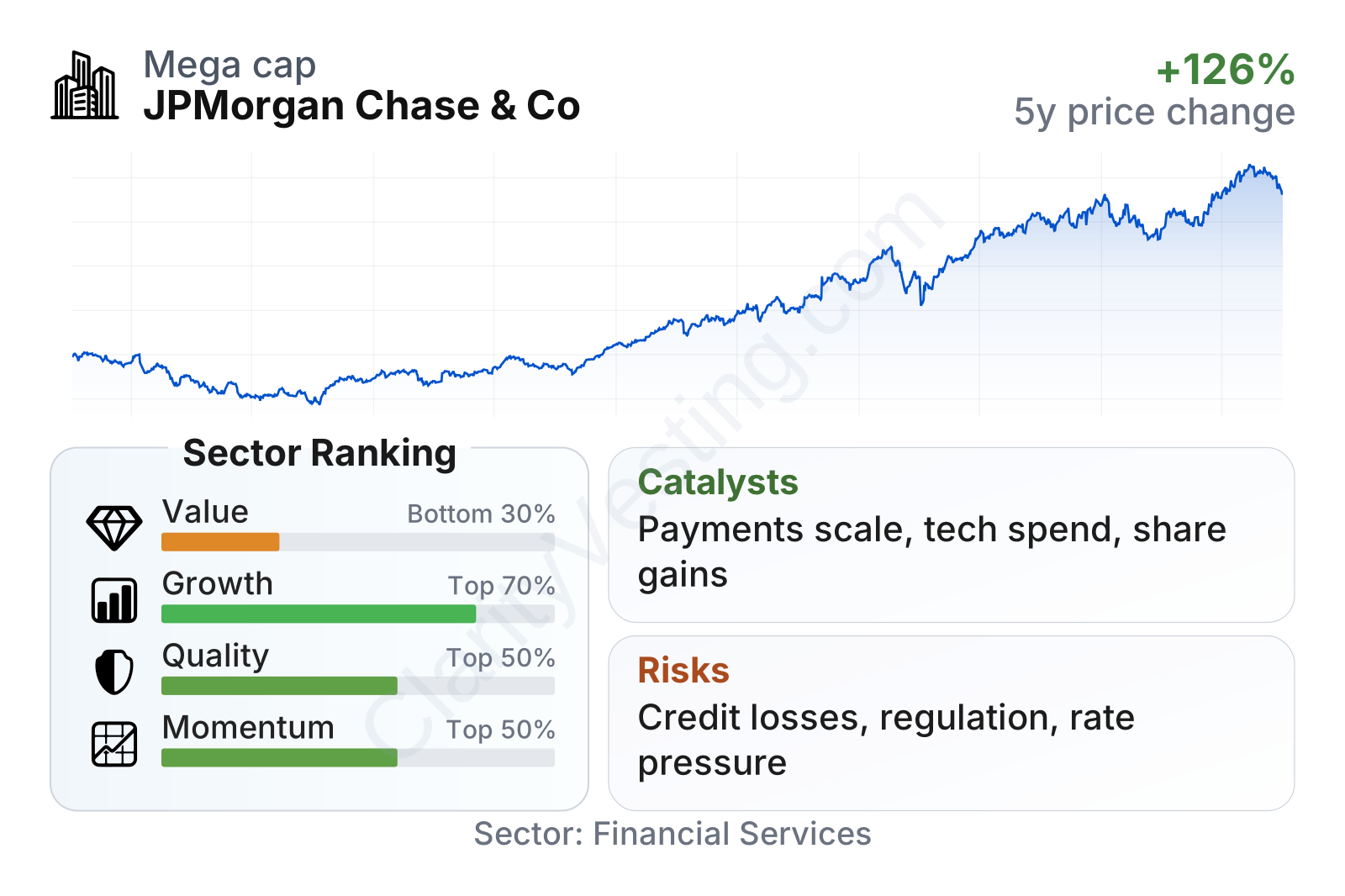
JPMorgan stands out for scale, profitability, and market performance. It is now valued as one of the largest listed financial companies globally, and its share price has advanced sharply over the last three years. The factor summary points to a business that ranks well on quality, growth, and momentum versus much of the financial sector, while appearing less attractive on traditional value measures because the stock trades at a noticeable premium to many peers.
That premium is not hard to understand. Return on equity is above the sector median, profit margins are stronger than average, and recent revenue growth has been well ahead of the sector median. At the same time, the dividend yield is lower than many financial stocks because the share price has risen faster than the dividend, and the price-to-book ratio is much higher than the sector norm. In other words, the market is already recognizing JPMorgan’s operating strength.
Growth
JPMorgan operates in a mature industry, so this is not a classic high-growth business in the way a young software company might be. Still, large-scale banking can grow steadily through share gains, product expansion, higher client balances, payments activity, wealth management inflows, and selective acquisitions. The company’s strategy is coherent: keep building a broad franchise, invest heavily in technology, deepen relationships with households and corporations, and use balance sheet strength to take share when weaker competitors pull back.
A major industry support is the continued concentration of deposits, payments, and corporate financial activity in the hands of a few very large institutions. Regulation has made banking more demanding, but it has also raised the barriers to entry. That tends to favor firms with national scale, deep compliance resources, strong brands, and broad product sets. JPMorgan fits that profile better than almost anyone.
Earnings per share have been volatile from year to year, which is normal for a large bank because interest rates, reserve releases, trading conditions, and deal activity can swing results. Even so, the broader direction has been constructive, with earnings recovering well after the 2022 slowdown and remaining near historically elevated levels in 2024 and 2025. That pattern suggests the company has not relied on a single temporary tailwind.
Book value per share has moved upward consistently over the last five years, growing at a faster pace than the sector median. For a bank, this is an important sign because it shows the company has been adding capital and retaining economic value over time. Rising book value, combined with strong returns on equity, usually points to a franchise that is compounding internally rather than merely expanding in size.
Recent company updates also support the growth case. Management has continued to emphasize investment in digital banking, payments infrastructure, artificial intelligence tools, and wealth management capabilities. JPMorgan has also remained active in expanding branches and improving its consumer reach in areas where it historically had less physical presence. In capital markets and treasury services, its global network remains a meaningful advantage as companies look for integrated banking partners.
One recent opportunity worth noting is the firm’s ability to capture business from market volatility and client activity. Large banks with dominant trading, payments, and corporate banking operations can benefit when clients need hedging, liquidity, financing, or balance-sheet support. That does not create straight-line growth, but it can strengthen market share and reinforce customer relationships over time.
Risks
This article is for informational purposes only and does not constitute financial advice. Some content is AI-generated. See Disclaimer