Stock Analysis · Joby Aviation (JOBY)
Overview
Joby Aviation is developing electric vertical takeoff and landing aircraft, often called eVTOL aircraft, for short-distance passenger transportation. The basic idea is to offer air taxi services that can move people between cities, airports, and dense urban areas with lower noise and no direct in-flight emissions. The company is also building the software, charging, operations, and certification capabilities needed to run a commercial air mobility network rather than simply selling aircraft as a standalone product.
At this stage, Joby is still largely a pre-commercial company. Revenue remains limited and does not yet reflect a mature operating business. Recent revenue has come mainly from government and defense-related work, along with smaller amounts tied to development services, contract work, and early commercialization activities. Based on recent company reporting, the mix appears to be concentrated as follows:
- Government and defense-related contract revenue: likely the large majority of current revenue, estimated at well above 80% in recent periods. This mainly reflects work performed under contracts connected to the U.S. Department of Defense and affiliated programs.
- Other revenue and services: a much smaller share, likely below 20%. This includes development-related work and limited early commercial activity rather than scaled passenger operations or aircraft deliveries.
- Passenger service revenue: currently 0% at meaningful scale. Joby has not yet launched broad commercial air taxi service.
- Aircraft sales: currently 0% at meaningful scale. The long-term model may include direct sales, partnerships, or fleet operations, but this is not yet a significant source of revenue.
What stands out is the gap between Joby’s ambition and its present income profile. The company is spending heavily to certify its aircraft, expand manufacturing, and prepare operations, while current sales are still small. That makes Joby less like a traditional aviation company today and more like an advanced transportation platform under construction.
The overall income flow shows a business still dominated by research and development spending. Revenue has started to appear, but operating expenses have risen much faster, especially engineering and scale-up costs. In other words, Joby is progressing commercially, but it is still very far from self-funding operations.
Key Figures
| Metric | Value | Sector ⓘ |
|---|---|---|
| Date | Oct 17, 2026 | |
| Context | ||
| Sector | Industrials | |
| Industry | Airports & Air Services | |
| Market Cap ⓘ | $4.93B | |
| Beta ⓘ | 2.66 | |
Value (Cheapness) | ||
| P/E Ratio ⓘ | N/A | 22.10 |
| P/B Ratio ⓘ | 2.53 | 1.97 |
| FCF Yield ⓘ | -15.09% | 6.38% |
| Dividend Yield ⓘ | N/A | 1.94% |
| EBIT / EV ⓘ | -18.61% | 4.79% |
| PEG ⓘ | N/A | |
Growth (Business expansion) | ||
| Revenue Growth ⓘ | 257493.30% | 9.30% |
| RPS Growth (5Y CAGR) ⓘ | N/A | 7.81% |
| EPS Growth (5Y CAGR) ⓘ | -6.71% | -13.06% |
| BVPS Growth (5Y CAGR) ⓘ | -6.43% | 6.14% |
| Margin Growth (5Y Trend) ⓘ | N/A | 0.88% |
| FCF Growth (5Y CAGR) ⓘ | N/A | 11.01% |
| DPS Growth (5Y CAGR) ⓘ | N/A | 9.48% |
Quality (Business durability) | ||
| ROIC (Latest) ⓘ | -36.80% | 10.84% |
| ROA (Latest) ⓘ | -42.64% | 5.41% |
| ROIC (5Y Median) ⓘ | -36.38% | 9.38% |
| ROA (5Y Median) ⓘ | -40.04% | 4.95% |
| Net Debt / EBIT (Latest) ⓘ | N/A | 2.08 |
| Net Debt / EBIT (5Y Median) ⓘ | N/A | 2.27 |
| Net Debt / EBITDA (Latest) ⓘ | N/A | 1.39 |
| Net Debt / Assets ⓘ | 3.84% | 19.28% |
| EBITDA / Interest ⓘ | N/A | 9.58 |
| Operating Margin (Latest) ⓘ | -753.84% | 10.50% |
| Operating Margin (5Y Median) ⓘ | -49700.68% | 10.29% |
| Debt to Equity (Latest) ⓘ | 41.63% | 65.48% |
| Profit Margin (Latest) ⓘ | N/A | 6.67% |
| Free Cash Flow (Latest) ⓘ | -$744.27M | |
Momentum (Price trend) | ||
| 3Y Return ⓘ | -25.88% | +61.68% |
| 12M Return (excl. last month) ⓘ | -55.00% | +12.58% |
| 6M Return ⓘ | -47.61% | 0.00% |
| Price vs. 200-Day MA ⓘ | -50.06% | +0.02% |
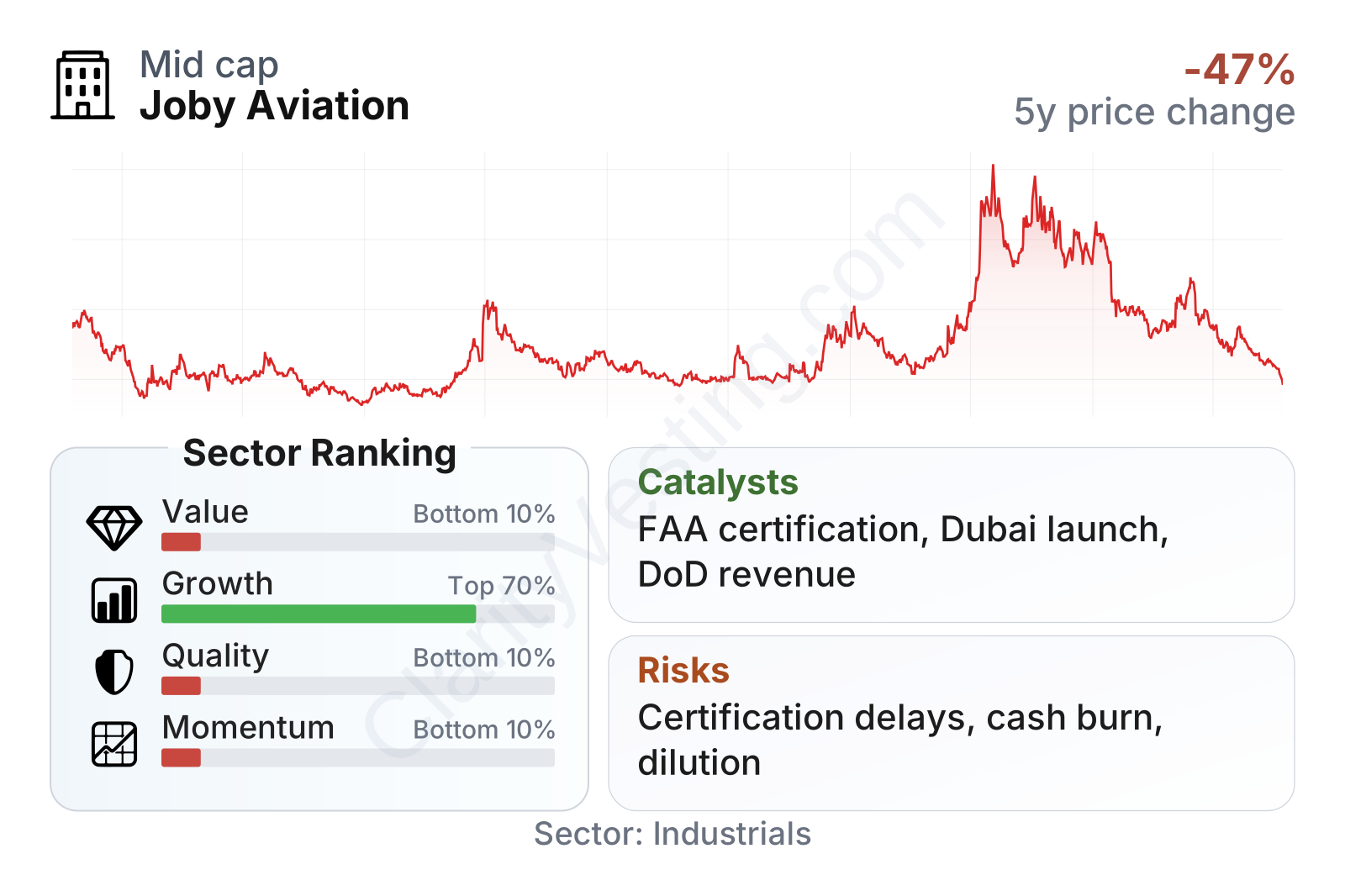
The broad picture is mixed but easy to read. Growth metrics look better than many sector peers because revenue is starting from a very small base, so percentage increases can look dramatic. By contrast, value, quality, and momentum rank poorly: profitability is deeply negative, free cash flow remains heavily negative, and the stock has been volatile and weak compared with much of the industrial sector. The company is also relatively lightly leveraged versus the sector, which matters because Joby is funding development more through equity and cash than through large amounts of debt.
The share price history underlines how speculative the market still views the business. Since listing, the stock has moved through sharp rallies and equally sharp declines, which is typical for a company whose valuation depends more on future certification and commercialization milestones than on current earnings.
Growth
Joby operates in a sector that could become meaningful over the long run if electric aircraft certification, infrastructure rollout, and customer adoption move forward together. Urban air mobility addresses real problems such as congestion, airport access, and premium regional travel time savings. If the category becomes commercially viable, early certified operators with strong partners could have a major head start.
Joby’s strategy is coherent for that future market. Instead of focusing only on aircraft design, it is trying to build an integrated system: the aircraft itself, the manufacturing base, the software stack, and the operating model. That approach is expensive today, but it could become an advantage later if the market rewards operators that can control safety, maintenance, utilization, and customer experience across the whole network.
A major catalyst is certification progress with the Federal Aviation Administration. In this industry, certification is not a routine box to check; it is the central gate that determines whether a prototype becomes a real business. Another important catalyst is manufacturing readiness. Joby has been investing in production capacity because success will require not only regulatory approval but also the ability to build aircraft at useful volumes and acceptable cost.
Partnerships are another important piece of the growth case. Joby’s alliances with established industrial and mobility players help validate the concept and may lower execution risk in manufacturing, fleet deployment, and market access. Its work with defense customers also matters because it creates operational experience, technical feedback, and some non-dilutive commercial proof before large-scale passenger service begins.
Revenue growth rates have recently looked explosive, but that needs context. The increases are real, yet they come from a very small starting point, so they should not be confused with broad commercial scale. The underlying positive signal is not the percentage alone; it is that Joby is beginning to convert development activity into actual reported revenue.
Cash generation remains the clearest growth constraint. Free cash flow has become more negative over time, showing that Joby is still in a heavy investment phase. That is common for a pre-commercial aerospace platform, but it also means the path to future growth depends on maintaining enough liquidity to reach certification and launch without severe financial strain.
Recent company updates have continued to point toward aircraft testing, certification milestones, manufacturing buildout, and international expansion plans as the most significant opportunities. For a company like Joby, those developments matter more than near-term accounting profit because they determine whether the business can move from technology promise to operational reality.
Risks
This article is for informational purposes only and does not constitute financial advice. Some content is AI-generated. See Disclaimer


